
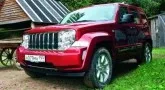
The first Cherokee, which debuted in 1984, turned out to be a truly successful model — with a bright character, distinctive looks and, importantly, automatically engaging all-wheel drive. The design was so successful that the car stayed on the assembly line for seventeen years! The result — almost 2.9 million units sold worldwide. Engines were constantly updated, suspension and transmission were refined, but the body-on-frame construction and recognizable angular shapes remained unchanged. Everyone got used to this image of Jeep and loved it just like that. Therefore, when the second generation appeared in 2002 — index KJ — the public met it without enthusiasm: rounded body, unusual headlights... In Chrysler, they apparently drew conclusions and tried to return the features of the ancestor to the new Cherokee's appearance.
And, to give credit where it's due, they succeeded. Sharp corners and broken lines in the body became more numerous again, the headlights regained their familiar square shape. The Cherokee became itself again, although a keen eye will surely notice its kinship with another model — the Dodge Nitro. Chrysler does not hide it: the platform is shared, both cars are assembled at the same plant in Toledo, Ohio. But there are plenty of differences, and they are fundamental: everything is done to separate these relatives into different niches — Nitro is oriented toward asphalt, and Cherokee toward off-road.
That is why the Jeep's wheelbase was shortened by 69 millimeters, and the overhangs were made smaller. Instead of the simplified transmission with conditional all-wheel drive, as in the Nitro, the Cherokee gets the proprietary Selec-Trac II system — with a transfer case and a low range. True, instead of a center differential, as in previous generations, a multi-plate clutch with electronic control is now used. A simplification? Possibly. But the rear axle has a BLD (Braking Lock Differential) system that can simulate the operation of a self-locking rear differential.
It engages automatically when the mode switch is set to 4WD Low, that is, when the low range is activated (the gear ratio here is serious — 2.72:1) and the torque distribution is forcibly locked at 50/50 between the axles. The logic is clear. In addition to this mode, there are two more: 2WD — the clutch is open, rear-wheel drive; and 4WD Auto — traction is divided in a 58:42 ratio in favor of the rear axle, but the proportion can change depending on the surface and conditions.
And does all this off-road arsenal help on real off-road? A free minute came up — and my colleague and I could not resist the temptation to test the Cherokee in action. We did not climb into the swamp, but we did arrange diagonal wheel hanging. In 4WD Low mode, the Jeep confidently crawls forward. And this is despite the fact that it had frankly road tires, and the grass under the wheels was wet. The Nitro definitely could not do that. Feeling that everything was working out, we directed the SUV into a pit from which it could no longer get out on its own. But, as they say, it's a simple matter: we are to blame ourselves — we miscalculated, the ground clearance was not enough, and the Jeep hung on the break.
The rest of the time, we drove in a friendly convoy along the dirt roads of the Penovsky district, including special stages where the Russian Rally Championship was held, which greatly surprised the local colorful residents. When the organizers said that we would move exclusively in a "single file," I was skeptical. As it turned out, in vain. The lead car set such a pace that the speed sometimes reached 120 km/h! And this is on dirt! A serious test for cars. The Cherokee did not let us down. Despite the potholes and bumps, it remained quite comfortable in the cabin. The Nitro at such speed and on such a road would have shaken the soul out of you. The Cherokee goes noticeably smoother. But on asphalt, the difference with the Dodge is almost not felt — the steering wheel here is just as empty.
During the run, each of us managed to drive both the gasoline and diesel versions. Both engines — the 3.7 V6 and the 2.8 CRD turbodiesel — are well known from other Chrysler models. The same ones are installed on the Nitro. In terms of dynamics, the Cherokee with these engines is similar. The less powerful CRD is helped by a five-speed automatic (the gasoline version has a four-speed gearbox) and a much larger torque — 460 Nm versus 314. As a result, in the sprint to a hundred, the diesel wins against the V6 by 0.2 seconds. Another well-known advantage of diesel engines is efficiency. When the fuel gauge on the CRD showed three-quarters of a tank, the gasoline version had already used half. True, you will have to pay extra for economy at purchase — the diesel version in Russia costs $1000 more. If the Cherokee Indians were suddenly evicted from the Cherokee Nation reservation in the USA, they could be safely invited to live on Seliger. I think they would like it there. The beauty is no worse than in Oklahoma, Tennessee, or Carolina, and the expanses of the Upper Volga lakes are quite comparable to the Great North American ones. And the new Cherokee against the backdrop of wild Russian nature looks quite organic. But its fate on the market is a mystery. I want to believe that the newly found charisma and recognizability will help the newcomer win its place in the sun in the modern market oversaturated with offers.
Engines
For the Cherokee, the same engines are available as for other Chrysler models — for example, the Dodge Nitro SXT or Chrysler Grand Voyager. We are talking about a gasoline V-shaped "six" with a volume of 3.7 liters with a single camshaft in the cylinder head (205 hp, 314 Nm) and a 2.8-liter CRD turbodiesel developed by the Italian company VM Motori (177 hp, 460 Nm) with a Common Rail fuel system.
History
The name Cherokee first appeared in the Jeep model line back in 1974. But that car, in fact, was only a three-door version of the Wagoneer model. Pay attention to its radiator grille — does it remind you of anything? One to one — GAZ-24! The real Cherokee — the world's first car with automatically engaging all-wheel drive — appeared in 1984 under the index XJ. Without serious changes, the XJ was produced until 2001, until it was replaced by the "big-eyed" KJ. The current Cherokee has been assigned the internal index KK.