
On and Off the Road
The test route looked like this: about 400 kilometers from the capital to Seliger, then a crossing by hovercraft to a picturesque shore (though the engine stalled halfway), a short overnight stay in a protected area, morning off-roading, and a final flight to Moscow on an Mi-8 helicopter, which took an hour and a half. The question is whether the audience for which the Dodge Journey and Jeep Cherokee are intended is ready for such adventures — Chrysler marketers estimate the average age of such buyers at 40. I don't know about them, but I had to go through all these trials to get acquainted with the two new models from the concern.
Dodge Journey
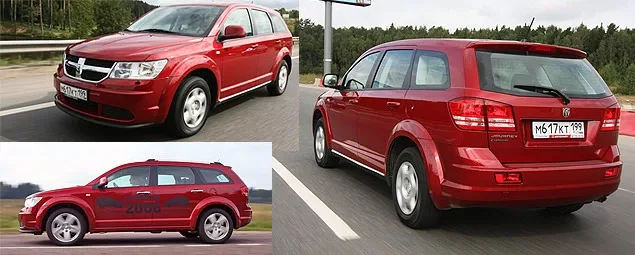
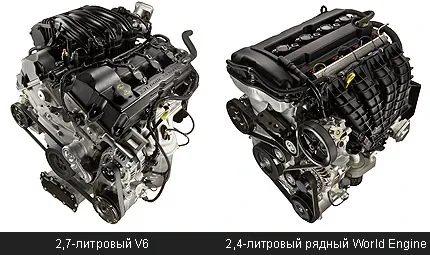
My acquaintance with the Dodge Journey began right in Moscow. We were shown cars in almost all trims available for the Russian market, with two gasoline engines — an inline four-cylinder 2.4-liter and a 2.7-liter V6.
For Dodge, a brand with a purely American pedigree, the word "crossover" sounds unusual. Fans of the brand are used to monsters like the Ram or uncompromising muscle cars like the Charger and Viper. But a modern manufacturer aimed at the mass buyer cannot do without a model of this class. So first Dodge had the Caliber, and now the Journey.
 |
For us Russians, the concept of a "crossover" usually implies all-wheel drive or at least the option to order it. The Journey has such an option, but only for the American market. Europeans, like us, were left without all-wheel drive, and also without the 3.5-liter V6 engine. Russian buyers also don't have access to the two-liter diesel, manual transmission, or the new preselective Getrag "robot" with two clutches, which is offered for the first time on European versions of the Dodge. The only consolation is that we got a seven-seat cabin — some manufacturers even remove the third row of seats for Russia.
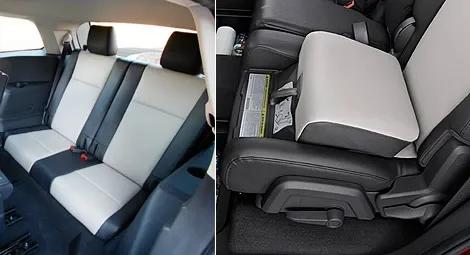
It was precisely for the extra seats that the body had to be lengthened: the base of the Avenger sedan, on whose platform the Journey is built, was stretched by 124 millimeters. Inside, everything is organized on the amphitheater principle: the second-row cushions are raised 40 millimeters relative to the first, and the third row is another 17 millimeters higher than the second.
 |
 |
The easiest way to get from Moscow to Seliger is along the M9 "Baltiya" highway, popularly known as New Riga. The road is perfect for evaluating driving qualities: the first kilometers are two lanes with smooth asphalt and a permitted 110 km/h, and after Shakhovskaya, beyond Volokolamsk, the surface deteriorates — ruts and potholes appear, and the speed limit drops to 90 km/h.
First, I got a car with the 2.7-liter engine, producing 185 horsepower and 256 Nm of torque. I insert the chip key, turn it, let's go… The highway is empty, the weather is excellent, I floor the pedal — and nothing. Gas to the floor again, the six-speed automatic from Chrysler hesitates, and when patience is at its limit, it sharply drops two gears, sending the tachometer needle into the red zone. But even this doesn't give the expected acceleration — just engine roar. The 1,755-kilogram crossover doesn't push you into the seat, and the speedometer with a dual scale (miles and kilometers) slowly crawls through the divisions. Manual mode works without delays, but it doesn't save the sluggish acceleration, and at speed, the steering feel is completely lost.
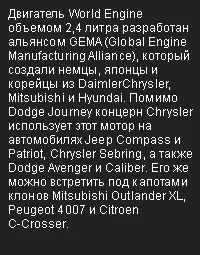
The six-speed transmission is a modernization of the four-speed gearbox created by Chrysler back in 1989. But when they removed two extra gears, paired with the 173-horsepower four-cylinder engine, it behaves much more adequately. The sluggishness hasn't gone away, but driving in this combination is more pleasant: adaptability is better — press the gas a bit harder, and the gearbox immediately drops a gear.
According to the specs, the Dodge Journey with the 2.4-liter World Engine accelerates to 100 km/h in 11.9 seconds — 1.1 seconds slower than the V6 version. But subjectively, there's no difference. The top speed of the younger version is 188 km/h, while the older one is 182 km/h. No, I would definitely choose the SE trim with the four-cylinder engine.
 |
 |
The swift silhouette of the Dodge Journey sets a sporty mood, but the appearance is deceptive. Behind the dynamic body lines hides an outdated interior with inexpensive trim materials. The soft and comfortable seats lack lateral support; in the top R/T trim, they are upholstered in two-tone leather — white and black. Trying to liven up the cabin, the designers inserted white plastic inserts into the door panels, which look rather strange.
From the driver's seat, the picture is rather dreary, and the instrument panel with an electronic compass reminded my colleagues of a "Moskvich," although nothing similar in shape existed in that brand's lineup. However, credit where due: the instrument readings are perfectly readable in any lighting.
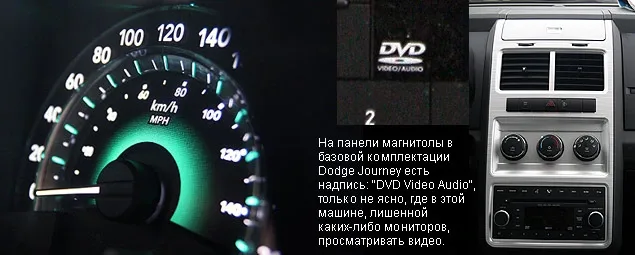 |
The gearshift lever is mounted at an angle, but you quickly get used to it. Much more inconvenient is reaching for the audio system buttons — it's located at the bottom of the center console. If you order the MyGig system with a 30-gigabyte hard drive, instead of a small box on top, a color touchscreen appears. The stereo supports MP3 and WMA (the latter is rare), and an iPod connector is hidden in the glovebox. For $2,350 on the R/T trim, you can get navigation and a rearview camera. The sunglasses holder has a panoramic mirror through which you can see passengers in the back seats — the same option is available in the Honda CR-V, one of the main competitors.
It seems that the Dodge Journey is entirely focused on passengers, while the driver is left somewhere in the background. The second row can be slid forward and backward by 12 centimeters and the backrest angle adjusted, while the driver only has partial power adjustment — the electric drive handles only the longitudinal position and height, everything else is manual. Passengers have access to two independent climate control zones, including a separate one for the third row, while the driver can't even change the temperature in the front passenger's zone. The rear doors open 90 degrees, making entry easier…
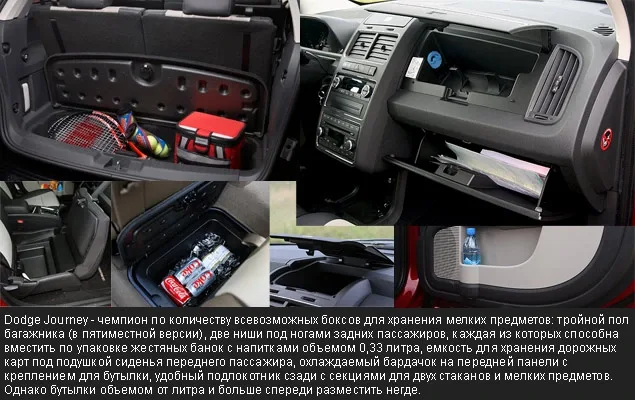 |
I rode both in the back and in the front passenger seat — I liked it there more than behind the wheel. But instead of four 12-volt outlets, I would have preferred a flip-down screen in the ceiling, and then it would have been completely comfortable. The Journey's suspension lends itself to this — it smooths out bumps excellently. In the R/T version, 19-inch tires with a high profile help, although visually they hardly differ from the 16-inch steel wheels with hubcaps on the base version.
The base Dodge Journey costs $34,300. The company hasn't yet switched to ruble prices and recalculates them at the current Central Bank rate. That's just over 877,000 rubles, although the official press release mentioned a price of 816,000 — at that time the rate was about 23.8 rubles per dollar. The top version with the "P2" options package is priced at $48,200 (recalculate yourself). For the third row of seats, you'll have to pay an additional $2,300 to $2,600 depending on the trim.
Jeep Cherokee
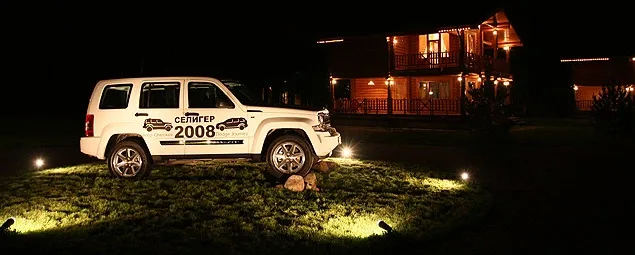
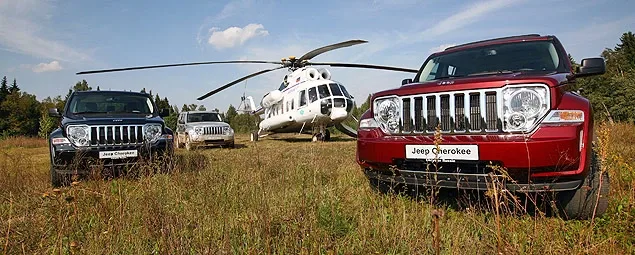
A completely different matter is the Jeep Cherokee (known as the Liberty in the US). This SUV literally shook up the journalists after the measured ride in the Dodge Journey. More than 100 kilometers along forest roads around Lake Peno (as the organizers later said, the "Peno" rally takes place here in winter) with huge potholes, the car handled playfully, and only occasionally did the shock absorbers' travel reserve fall short of fully absorbing the loads on the body.
 |
The fourth-generation Cherokee (not to be confused with the Grand Cherokee) is essentially a twin of the Dodge Nitro, which debuted a year earlier. But Jeep has much more serious demands for off-road capability, so the new model received its own Selec-Trac II transmission. It differs from the previous transfer case by an electronically controlled clutch that independently doses torque to the front axle — in "2WD" mode, only the rear wheels are driven. Previously, the driver could choose between "4 Part Time" and "4 Full Time," but now these modes are combined into one — "4WD Auto," where all-wheel drive works constantly and torque is distributed automatically. Instead of a transfer case lever, a neat toggle switch appeared, located to the left of the automatic transmission selector.
The reduction gear hasn't gone anywhere: when "4WD Low" is activated, the torque at the wheels increases by 2.72 times, and the Cherokee confidently crawls up steep inclines. There are no differential locks here — their role is played by the stability control system, which brakes the spinning wheel and redirects torque to those with traction. How exactly this works is better seen once than read a hundred times — a clear example in the video.
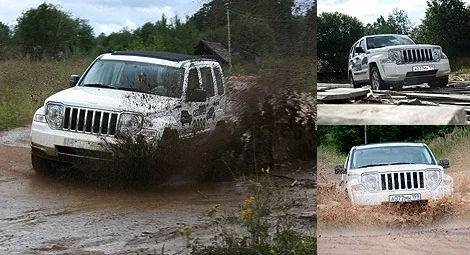
As befits a modern SUV, the Cherokee has acquired hill descent and ascent assist. On an incline, the brake pads hold the vehicle while the driver moves their foot from the brake pedal to the gas, and on a descent, ABS independently controls the speed. If the low range is engaged, the anti-lock braking system switches to a special off-road mode and allows the wheels to "pile up" soil in front of them.
ESP handles diagonal articulation brilliantly, but on gravel and broken roads it only gets in the way. On bumps and potholes, the SUV constantly shifts the rear axle, and even on straights there is a risk of skidding. The solution is simple — press and hold the "ESP OFF" button for a few seconds until the corresponding message appears on the instrument cluster, and then the system can be disabled, getting a much more lively connection with the vehicle. True, such a trick is only possible for experienced drivers: during the test, one of my colleagues almost flew into a ditch when he tried to turn off the stability control.
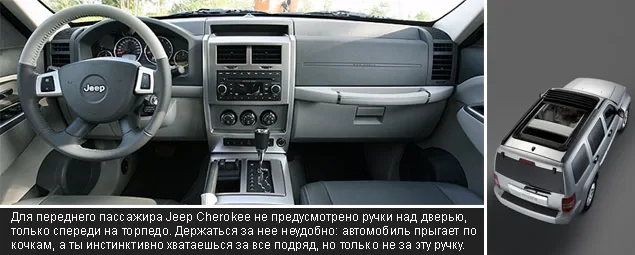
The exterior of the new generation has become noticeably more brutal. Round headlights are a thing of the past, and instead of streamlined shapes — chiseled edges that allow a different look at the Cherokee. The tailgate now opens only upward, and for an extra charge, a huge Sky Slider fabric sunroof is available, reminiscent of a convertible's soft top.
Inside, you feel a real Jeep: the trim materials are, of course, not great, but during off-road driving you don't pay much attention to that — unlike, say, the Dodge Journey. The trunk, alas, is a bit small: 409 liters, and that's, as they say, "up to the ceiling." But the cabin is spacious both in the front and in the back.
The suspension has not fundamentally changed: independent with double wishbones in front, a solid axle in the rear. However, new springs and shock absorbers with different settings have eliminated the diagonal body sway and nose dives under braking that plagued the previous generation.
The powertrains and transmissions have moved to the new model unchanged. Before the test drive, I immediately chose the diesel version and did not regret it. The 2.8-liter turbodiesel from Italian VM Motori produces 177 horsepower and works in tandem with a five-speed automatic from Mercedes. The torque of 460 Nm allows you to forget not only about inclines but also about the vehicle's load — it pulls with any number of passengers and cargo.
The gasoline version seemed duller. The four-speed automatic works decently, but even 205 horsepower from the V6 does not provide the same drive as the diesel — its torque is significantly lower (314 Nm).
Prices for the Cherokee are steep: for the ability to use the low range, you'll have to pay 51.6 thousand dollars in ruble equivalent, and the diesel version costs 52.6 thousand. But if you're buying an SUV for its main trump card — off-road capability — then it's worth adding 1,350 dollars for the "Travel Convenience Group" package, which includes protection for the suspension, fuel tank, transmission, and engine.
Technical specifications of Dodge Journey 2.4
| Length, mm | 4888 |
| Width, mm | 1878 |
| Height, mm | 1691 |
| Wheelbase, mm | 2890 |
| Curb weight, kg | 1705 |
| Engine displacement, cm3 | 2360 |
| Power, hp/rpm | 173/6000 |
| Torque, Nm/rpm | 220/4500 |
| Acceleration 0-100 km/h, s | 11.9 |
| Top speed, km/h | 188 |
Technical specifications of Dodge Journey 2.7
| Length, mm | 4888 |
| Width, mm | 1878 |
| Height, mm | 1691 |
| Wheelbase, mm | 2890 |
| Curb weight, kg | 1755 |
| Engine displacement, cm3 | 2736 |
| Power, hp/rpm | 185/5500 |
| Torque, Nm/rpm | 256/4000 |
| Acceleration 0-100 km/h, s | 10.8 |
| Top speed, km/h | 182 |
Technical specifications of Jeep Cherokee 2.8 diesel
| Length, mm | 4493 |
| Width, mm | 1839 |
| Height, mm | 1736 |
| Wheelbase, mm | 2694 |
| Curb weight, kg | 1985 |
| Engine displacement, cm3 | 2768 |
| Power, hp/rpm | 177/3800 |
| Torque, Nm/rpm | 460/2000 |
| Acceleration 0-100 km/h, s | 10.5 |
| Top speed, km/h | 179 |
Technical specifications of Jeep Cherokee 3.7 gasoline
| Length, mm | 4493 |
| Width, mm | 1839 |
| Height, mm | 1736 |
| Wheelbase, mm | 2694 |
| Curb weight, kg | 1935 |
| Engine displacement, cm3 | 3700 |
| Power, hp/rpm | 205/5200 |
| Torque, Nm/rpm | 314/4000 |
| Acceleration 0-100 km/h, s | 10.7 |
| Top speed, km/h | 193 |