
Jaguar XF. An aristocrat with Aston Martin manners
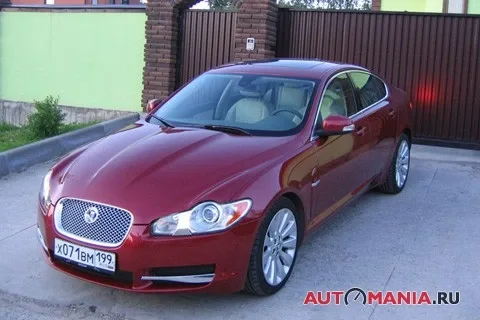
Russia is a country with its own quirks, especially when it comes to the tastes of buyers.
Here, it's easier to sell a modest Mercedes or BMW than a loaded Hyundai Grandeur or even a very interesting Seat Altea Freetrack. Mitsubishi Lancers, which nobody looks at in Europe, sell like hotcakes here, while Opel and Ford are not leaders west of the Brest region. Even Bentley, Ferrari, and Hummer do quite well. But Jaguar and Saab have clearly not found their buyer. What can we say about Alfa Romeo: sales in the first half of 2008 compared to the same period in 2007 fell by 68.76% — the worst indicator among all brands. Their next return to our market, unlike Fiat's third coming, went completely unnoticed.
Buying a car with a wild cat on the hood means being a devoted fan of this legendary British brand. Russian owners of Jaguars are somewhat reminiscent of Saab fans — both can be safely called car gourmets. The figures for the first half of 2008 compared to the same period in 2007 speak for themselves: across the country, only 854 Jaguars and 639 Saabs were sold in six months. True, a year earlier it was even fewer — 521 and 354, respectively.
Perhaps the new XF model will help the brand, which recently passed from Ford to the Indians at TATA, improve its business in Russia? That's why we decided to test the Jaguar XF in a version far from the maximum — with a 3.0-liter engine producing 238 hp. If you study the price lists and technical specifications, it becomes clear: the main competitors of the XF in our market are the Audi A6, BMW 525i, Cadillac STS, and Chrysler 300C (its test will soon appear on our site). Perhaps later we'll get to the top version with a V8 4.2 supercharged for over 3 million rubles, but for now, we'll focus on the variant that XF buyers choose more often.
Fitness for the wild cat
The abbreviation XF can be deciphered in different ways. The British say it's neXt Future, and Russians say Xtra Fitness. The latter is perhaps more accurate, because the new Jaguar is completely unlike its predecessor, the S-Type, although it inherited the platform from it. The conservatism that distinguished all previous models is gone. The company, going through hard times, was forced to radically update both the appearance and the inner world of the car. And this fitness really did the "cat" good. Chief designer Ian Callum, who gave the Aston Martin DB9 its current look, decided to break Jaguar's traditions — and he succeeded. The old stereotypes are completely destroyed. Taking as a basis his previous creation, the XK coupe, and combining it with the S-Type platform, he got a body with crazy design. But the main thing is not so much the fantastic appearance, which usually determines the choice, but the interior packed with electronics.
The cabin is like a toy store
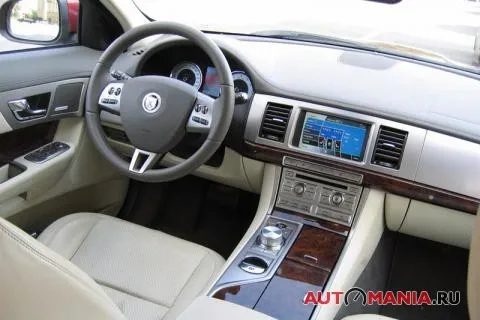
The interior designers tried their best to surprise the buyer and offer a bunch of pleasant little things (and not only!) that no other car in the world has. Perhaps they even overdid it, turning the cabin into a "toy store." I would compare the XF's interior to the iPhone. What is the iPhone? It's more of a trendy gadget than a phone. It has many useful functions, but even more unnecessary and even meaningless ones. Its success is determined by fashion and artificial hype, not real merits. The XF, like the gadget, is overloaded, and it has no fewer drawbacks than advantages.
We open the car, sit down, close the door — and the show begins! I haven't even had time to look around, just settled into the seat, when the "start/stop" button began to pulse with bright scarlet light in time with the heart, as if calling: "Touch me!" A light touch of this "heart" button — and the car wakes up. The dormant air vent deflectors smoothly open, and a washer slides out from the lower part of the central console, replacing the traditional automatic transmission lever. I encountered this method of gear shifting for the first time, but quickly realized: you don't need long to get used to it. It's no less convenient than a regular lever. Moreover, the letter designations P, N, D/S don't need to be looked at — they are duplicated by pictograms on the instrument panel. It's easy to get the hang of it.
The handbrake is electromechanical, the steering wheel is adjusted for height and reach also electronically, and in "auto" mode, when the engine is turned off, it moves up, freeing space for the legs. Behind the wheel are paddle shifters for manual gear shifting. Moreover, if you make a mistake and select the wrong gear, the car itself will switch to automatic mode "D" (drive) — very convenient for inexperienced or nervous drivers.
Keep up within 60 seconds
Adaptive headlights and cruise control — you won't surprise anyone with these today. Even the ASL system — an automatic speed limiter that you set yourself (you can then even press the pedal to the floor — the car won't accelerate!) — is no longer a rarity in the business class. But the multifunctional touchscreen for Jaguar is something unusual, and again the iPhone comes to mind. There are no familiar buttons on the console. All control — air distribution, seat heating and cooling, steering wheel heating, temperature, radio settings — is done by touching the screen with your fingers. The solution is new, but debatable. Staring at the screen while driving, without being distracted from the road, is dangerous. It's easy to miss and turn on, say, seat heating, and realize the mistake only when it starts to burn from below. Instead of adjusting the temperature, you change the airflow intensity. It's especially inconvenient for those who like to switch radio stations on the go and browse FM waves. With the settings and switching of 9 stations on FM-1 and another 9 on FM-2, it's not easy to cope: stations don't stay on the screen long, everything resets to the "home menu."
The TV deserves credit — the signal is picked up on both digital and analog channels. There are so many channels that it's hard to find the right one, because the image with preliminary settings stays on the screen for exactly 60 seconds, and then, like in the receiver, resets to "home" mode. The computer communicates with you in 13 languages. Guess if Russian is among them? Of course not! Honestly, this is disrespect to Russian buyers. Russifying the few commands and terms is not such a difficult task. Ford and Volvo did it long ago, and Jaguar until recently belonged to Ford.
If you will inevitably "paw" the display and constantly wipe it from fingerprints, then the interior lighting lamps, on the contrary, will remain perfectly clean thanks to contactless sensors. They turn on and off if you pass your hand 10–15 mm in front of them. A point touch on the round knob on the wooden insert opens the glove box, another one closes it. Seemingly little things, but how pleasant! We haven't played with such interesting toys for a long time.
Music lovers and good sound enthusiasts will appreciate the Hi-End Bowers&Wilkins audio system with 13 speakers and a subwoofer for 49,500 rubles. For this money, you get innovations such as a diamond dome tweeter and Kevlar diffusers. Unlike many cars, here the receiver can be used with the engine off, and the TV too. Of course, this drains the battery, especially the TV (remember that!), but you won't get bored in the parking lot.
Everything in the cabin is honest
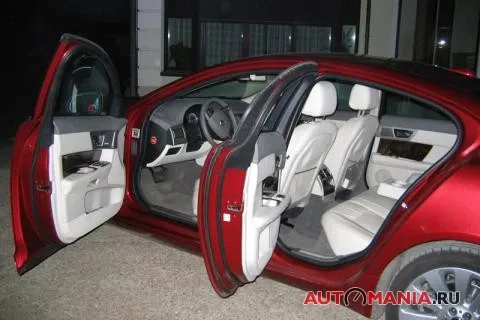
The interior trim is without fakes. The quality of the creamy-white leather (as in most Jaguars) is beyond praise, the wood is natural, not plastic imitating it. Metal is metal. Well, plastic, which is indispensable today, no matter how you embellish it, remains plastic. There's plenty of it in the cabin too. But even it doesn't spoil the impression — the interior looks luxurious and perfect.
The downside of the XF is the cramped cabin. You need to sit down carefully, otherwise you'll either catch your knee on the front panel or hit your head on the low roof. It's also cramped in the back, and the high transmission tunnel is unlikely to add comfort to the third passenger. There's little legroom, so calling the XF "business class" is purely conditional.
The rear seats fold like in a Hyundai Elantra: you open the trunk and pull the handles to the right and left of the seats. I can't say it's convenient.
Darkness is the best friend of XF owners
As soon as darkness falls, the car transforms: the entire cabin is flooded with a mesmerizing turquoise light. The backlighting of every interior element is styled after neon signs of the last century. Particularly amusing was the glow around the automatic transmission selector — it reminded me of the display of the good old Motorola RaZR phone. The sight is so impressive that I would advise selling this car in semi-darkness — that's where it reveals itself in all its glory. And, frankly, it's best to drive it at night. During the day, the instrument panel is practically unreadable, and you constantly have to adjust the brightness with the wheel. In addition, in sunlight, reflections from the central audio column and panel joints above the console glare unpleasantly on the windshield. And one more warning for music lovers: don't even think about turning on the receiver in "stereo" mode, leave the standard three-channel sound. The stereo here is aggressively terrifying — you can really go deaf in one ear.
The interior seems to have come straight from the pages of a science fiction novel or a computer game — it is so saturated with technology. Sometimes it seems the car has outrun its time. For example, under the central mirror, I found three buttons with numbers 1, 2, and 3. As it turned out, this is a remote control for garage doors. Three of them! Honestly, I doubt such an option is really necessary here. But the button with a triangle and a car silhouette to the left of the knee is a different matter. This is the Forward Alert system, which warns of obstacles ahead (similar solutions are found in Volvo and Cadillac). The higher the speed, the earlier it activates and starts beeping if another car is ahead.
Overtaking is a sheer pleasure
But we have talked too long about details and forgotten the main thing — how this car drives. And here my story will be very short. Why? Because the Jaguar XF is primarily a design masterpiece, not a car created for a breakthrough in driving characteristics.
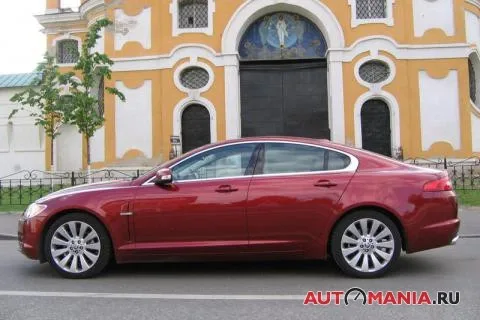
The concept remains the same: three V-shaped engine options, classic rear-wheel drive, and a platform inherited from the S-Type.
I got the most affordable version (if the word "budget" applies to Jaguar at all) with a 3-liter engine producing 238 horsepower. Even it pleases with dynamics. The XF accelerates smoothly but persistently, obediently following the gas pedal. The character of acceleration is very interesting. On kickdown, the tachometer needle flies up to 6,500 rpm, the engine starts to roar furiously, but then quickly calms down, and the revs drop to 3,000. Here, the ZF gearbox plays an important role — the same one used in BMW. But in the Jaguar, it is tuned differently: responses are faster, and shifts are less noticeable. In terms of response speed, this automatic is only slightly inferior to Audi's DSG, but it surpasses it in the speed of shifts both up and down. No delays or dips. Even in second gear, the Jaguar confidently accelerates to 109 km/h (at 6,800 rpm), and in third — to 165 km/h.
Every overtake is a celebration. Not only because of the engine's growl but also thanks to the predictability and reliability of the transmission. On the highway, the XF holds confidently, does not wander, and calmly handles transverse slopes. In corners, the car is also good, but the steering feels somewhat numb, lacking feedback. However, the brakes are beyond praise — no complaints at all. Even a person who gets motion sickness in any vehicle won't feel sick here, no matter what driving style the driver chooses.
A voracious cat
There are fewer "horses" under the hood than in the Infiniti or Lexus, but the appetite... The fuel consumption of A-95 gasoline is very high. The official figures promise from 10.5 to 15.8 liters per hundred, but in our test, which took place on the weekend without serious traffic jams, we got from 16.9 to 18.7 liters. And that's not the limit. The onboard computer has a column for average consumption over the car's entire life. So, with a mileage of 3,200 km (how much was before me), the average figure was 20.3 liters per hundred. However, this is understandable — before us, journalists thrashed the car to the fullest. We tried to squeeze out minimal figures without doing anything extreme. But no matter what, having received the car with a full tank, we saw a range of only 380 km on the display. That is, a full 70 liters is enough for a maximum of a couple of days. It's not a cheap pleasure to drive this car!
However, the word "cheap" does not fit a car with a wild cat on the radiator grille. The base version of the 3.0-liter XF in Premium Luxury trim costs 2,011,000 rubles. Here is the list of options installed on the test car and their prices:
| Front parking sensors and rearview camera | 24,500 |
| Adaptive bi-xenon headlights with cornering function | 16,800 |
| Sunroof | 38,100 |
| Ventilated front seats | 36,100 |
| Bauer&Wilkins audio system | 49,500 |
| Fine air filtration system | 2,000 |
| Garage door remote control | 10,300 |
| iPod player (incompatible with CD changer) | 26,000 |
| Royal oak interior trim | 7,200 |
| Navigation | 70,100 |
| TV tuner | 28,900 |
| Adaptive cruise control | 51,600 |
| Ivory leather interior | 33,500 |
| Tire pressure monitoring | 21,900 |
| Power rear sunshade | 14,400 |
| Total: | 456,700 |
Thus, the price of the tested car increased to 2,467,700 rubles (or 102,800 dollars). This is the level of almost top-end Cadillac STS 3.5 or Chrysler 300C with the same engine size. But note: the Jaguar XF is a much more revolutionary and innovative car than the mentioned American premium cars. Buying a Jaguar, you get chic with a "cat" on the hood.
Dmitry Shavyrin
We thank the company "Land Rover Jaguar" for providing the car for the test.
Specifications
| Dimensions (mm) | 4961 x 2053 x 1460 |
| Wheelbase (mm) | 2909 |
| Curb weight (kg) | 1679 |
| Gross weight (kg) | 2215 |
| Ground clearance (mm) | 160 |
| Tires | 245/40 R19 |
| Trunk volume (l) | 500/923 |
| Engine displacement (cm3) | 2967 |
| Max power (hp) | 238 |
| Max torque (Nm/rpm) | 293/4100 |
| Max speed (km/h) | 237 |
| Acceleration 0-100 km/h (s) | 8.3 |
| Fuel consumption (avg l/100 km) | 10.5-15.8 |
| Tank capacity (l) | 70 |
| Fuel | A-95 |
| Price (base) (rub.) | 2,011,000 |
| Price of tested car (rub.) | 2,467,700 |
Source – AUTOMANIA.RU