The Big Guy
At the parking lot of the Caucasus Mineral Waters airport, a not-too-friendly and sullen car was already waiting for me, matching the gloomy day. Its appearance is expressive: wide protruding "eyebrows" above the headlights, a massive "nose" part, athletic build — a real predator. But there is nothing frightening about it. Besides, I have known its predecessor for a long time, so all its habits and manners are well known to me. And the Japanese creators tried not only to retain all the strengths of the previous model but also to add something new.
If anyone hasn't understood: we are talking about the company Infiniti (or Nissan — whichever is more familiar), and the car meeting me is the fresh sporty crossover FX.
What's New
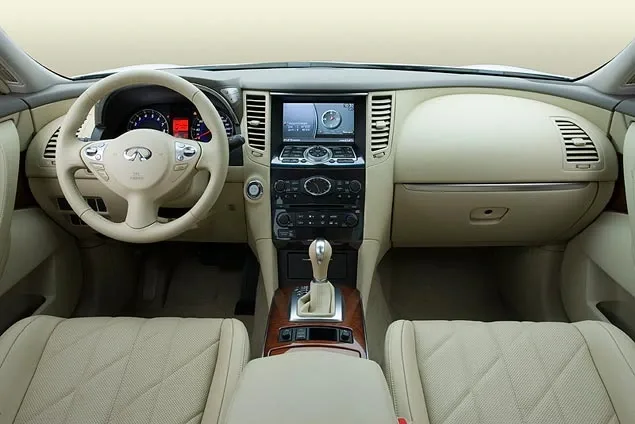
According to Nissan representatives, when creating the new FX, the designers were tasked with making the car more refined and "human," that is, to make life easier for the owner through modern systems. In the press release, this sounds like adapting electronics "to the lifestyle of Infiniti FX owners." But, looking ahead, I note: there is so much electronics in the car that it's no longer about "humanizing" but rather about "robotizing."
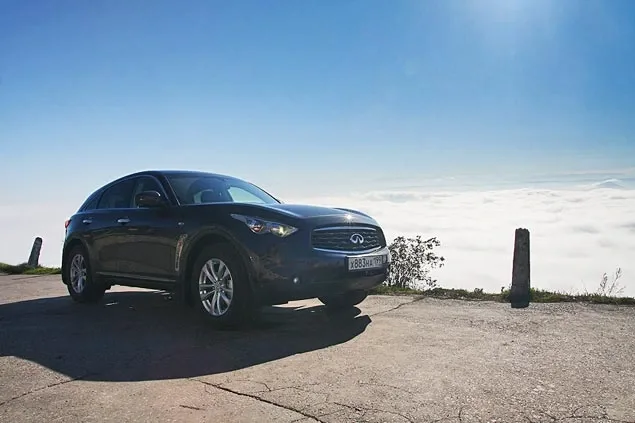
The design of the "FX" has become more aggressive. Whether it has become more elegant is a question, but that the crossover looks more modern than before is beyond doubt. It couldn't be otherwise: the exterior of the new Infiniti FX was worked on by Hiroshi Hasegawa, who previously created the look of the Nissan GT-R supercar.
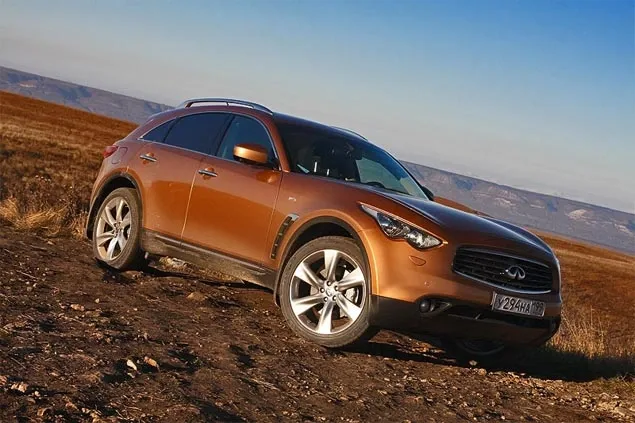
Besides the predatory squint of the headlights, a different radiator grille, and a more sculpted hood, the new model has a noticeable detail — ventilation slots in the front fenders behind the wheels. And this is not just decoration but a fully functional option.
Thanks to it, the crossover looks sportier, and it also solves the task of removing hot air from the engine compartment and reducing lift on the front of the body by five percent. Aerodynamic drag has been reduced from 0.37 to 0.36/0.35 (depending on the version), and even such small things as the shape of the rear lights, the spoiler angle, and the contours of the front bumper sides are used for proper air flow distribution.
The Infiniti FX body has been reinforced with high-strength steel inserts in the rear pillars, hood, engine compartment, sills, and central tunnel. As a result, torsional rigidity increased by 1.6 times, and bending rigidity by 3.4 times. At the same time, the weight of the frame, despite additional steel elements and improved sound insulation, decreased by almost 90 kilograms. The aluminum doors alone saved about 20 "kilos." The result is good, if you don't consider that the total weight of the car in curb condition has become noticeably larger — over two tons. And the same electronics are to blame for this.
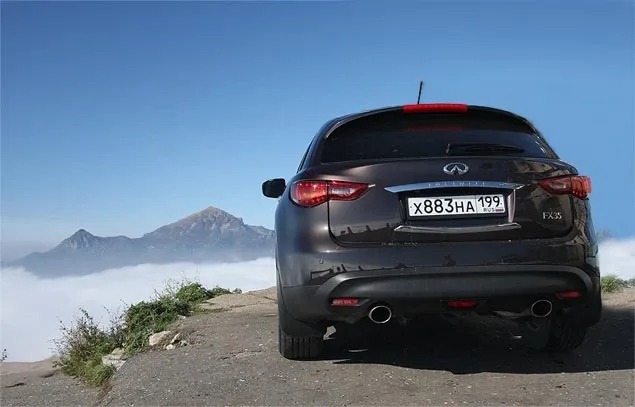
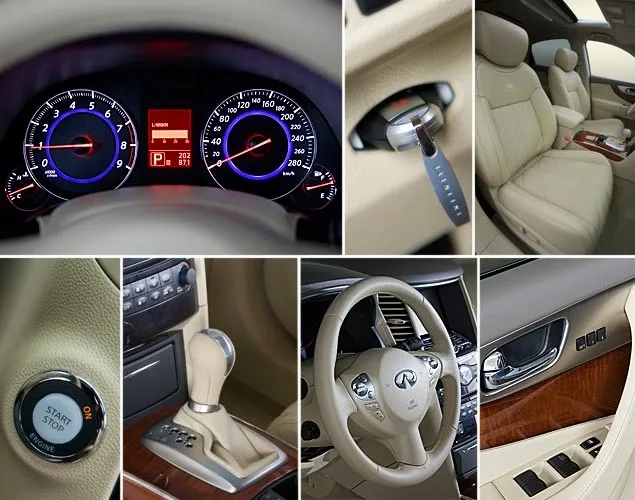
There are plenty of electronic "gadgets" here. Already in the first minutes of the trip, we tested one of them — the intelligent cruise control ICC, which itself maintains the distance to the car ahead. The system controls the brakes, throttle, and laser rangefinder, and activates from 40 kilometers per hour. Control is entirely from the steering wheel: set the desired speed, choose the distance to the car ahead (three options are provided — close, far, and even farther) — and that's it. The system itself analyzes the closing speed and maintains the selected distance, braking or accelerating the crossover.
However, you won't be able to relax completely: the car cannot brake to a full stop but only slows down to 40 kilometers per hour. Then you'll have to press the pedal yourself.
In practice, driving with ICC enabled initially makes you nervous. On one hand, you understand that the system reacts instantly and adequately to approaching traffic ahead, but on the other hand, a feeling of distrust of electronics doesn't leave you. For example, ICC won't see a cat or dog crossing the road, and it's unlikely to react correctly to a reckless driver sharply cutting into your lane.
Moreover, on the highway, when the car in front of us began to slow down, the "Finik" (as owners affectionately call the Infiniti FX), by feel, sometimes slowed down insufficiently briskly. Apparently, the system considered that there was no dangerous approach yet and chose a gentle braking mode. But it almost always seemed to me that this was not enough, and I had to intervene myself.
On the Road
When traffic on the highway towards Kislovodsk became freer, we finished experiments with ICC and decided to slightly exceed the speed limit to focus on the crossover's behavior on uneven Caucasian roads.
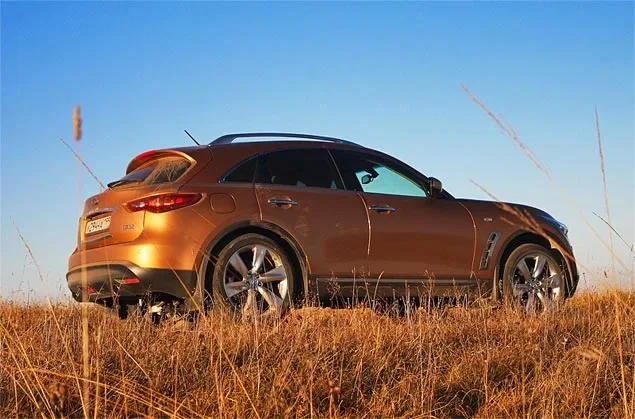
The suspension of the base FX35 — in my opinion, is that very "golden mean": not harshly stiff, but not relaxed-soft either. True, this is only valid for a car on 18-inch wheels, which are installed in the standard Elegance trim. In more expensive versions, the crossover is "shod" in aluminum 21-inch Enkei wheels with 265/45 tires. On them, the nature of the ride changes: the FX becomes stiff. Even too much.
But on a straight line, the "Finik" stands perfectly, and even with the stability control system enabled, it allows the driver to hooligan a bit. In high-speed corners, the body rolls slightly (just a little, not critically), and it's here that the main drawback of handling manifests — insufficiently informative steering. For a crossover positioned as sporty, such steering settings look a bit strange. No, you feel the car, but the "blurriness" in the near-zero zone and the overly "light" steering wheel are a bit disappointing.
But still, driving the crossover is pleasant! And primarily thanks to the excellent chassis. The FX has a new front suspension — instead of MacPherson, there are double A-arms. The front axle moved forward by 35 millimeters, and the track widened by 43 millimeters. The rear suspension is almost untouched — engineers only lightened it and increased wheel travel.

And the realization that the FX now has a "smart" all-wheel drive system ATTESA E-TS adds confidence on any surface. Depending on the situation, it distributes torque between the axles in proportions from 50:50 to 0:100. When starting from a standstill, traction goes to all four wheels, and when there's no need for all-wheel drive, up to 100 percent of power goes to the rear axle.
But the most technologically advanced will be the FX50 Sport. Already in the base, it will get electronically controlled shock absorbers that continuously change stiffness depending on the road. And if you want to "light up," there's a "Sport" mode in which the shock absorbers "tighten," making the car less rolly and more "driver-oriented."
Another feature of the FX50 Sport is the "all-wheel steering chassis," where all four wheels turn. True, the rear ones — only at very small angles, no more than one degree. How much to turn them is decided by electronics based on speed and the steering angle of the front wheels. We couldn't test this system (there were no such cars in the test), but Nissan representatives promise that the car will respond faster to the steering wheel and be more maneuverable.
The list of innovations doesn't end there. The crossover has been "humanized" to such an extent that it now "heals wounds" itself — restores the paint coating after minor scratches. But only very small ones, microns deep (such can appear, for example, after careless washing). Deep damage won't disappear on its own, so don't run a nail over the body and wait for a miracle. Better to go straight for repainting.
Shallow damage to the paint coating can disappear by itself — all thanks to a special highly elastic polymer in the paint composition, which increases its plasticity and resistance to external influences. The healing time for a scratch varies from a day to a week: it all depends on how deep the mark left on the body and on the air temperature. In hot weather, the process goes noticeably faster, but in winter, you can speed up "regeneration" by simply pouring hot water over the damaged area.
Alas, we were never given the chance to test this "miracle technology" in practice. And I would very much like to see such "magic" with my own eyes.
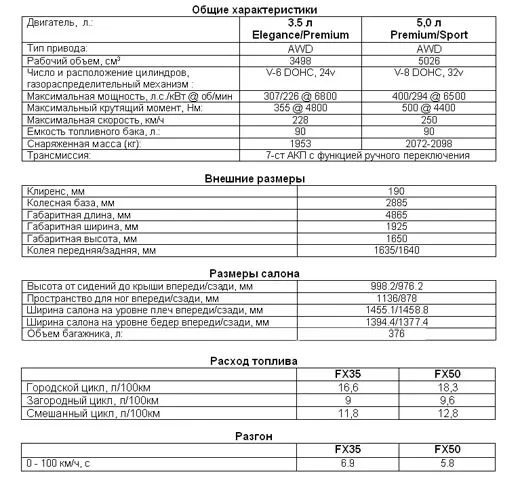
While my colleague and I were discussing polymers and scratches, our path passed through a traffic police post before Kislovodsk. The inspector, seeing an expensive foreign car, immediately stopped us. "Thirty-fifth?" — he asked, without even looking at the documents. Exactly so. On the first segment of the route, we got an FX35 with a 3.5-liter "six" producing 307 horsepower. That's 27 "horses" more than the predecessor with the same index on the trunk lid. According to Infiniti, the dynamics of such a car are almost not inferior to the previous FX45 with a powerful gasoline V8. The new FX35 reaches a hundred in 6.9 seconds — only six-tenths slower than the "forty-fifth," which needs 6.3 seconds. The difference is, of course, small, but such indicators can't be called a "hurricane" either.
The Infiniti FX with the "45" badge will no longer be part of the lineup. It is being replaced by the FX50 with a five-liter V8 producing 400 horsepower — now that's a real "hurricane." Even a light press on the gas pedal literally pushes passengers into their seats. The two-ton crossover accelerates to 100 km/h in just 5.8 seconds — the territory of true sports cars!
To tame such a "monster," engineers fitted the car with powerful brakes from the Infiniti G37 coupe: four-piston calipers with 355-millimeter discs up front, and two-piston units with 350-millimeter discs at the rear. And that's the right decision, because judging by complaints on forums, owners of the previous FX most often lamented the "weak brakes."
Both engines — the six-cylinder and the V8 — work in tandem with an adaptive seven-speed automatic that replaces the old five-speed gearbox. There are no complaints about the transmission: shifts are smooth, quick, and almost imperceptible. And for those who want more driving excitement, there's the top-spec FX50 Sport with magnesium-alloy paddle shifters — they allow manual gear changes.
After satisfying the traffic cop's curiosity, my partner and I hurried on, but soon stopped… to park. We were eager to test the around-view monitor system. It displays on the color screen at the top of the console a picture from four wide-angle digital cameras mounted at the front, rear, and sides of the body. The images from them are cleverly combined, and the screen shows a bird's-eye view of the car.
Thanks to this "feature," you can keep track of all obstacles around the car without even looking around or in the mirrors. The image updates quickly while driving, without delays. And if you don't like the top-down view, it's easy to switch to other cameras — for example, the rear one that shows the trajectory, or the cameras in the side mirrors (very handy for parallel parking near a curb). You can even see what's happening right in front of the front overhang.
The around-view monitor system truly eliminates "blind spots" and significantly simplifies parking. However, it lacks a semi-automatic parking function where the steering wheel turns itself — like, for instance, on Volkswagen Group cars...
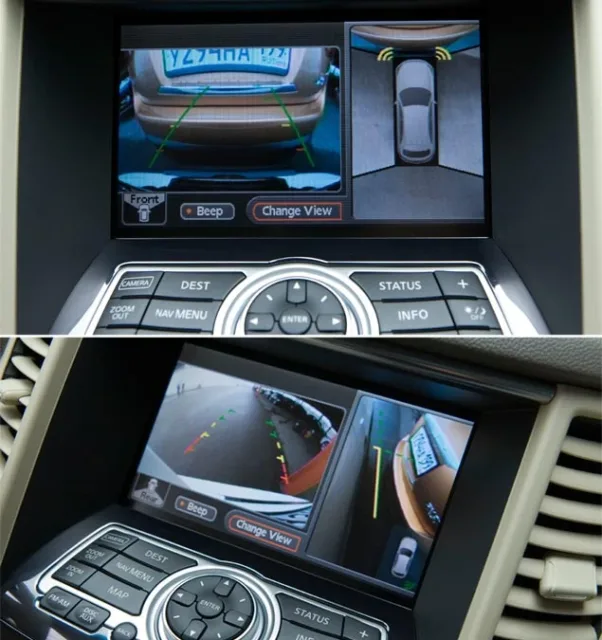
Bottom photo: images from the rear video cameras
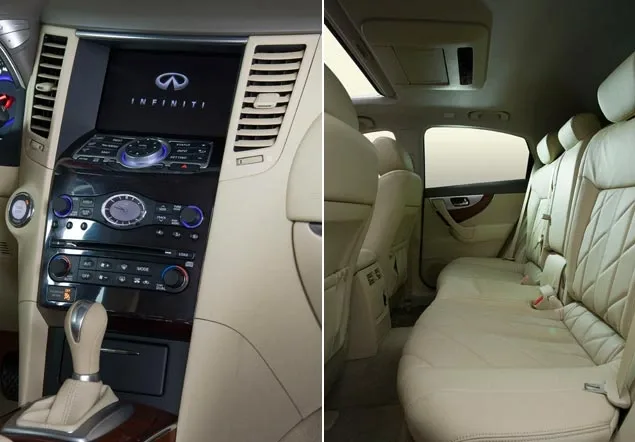
The eight-inch monitor displays not only images from the parking cameras, but also data from the Bose audio system, climate control, or Russian-language navigation, for which maps of Moscow, St. Petersburg, and the surrounding areas are already prepared.
What costs what
Sales of the new Infiniti FX35/50 in Russia have already started. The crossover is available in seven fixed trim levels. Prices for the Elegance version start at 1,952,600 rubles. Even in the simplest trim, there's a full set of safety systems, parking cameras, bi-xenon headlights, leather interior, climate control, light and rain sensors, Bose audio system, cruise control (regular, not the ICC "autopilot"), and much more. The "Infiniti" in maximum "loaded" spec — with the 400-horsepower engine, all-wheel steering chassis, and adaptive dampers — will cost 2,476,700 rubles.
But, compared to competitors, the new FX turns out not to be that expensive. Looking at the price lists, it's easy to notice: rivals don't have versions cheaper than two million rubles. For example, the Germans: the BMW X5 with a three-liter gasoline engine producing 272 horsepower costs almost 2.5 million, while the Mercedes ML350 with a 3.5-liter "six" (with the same power) costs 2,331,000 rubles.
Conclusion
So what about "humanity"? If we understand this word as an increase in the pleasure of owning a car thanks to many electronic and genuinely useful systems, then the new FX has become noticeably "livelier" and more interesting. And it hasn't disgraced its predecessor: the crossover looks more aggressive and modern, and it's good not only when parked but also on the move. Minor flaws in the steering can be written off — if you don't specifically focus on them, you won't notice them. But the five-liter engine is magnificent, and the gearbox is so good that you simply forget it exists.
It would, of course, be interesting to try the FX with active suspension and chassis, but that's for another time...