
The main character of this material is the G37 in convertible body style. After all, this is the first coupe-cabriolet with a hard folding roof in the brand's history. Thanks to this "opener," Infiniti remains one step ahead of Lexus in this segment. Lexus did not bother with the Skyline coupe, limiting itself to the comfortable IS 250C coupe-cabriolet built on the basis of the IS sedan. Infiniti, on the other hand, produces a sedan, a crossover, and a coupe on the common FM platform, and now a cabriolet with a hard folding roof has joined them.
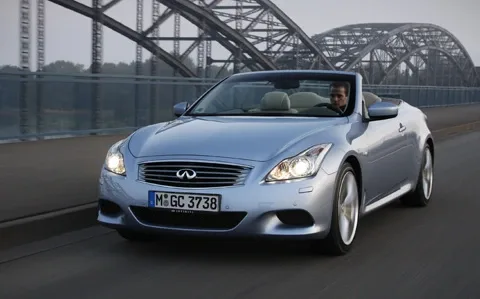
For the Russian market, it was decided to use the name G37 Cabrio — apparently, marketers are not sure that the domestic Infiniti buyer can handle the translation of the global name G37 Convertible.
From a technical point of view, everything here repeats the two-door G37 coupe: double-wishbone suspension at the front, multi-link at the rear, and a longitudinally mounted naturally aspirated V6 with a displacement of 3.7 liters is located within the wheelbase. Paired with this engine now works a new seven-speed "automatic" — a corporate-wide development that replaced the previous five-speed gearbox (the coupe's transmission was also updated). However, the external resemblance to the coupe disappears already behind the front fenders. The silhouette of the car is swiftness and lightness, which other coupe-cabriolets often lack.
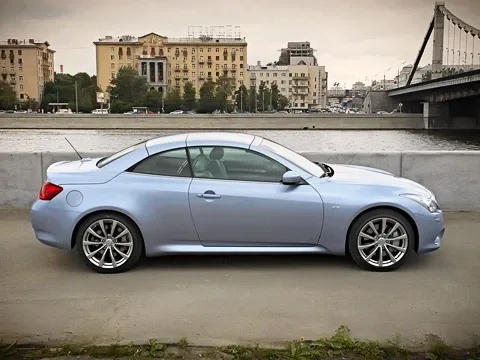
The drag coefficient Cx of the G37 Cabrio with the roof raised is even better than that of the coupe: 0.31 versus 0.32.
The rear body section of the Cabrio G37 is widened by 32 mm compared to the coupe, and the overhang has become longer by five millimeters. Practicality was deliberately sacrificed for style: under the tightly compressed "sandwich" of the three-section roof, no more than 70 liters remain in the trunk for luggage. And that's only on paper. In reality, a driver's emergency kit barely fits there. On top of that, the folding top mechanism and additional body reinforcements increased the curb weight by 180 kg relative to the coupe. Dynamics also became more modest: the G-cabriolet takes half a second longer to accelerate to 100 km/h — 6.4 seconds.
And yet the acceleration is confident and assertive, though without the coupe's aggression. The new "automatic" tries not to draw attention to upshifts, and when shifting to lower gears, it shows slight thoughtfulness. Everything happens quickly enough not to irritate, but, I repeat, without sporting anger.
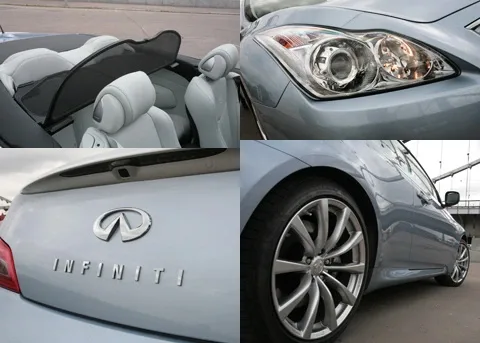
The base equipment of the G37 Cabrio already includes leather seats with heating and ventilation, 19-inch wheels, bi-xenon, navigation, and much more. Prices start from 2,499,000 rubles for the Hi-Tech version. This is 240 thousand more expensive than the less powerful Lexus IS 250C.
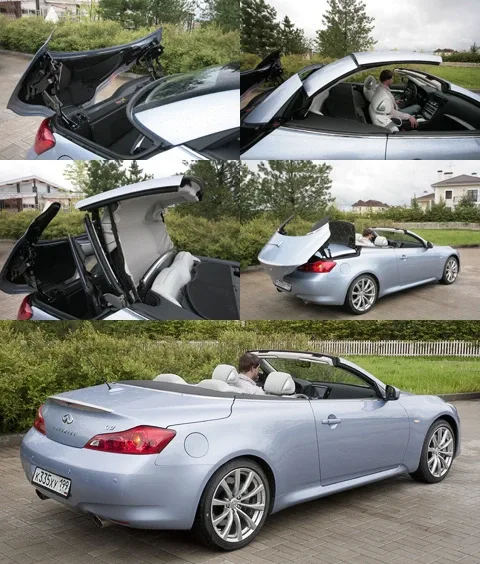
It takes 25 seconds to transform a closed car into an open one — some Moscow traffic lights have a shorter cycle. Having finished with the servo drive control button, I notice how close to my head the windshield frame ends. It looms too intrusively at my forehead, crossing the ozone-charged dark sky. It interferes with focusing on the road even with the driver's seat fully lowered. A shorter driver will find it more pleasant.
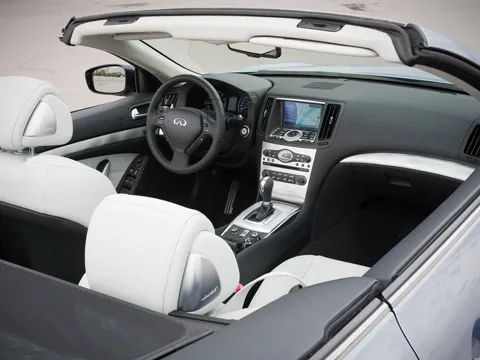
The interior of the cabriolet is identical to the interiors of the G-series sedan and coupe. The steering column moves together with the instrument cluster. The idea is not new, but still functional. This makes it harder to block the scales with the steering wheel rim.
I don't get blown much below the protruding crown of my head. The cabin maintains a relatively windless atmosphere. True, for this you need to drive with the side windows raised, and the rear seats must be given up to the wind deflector. Fortunately, it is included in the base equipment of all G-cabriolets. Envy, owners of open BMW "threes" — you have to pay an extra 18.5 thousand rubles for the screen!
And the leaky sky is not a hindrance either. Rare raindrops are blown away by the oncoming flow. Just don't get carried away, savoring the good aerodynamics. If you miss the moment before a serious downpour starts, you risk getting soaked to the bone. After all, Infiniti does not allow raising the roof at low speed — only at a complete stop. And that's another 25 seconds. So it's better not to delay with a "pit stop."
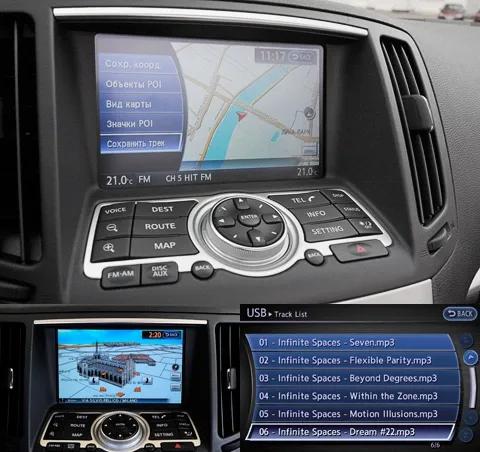
- The Infiniti navigation system with support for three-dimensional graphics covers the central part of Russia, Moldova, Belarus, the Baltic states, as well as the most relevant part of Europe for our road travelers, in particular Germany and Finland.
- Three quarters of the 40-gigabyte hard drive is allocated to navigation software, which should be updated twice a year. The remaining ten gigs can be filled with music.
The closed car is unpleasant with acoustic noises. Moreover, they are concentrated in the rear part of the cabin. On the one hand, the tires sounding from the gallery and the intrusive whistling of the wind do not force the front occupants to raise their voices. On the other hand, the feeling is strange. It seems that the electric motors have just buzzed, the sky above your head is covered with plastic — but you seem to still be driving in an open car. Uncomfortable.
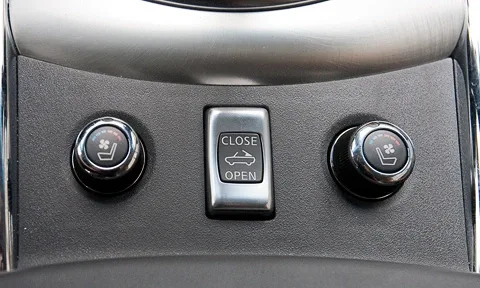
The folding roof control button is located on the central tunnel between the "barrels" of seat heating/ventilation. The button must be held pressed for all 25 seconds. The heating handles have vague fixation and weak backlighting: I drove the first half of the journey with the airflow on, and the second half with the heating on.
In the chassis settings of the G-cabriolet, unlike the G-coupe, the emphasis is on comfort. The shock absorbers have been recalibrated, and the steering column is equipped with an additional damper designed to dampen suspension vibrations, protecting the more pliable body from vibrations. I won't say that I deliberately collected all the potholes on the 20-kilometer route, but those that did fall under the wheels, with rare exceptions, were successfully digested by the suspension.
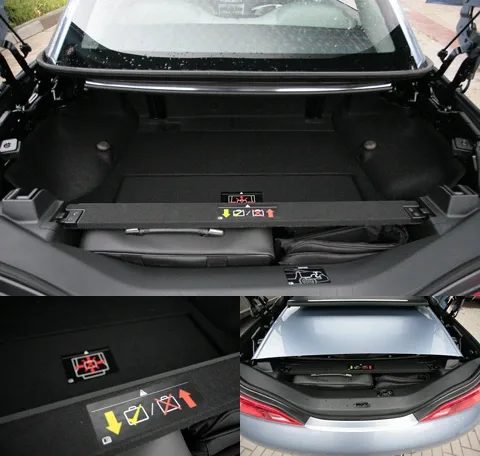
With the roof raised, the trunk of the G-cabriolet is not so small — 333 liters. But if you've folded it, don't complain.
With the top folded, body oscillations on large irregularities are felt more strongly, but overall ride smoothness is better this way. In general, the difference in behavior with or without the roof fits well within the margin of subjective sensations. Reactions to the steering wheel are smooth in both cases (the cabriolet does not have a rear-axle steering mechanism or an active steering gear), and a slight delay on the first deviation of the steering wheel, although noticeable, does not interfere with controlling the powerful car.
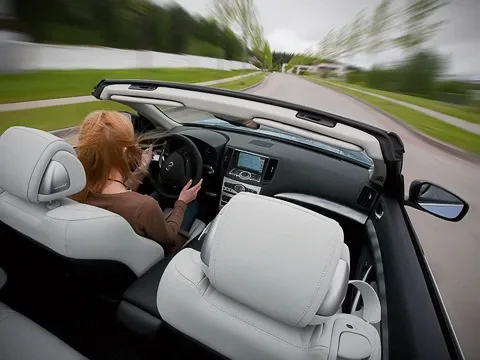
In case of a rollover, the occupants will be protected by the reinforced windshield frame, arcs that shoot out from the rear headrests, and six airbags.
There are rolls, but the car does not sink into them, but rather carefully leans on the springs in a turn. In general, everything in the cabriolet seems to set a calm tone, relaxes, works for the image of a leisure car. Only the excessive sensitivity of the brakes is puzzling. You roll along as if nothing happened — and suddenly a barely noticeable touch of the brake pedal responds with a sharp and deep dive, instantly destroying the established idyll.
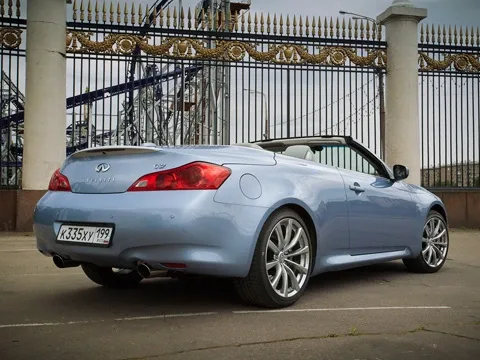
But the updated rear-wheel-drive Infiniti G25 sedan, into which I move from the platform-sharing cabriolet, does not show such anomalies. The deceleration is just as powerful, but this time it is adequate to the applied effort. Although braking dynamics is by no means the main thing in this car. Question number one is this: what is left of the vaunted acceleration after the Infiniti G became 222-horsepower, that is, even weaker than the native Japanese Skyline with a V6 2.5?
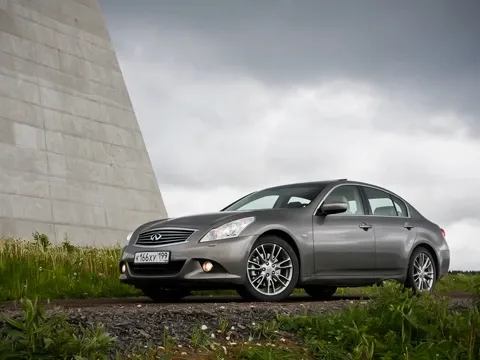
In addition to the new 2.5-liter engine, the G-sedan underwent minor exterior adjustments: the L-shaped head optics lost the fog lamp sections, which moved to the modified front bumper. The pattern of the false radiator grille has changed.
Well, how can I put it? It has noticeably deteriorated. The loss of 111 "horses" added three seconds at once to the acceleration time to 100 km/h. And despite the more than 100-kilogram weight advantage compared to the G37 version, the G25 sedan cannot reach 100 km/h faster than nine seconds. The maximum speed no longer needs forced limiting — 232 km/h. In short, I am driving the slowest Infiniti in the world.
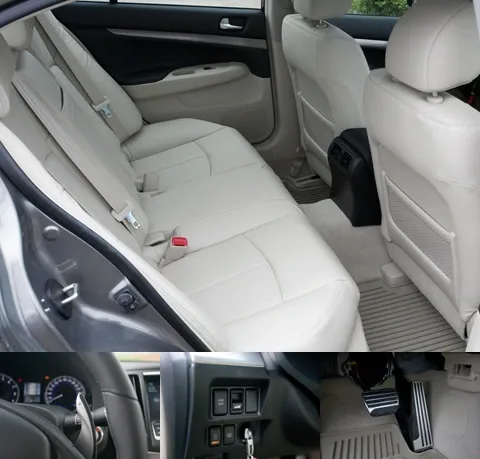
- To the left of the steering wheel is a block of auxiliary buttons and a slot for the ignition key. It is not necessary to insert it there; you can keep it in your pocket. All Infiniti cars are equipped with a keyless access and engine start system.
- The floor-mounted accelerator pedal is like in BMW.
- Titanium paddle shifters are active in any automatic mode. After pressing a paddle in Drive, the gearbox holds the selected gear for a few seconds and then automatically returns to automatic mode.
On narrow country roads, where overtaking often has to be done at full throttle, this is especially noticeable. You press the gas and catch yourself thinking: isn't this driving attitude undermining the Infiniti image? Previously, the G sedan was interesting because under the premium badge hid a top-tier Nissan — powerful, packed with options, and all-wheel drive. Now it turns out that the Infiniti buyer is ready to settle for less and doesn't chase records? After all, speed has always been part of these cars' character. What can the G25 offer besides an attractive price-to-equipment ratio?
At the very least — excellent driver connection. The seven-speed automatic tries its best to hide the lack of horsepower. In the city, it promptly shifts down with almost no pauses. Don't forget that the G25 is a rear-wheel-drive car with a perfectly balanced chassis and a fully switchable stability control system. It may be the slowest Infiniti, but it's also the lightest: even the G37 coupe weighs a full 60 kg more. So the driving pleasure here is no less than studying the price list. Prices start at 1,515,000 rubles. So, every lost second of acceleration to 100 km/h saves the buyer of the "twenty-fifth" 100,000 rubles. A quite reasonable compromise!
Next up for testing is the EX37 crossover with the same 3.7 engine as the coupe-cabriolet. But this engine sounds completely different here — fresh, spirited, younger. Adjusting the leather seat to my liking and escaping the shadow of Moscow-region penthouses, I fly headlong along winding roads. It seems like the same six and a half seconds to 100 km/h, but how differently the EX's dynamics are perceived against the backdrop of the leisurely cabriolet! Not the slightest delay in response to pressing the gas pedal. It feels like the pedal is connected to the engine not by wires but by a cable — press, and you get it immediately.
The transmission is tuned in the same vein. In Sport mode, the seven-speed automatic shifts very quickly but with noticeable jolts. In Drive mode, the gearbox behaves a bit softer, and shifts become smoother. But in any selector position, the gearbox seems to provoke active, even hooligan driving, constantly offering a lower gear.
I brake hard before a huge pothole — and the automatic instantly drops from fifth to third. The engine howls, the car noses down harder than I expected, and my female passenger and I hang on the seatbelts. Perhaps the EX overdid it here: we're not on a race track but in the city. I'm all for sport, but the EX is unlikely to ever see a circuit, so Japanese engineers still need to work on the transmission's adaptability.
However, the chassis is set up combatively. No delays in steering response. A slightly heavy but very informative steering wheel gives a complete picture of the position and load of the front wheels. True, the suspension here is noticeably stiffer than in the cabriolet. It works through every crack in the asphalt, transmitting all road irregularities into the cabin one-to-one. In character, the EX is a true heir to the sporty Stagea (M35) wagon, the utilitarian version of the Skyline. No wonder the EX is called Skyline Crossover on the home market. The car has definitely benefited from the engine change.
Surely, installing the same engine has also benefited the large Infiniti FX crossover. Unfortunately, the FX37 turned out to be the only new model I couldn't test — the car stayed in Moscow for some reason. What a pity! It's the most important of the updates — a potential bestseller. Last year, more FX35 crossovers were sold than all Infiniti sedans and coupes combined. Even the small EX doesn't enjoy such demand.
As a journalist, I'm indignant, but as a person, I secretly rejoice: the heavier FX37 is unlikely to raise the driving bar after the "E-X." And I'd like to end the test on a high note. And here it is — the key fob for the 400-horsepower all-wheel-drive flagship FX50 S! So much has been said about this car — time to form my own opinion...
You say the "FX" looks too flashy and the interior is a bit cramped for nearly five meters of length? Never mind! The speedometer needle crosses the first three-digit mark in less than six seconds after the start. The quiet but dense engine sound creates the feeling of sitting on a transformer. The air in the cabin seems electrified.
When a two-tonne behemoth leans in corners less than some sports coupes, you forget about everyday inconveniences. The person behind the wheel of the "FX" has not a shadow of doubt. Tested on myself. The engine's thrust seems limitless, the suspension omnivorous, and the steering all-powerful. A true flagship!
I really liked the FX50 S, although I understand that it's the younger FX35/37 version that will remain the foundation of Infiniti's success in Russia. After the engine update, things should go even better for the "FX," as well as for the updated EX crossover. But there's a risk that Infiniti will turn into a brand of two crossovers. A tree needs to grow not only upward but also outward, otherwise it will break. To prevent this, affordable modifications are needed, like the G25 sedan, which could well make the brand mainstream. That's good for recognition. And for everything else, there's the fearless FX50 and the image-oriented coupe-cabriolet.
Specifications
Trims
Technology
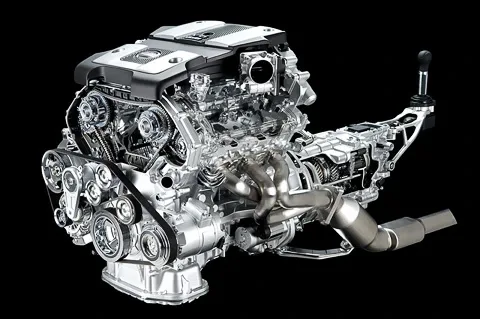
The VQ37VHR engine is based on the previous 3.5-liter "six" — 65% of its parts are taken from it. The piston stroke has increased by 4.7 mm, but the key innovation is the VVEL (Variable Valve Event and Lift) system, which operates without a throttle body and resembles BMW's Valvetronic in principle. The mixture composition and efficiency of the working process are handled by the variable valve lift mechanism and phase shifters installed on both camshafts.
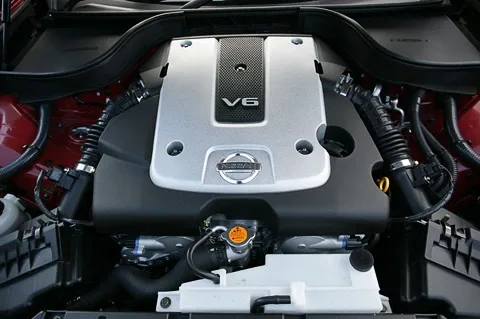
The aluminum V-shaped "six" VQ25HR with a displacement of 2.5 liters is intended for the Japanese Nissan Skyline sedan. It features variable valve timing on both intake and exhaust. In the European version, power was slightly reduced — by three horsepower, to 222 hp.
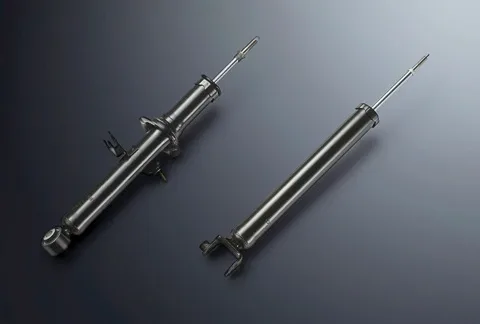
In the Dual Flow Path adaptive shock absorbers, the damping fluid, as the name suggests, flows through one of two circuits — depending on the position of the bypass valve.
The entire Infiniti G family, as well as the FX crossover, is based on the second-generation FM (Front Midship) platform. The photo shows the chassis of the rear-wheel-drive Nissan Skyline sedan, also known as the Infiniti G. In the cabriolet, this "cart" has been refined: the rear track is wider, and the rear shock absorbers have different settings.
Off camera: there are rumors that the pyramid recharges energy and enhances male strength... Well, I went inside — and what? For the first time in a long while, next to me in the car sat not an eternally shaggy photographer but a pretty girl, and I still think only about the car, the weather, the shoot, and where to wash the car. And then it started raining — as if on purpose! Either I got a defective pyramid, or it's time for me to take a vacation, or maybe even go to the registry office...