
The sun is setting, and the day smoothly gives way to evening. A calm atmosphere prevails around, people are hurrying home from work. A car pulls up to a country house along a wide American highway. Stop. What car did you just imagine? Most likely, a large SUV came to mind — a classic symbol of success and status. What if we transfer this picture to our roads, leaving just a country house instead of an American mansion, but keeping the main character — the huge SUV — unchanged? That's exactly what we wanted to test by taking the Hyundai ix55 for a review. Judge for yourself: this car, known to Americans as the Veracruz, has been selling well in the States for several years now, and has now reached Europe and Russia, changing its name but preserving its essence. Will it take root here and can it appeal to those who appreciate big cars? Let's find out!
A Mysterious Foreigner
I'm heading to my Hyundai ix55, parked a couple of streets from the office. Where did my partner leave it? So, turn right, near the intersection... Ah, there it is! It's not hard to spot — the dimensions give it away immediately. There seem to be plenty of cars this size in the city, but this one stands out with its design. Looking at it, you can't immediately tell where it's from. It seems clearly Asian: there are smooth body contours, window lines, a profile somewhat reminiscent of the Lexus RX300, a cunning "grin" on the grille, and slanting headlights. But look at the size, huge mirrors, and flat hood — and the thought that you're facing an American doesn't leave you. So this guest might say "How do you do?" upon meeting, but won't forget its native Korean "Annyeong haseyo" either.

Hyundai ix55: an American of Korean origin. Photo: Timofey Isaev. Auto.Ytro©
However, calling this combination flawless is hard. The ornate shapes of the front optics and taillights somehow don't fit the image of a respectable businessman. Even the chrome door handles suggest a person who buys expensive accessories to seem more prestigious. Or maybe it's just part of the Asian style? But what lies inside?
You open the wide door — and your eyes are pleased by neat, balanced shapes. True, when getting in, don't forget to step on the wide sill: if you don't, it's easy to get dirty, which is quite inappropriate for someone in a business suit. The same goes for getting out. However, over time you get used to this sill and even find a plus in it — it reduces those very centimeters to the curb that are sometimes so lacking.
The interior itself leaves a mostly pleasant impression. You won't find any signature "zest" of Hyundai here, but everything is done practically and conveniently: soft plastic, pleasant-to-touch leather on the steering wheel and seats, and functionality is a non-issue — you can figure out the music and climate controls without instructions. The abundance of niches and compartments is especially pleasing: there's a double box, a spacious glovebox, and a compartment for credit cards. There's always a place to put small items. The conveniences don't end there — there are audio system buttons on the steering wheel, a rearview mirror, cup holders, and various compartments in the back. But you sit and catch yourself thinking: is this still a premium crossover or a family wagon? However, this is more of a plus.
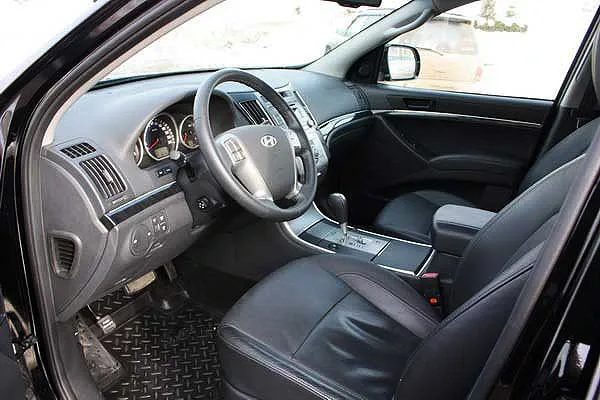
Hyundai ix55: an American of Korean origin. Photo: Timofey Isaev. Auto.Ytro©
We throw a large bag into the trunk. Against the backdrop of its volume, it no longer seems so big. There's more than enough space here — almost 600 liters. And if you fold the second row, you get a real little truck with 1746 liters.
Overall, the car seems designed so that the driver and passengers can relax and feel comfortable. But isn't there too much of these features? Let them be, as long as they don't distract from the main thing — the pleasure of driving. And how the ix55 behaves on the road, we'll find out now.
Big and Strong
Well, overseas guest, show what you can do? Another detail reminds us that it's truly from across the ocean — the parking brake. Here it's made like in many American cars, as a small pedal to the left of the main ones.
We start the engine and... get the first unpleasant surprise. But not from the engine, but from the steering wheel, or rather, its electronics. The fact is that the Hyundai ix55's steering column has electric adjustment, and it was this that worked intermittently on our example. Similar caprices were also observed with the electric drive of the mirrors. Perhaps the incorrectly installed alarm system is to blame, and production cars don't have such problems. But the aftertaste remained.

Hyundai ix55: an American of Korean origin. Photo: Timofey Isaev. Auto.Ytro©
Before driving off, let's turn on the lights so we're visible. We turn the lever — and the instruments and central console are flooded with blue backlighting. The color is pleasant, eyes don't get tired, but for a car of this class it seems somewhat frivolous. The instruments themselves look simple and boring: from a powerful crossover, you expect something more than three ordinary "wells." However, there are no complaints about their readability, so perhaps it's a matter of taste.
Well, shall we go? First, let's back up a bit to move away from the BMW parked close in front. We engage reverse and... discover that the gearshift lever has no lock button. Nor is it necessary to press the brake pedal when shifting, so an accidental touch of the selector could engage a completely different gear than needed. Hyundai explains this design by saying that American safety standards, unlike European ones, don't require automatic transmission locking. But you'll agree, this isn't very good, especially if there's a small child in the cabin reaching for all the levers. And it's easy to bump it yourself. However, now we know about this feature.
We back up. The distance to the car behind is small, but it should be enough. Here, the mirrors that change their tilt themselves and the parking sensors help. True, the latter, honestly, is more of a hindrance: it only beeps, with no visual distance indicator. It's a pity there's no rearview camera here — for such dimensions, it would be very useful.
Finally, we drive out. Ahead of us is a street with tram tracks. The rails themselves and the asphalt around them are, to put it mildly, in a poor state. But this doesn't seem to affect comfort at all. The Hyundai ix55 confidently swallows both such potholes and larger bumps — the suspension clearly knows its job. Up front, there's MacPherson, in the rear — multi-link, and ESP and traction control are standard. Thanks to this, the car holds its course well: of course, it's not a sports car, but for its size, the ix55 behaves very decently. Neither strong body rolls in corners nor deviations from the trajectory are noticeable.

Hyundai ix55: an American of Korean origin. Photo: Timofey Isaev. Auto.Ytro©
Behind the wheel of this car, you want to press the pedal to the floor and race to the very horizon. And that's not surprising: under the hood of our Hyundai ix55 is a gasoline "six" with a volume of 3.8 liters DOHC and 264 hp. With such an engine, the car accelerates to 100 km/h in 8.3 seconds, and the top speed is 190 km/h. A six-speed automatic helps the engine, shifting easily and imperceptibly. Add excellent sound insulation here — and the trip can be very pleasant. But only until you need to brake. Here, the driver faces disappointment: the brakes are rather mediocre. The pedal is "soft," lacking feedback. True, if you press to the critical point, ABS works without complaints. Maybe it's a matter of habit? Or maybe the car simply isn't designed for the frantic Moscow pace, but for long American highways with their smooth accelerations and decelerations? Remember about the horizon? The car's dimensions will also remind you in the city: you can't turn around in courtyards, and finding parking in the center is a whole problem. But outside the city — complete freedom: on the highway, the car is willingly let through, xenon headlights perfectly illuminate dark sections, and off-road capabilities are quite sufficient.
It's worth mentioning that in the urban cycle, the gasoline version consumes 17.6 liters per 100 km. On one hand, for such a large car, these figures seem expected, but on the other, modern technologies could allow for a more modest appetite. Those who want to reduce fuel costs should look at the diesel: it's content with just 12.4 liters with 176 hp and a 2.6-liter volume. At the same time, dynamics hardly suffer — acceleration to 100 km/h takes 10.7 seconds, and the top speed doesn't change. A bonus is also a lower transport tax. By the way, since we're talking about finances...
Money, Money, Money...
The price of the Hyundai ix55 with a diesel engine starts at 1,799,900 rubles, while the gasoline modification will cost a bit more — from 1,814,900 rubles.
Regardless of the chosen version, the buyer gets generous equipment already included in the base price. Among the options are dual-zone climate control, an improved visibility package with xenon headlights, a comprehensive safety system with a large number of airbags, as well as alloy wheels and a full-size spare tire.
It is worth noting that the model's main competitors are noticeably more expensive — around two million rubles. Moreover, for that money, as a rule, far from the richest trim is offered. In this light, the Hyundai ix55 looks very tempting in terms of price.
Foreign flair
Our test drive is coming to an end, and it's time to sum up the acquaintance with this "American" of Korean origin. The Hyundai ix55 turned out to be an ambiguous car: on the one hand, it is well adapted to our roads and can boast excellent spaciousness, and on the other — it is not without drawbacks and in some ways falls short of the expectations of its audience. The exterior, periodic electronic glitches, and rather simple interior — all this can scare off some potential buyers. There is also another nuance related to stereotypes.
Let's go back to the beginning of our story. The sun is setting. A large black car drives up to a country house along a wide American highway. Stop. What car did you just imagine? For some reason, it seems to me that in your imagination it was not a Hyundai.
Pros: excellent dynamics, high functionality, attractive price
Cons: "spongy" brakes, controversial design, electronic glitches
Author's subjective ratings on a five-point scale:
Engine: 5
Exterior: 3
Interior: 4
Spaciousness: 5
Handling: 4
Fuel consumption: 4
Suspension: 5
Automatic transmission operation: 5
Multimedia: 4
Price: 5
Average score: 4.4
We thank Hyundai and personally Yulia Tikhonravova for providing the car.