But I won't bore you with long stories about the trip — I'd rather get straight to the point. I was ready to see anything in Seoul, but not lines of five-meter black sedans and silver crossovers. Yet they were the ones that filled the streets.
THE ONLY RIVAL
Korea is a small country, with about 50 million people living here. There are almost no free territories; everything is planted with rice and cabbage. Housing prices are comparable to Moscow's, and a liter of gasoline costs $1.80. It would seem that under such circumstances, it would be logical to switch to economical small cars like the Matiz, but there are only about five of them in Seoul, and I might have counted one twice. We drove around the capital for a long time, and over two days of close observation of traffic, I managed to spot only one Hyundai Getz and one Accent.
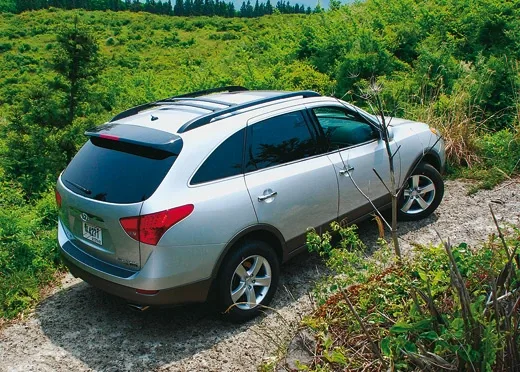
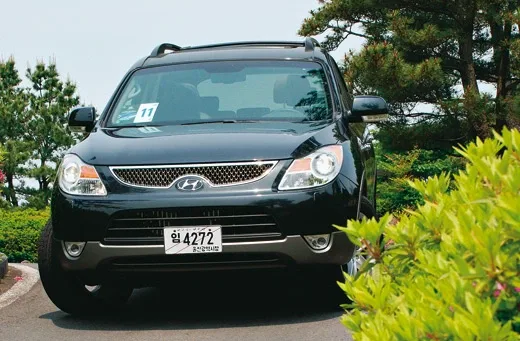
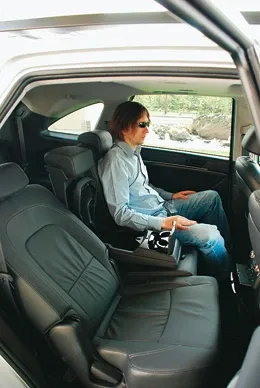
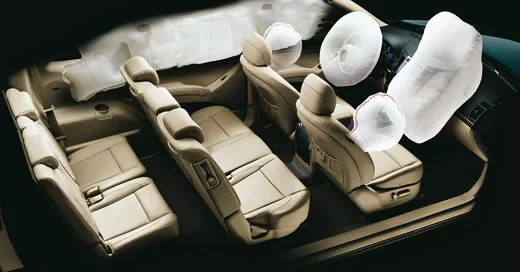
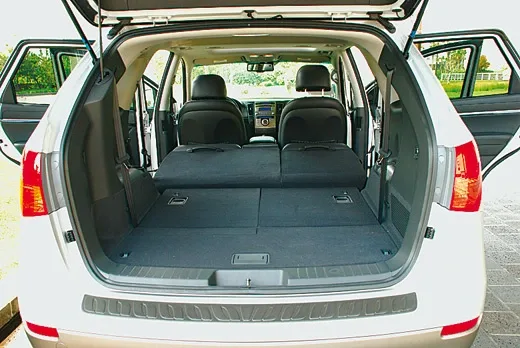
Locals do not recognize cars below the D-class. Even the old Sonata is considered compact here. Seoul taxis, like in New York, are not inferior in length to the Chevrolet Caprice. It is these fans of big cars and "jeeps" who created the seven-seat Hyundai Veracruz crossover (by the way, with a fairly spacious third row). It is 190 mm longer than the Santa Fe and falls into the category of full-size SUVs, where the Honda Pilot, Acura MDX, and Mazda CX-9 (read about it in this issue) reside. All of them have unibody construction, independent suspensions, and no low-range gear. This class is crowded, competition is serious, but except for the mentioned models, all others are five-seaters and formally cannot compete with the Hyundai Veracruz. Moreover, the Acura MDX is only brought in by "gray" dealers. But the Honda Pilot, Mazda CX-9, and the hero of my story will soon be on sale. It's time to organize a three-way comparison...

A BICYCLE AWAITS US
The Korean auto industry is structured like this: 30% of produced cars stay on the domestic market, of the remaining 70%, half goes to the States, and the rest is divided between Russia and the Emirates. Other countries get only small batches.
I'm not a marketer, but in my opinion, the principle "what's good for the USA is good for Korea" will soon lose relevance. Current fuel prices cannot but affect production plans. Let me give one telling fact: in Russia, 90% of SsangYong Rexton SUVs are sold with diesels. And this is the first step — first we switch to diesel, and then... we switch to a pedal-driven Suzuki Jimny. However, things are not easy in America either. GM, for example, calls the Chevy Aveo one of the most promising models (see p. 10). Meanwhile, Hyundai offers us a 3.8-liter gasoline engine — enjoy!
SIGNS OF A TRUE "AMERICAN"
The Hyundai Veracruz, as befits a typical American car, brakes unusually: the pedal is too stiff and has a lot of free play. This is easy to explain if you imagine a two-hundred-kilogram Texan behind the wheel, who has always had trouble with precise pedal pressure.
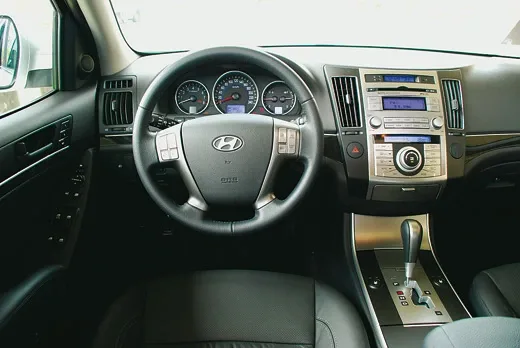
What other features give away the "American"? A light, empty, and not at all sharp steering wheel. It is good because it doesn't allow mistakes with sudden movements. Body roll in corners, which in the USA is called ride smoothness. Stretched gears in the automatic transmission. Again, this is not a drawback, but a way to eliminate excessive driver aggression.
The Hyundai Veracruz cannot be taken apart and studied under a microscope. You need to look at it as a whole. It's a big car. Inexpensive (prices not yet announced, but it's cheaper than all competitors). Smooth. Non-aggressive. An all-wheel-drive family bus. There are few such cars on our roads. Perhaps there will be more, especially if the Koreans decide to supply a version with a three-liter diesel. Unfortunately, it wasn't shown at the presentation.
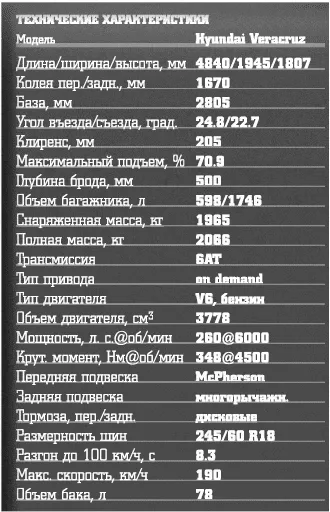
TECHNICAL DATA: HYUNDAI VERACRUZ
CRYING OVER THE BUMPER
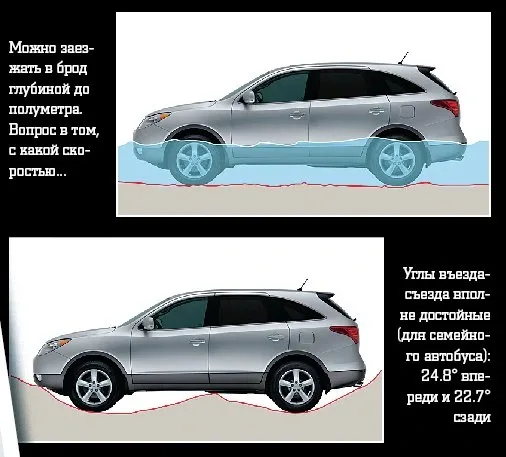
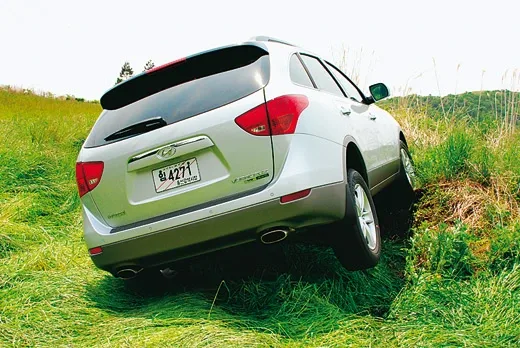
We drove the Hyundai Veracruz around Jeju Island, circling a volcano. The roads are all asphalt: straight, wide, and smooth. Breaking away from the main group and turning into a field, I was able to test the new model's off-road talents. First, the ride smoothness is excellent: driving over a bumpy field was a pleasure. But the diagonal wheel articulation test revealed the weakness of the traction control electronics off-road. It doesn't allow the revs to rise freely, so you have to take the obstacle with a run-up, crying over the front bumper.
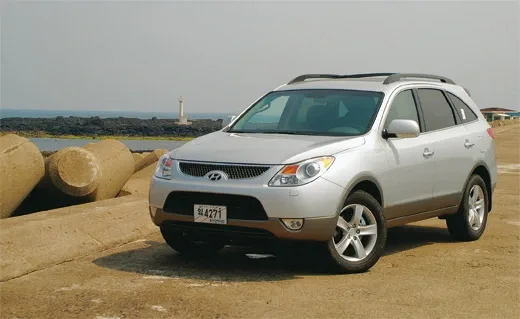
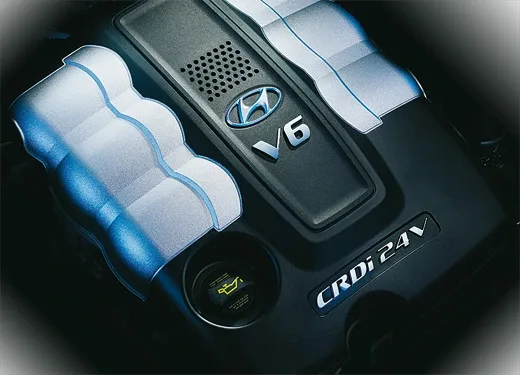
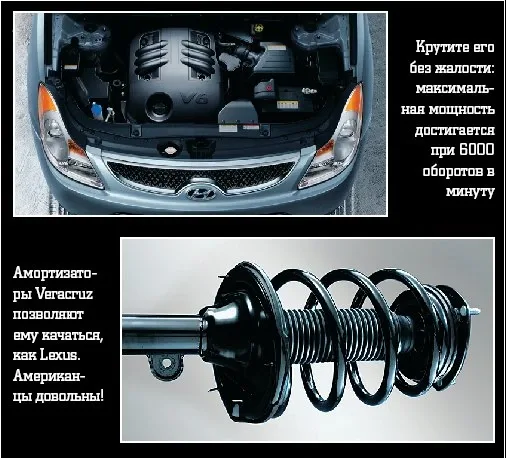
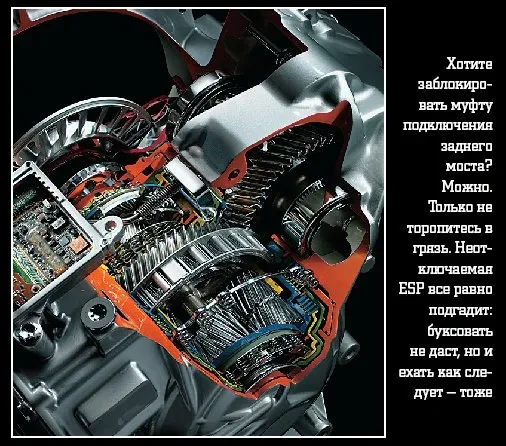
On asphalt, the Hyundai Veracruz's front wheels are the driving ones. The rear axle coupling can be locked. There is no low-range gear — like most classmates. On a straight line, the V6 accelerates the car to 100 km/h in 8.3 seconds. For this class, that's a decent figure. However, the gasoline engine doesn't shine with low-end torque. The maximum 260 hp is available only at 6000 rpm, and the peak torque of 348 Nm at 4500 rpm. In winter, getting stuck in a snowdrift will be easy. For our all-wheel-drive fun, we need a diesel!
The Veracruz is one of the last big crossovers created in the hope that the price of gasoline won't jump to $50 per liter by the end of the year. Or, on the contrary, is it a modern spacious vehicle that in a couple of years will have fuel cells built in and the roof replaced with a solar battery? I don't have an exact answer, but for now I say: give us a diesel!