
Hyundai NF Sonata. Business class got its name back
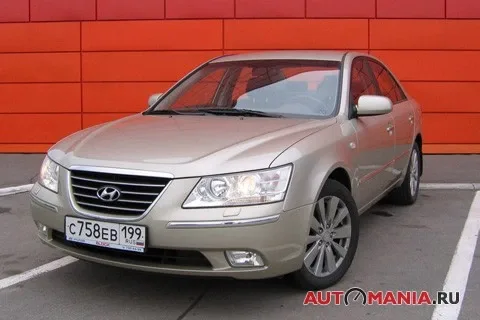
The advertising campaign about the "spring refresh" worked flawlessly — I was eager to get behind the wheel of the restyled version, which finally got its original name back instead of just the NF index. The intrigue with the sixth Sonata was that the price, despite noticeable changes, remained the same. Owners of the "plain NF" might feel a bit offended: they paid the same money but got a product that is no longer fresh. However, the strict Korean D-class sedan is aimed at a conservative audience that values classics, and you can't lure them with trendy gadgets.
Outside — light makeup, inside — serious work
The exterior has changed minimally. First, the headlights have become noticeably larger, and this is a controversial decision: personally, I liked the previous optical elements more. Second, a new radiator grille with an integrated emblem has appeared. Chrome has been added both on the sides and on the bumpers. The wheels have also been redesigned — now they are 10-spoke.
The 2.4-liter engine has gained 9 horsepower. As for handling, the steering wheel now requires fewer turns to lock.
But the interior has transformed much more significantly. The central armrest now has two sockets: one for USB and iPod, the second for other gadgets. The dashboard is trimmed with softer plastics, and the instrument cluster has received neon backlighting. The blue backlighting overall can now be adjusted in brightness over a wider range — this is clearly missing in the Santa Fe and Elantra. The onboard computer has changed its display: blue digits on a black background instead of black on blue, and they are easier to read. There is one complaint about the trip computer: the trip time resets if you are away from the car for more than three hours. But this is a minor issue — most cars don't have this function at all.
The most striking interior detail is the smoothly descending V-shaped console with aluminum trim. It is laconic, without unnecessary embellishments. At the top, the console is crowned by an audio system, from which the cassette compartment has finally been removed. The system has gained RDS and PTY functions, and windows with station names have appeared above the station selection buttons. Now you won't have to blindly poke your fingers in search of the desired wave — this is how many audio systems on GM models work.
The climate control remains single-zone, but instead of dials, there are now buttons. True, in the dark at minimum instrument brightness, the "temp" and "mode" buttons are almost invisible. You either have to increase the brightness or take your eyes off the road to adjust the climate.
What to do with the door lock?
But that's just the beginning. The real issue is something else. The doors lock automatically while driving, and it is impossible to open them manually by pulling the handle twice, as in most cars. Only the driver can unlock them using a button located next to the window switches, which is not illuminated and is hard to find blindly. But that's not the main thing. The main thing is how to get out if the electronics fail, something shorts under the hood, and a fire starts, as happened to me two years ago? My car burned down in a matter of minutes. Had I been in a Sonata, I would have burned with it. So Hyundai engineers have something to work on.
Comfort is perfectly fine
But you won't be able to find fault with comfort. And importantly, for the test we took not the top trim. There was no leather, no sunroof, no wood trim on the steering wheel, no auto-dimming mirror, no cruise control. All of this, by and large, is not critical for a metropolis. Giving up these options saves 59,000 rubles. Although I would have kept the leather — the velour looks decent, but leather is more practical to maintain.
It's comfortable to sit in the car, especially in the back. Even a person nearly 190 cm tall, with the front seats fully pushed back, won't have their knees touching the seatbacks. Here, the NF Sonata is perhaps unrivaled in the D-class. But the trunk is not a leader: 523 liters. That's a lot, but less than the Ford Mondeo (550 L) and VW Passat (565 L). Plus, the Hyundai doesn't have a "ski hatch" for long items.
The base trim is solid: six airbags, a full package of active safety, power accessories, onboard computer, rain sensors, 17-inch wheels with Japanese Dunlop SP Sport 270 225/50 R17 tires, and a six-disc CD changer. With competitors, you'd have to pay extra for much of this.
Unavailable options
What's disappointing is something else — many things are not available for the NF Sonata even for an extra charge. For example, power-adjustable driver's seat, rear seat heating, xenon, or parking sensors. The latter situation is solvable but questionable: the test car had Park Master parking sensors built into an overlay rearview mirror (which, by the way, significantly distorts the image). They worked like this: a beep sounded 2–3 seconds after a complete stop in front of an obstacle. That's money thrown away — with such parking sensors, you can easily hit all the posts and curbs, not to mention other cars' bumpers. This is a case where bad parking sensors are worse than none at all. Zero use. I'd like factory ones that work properly, so as not to spoil the impression of an otherwise solid car.
Dmitry Shavyrin
We thank the "Blok Motors" dealership for providing the car for the test.
Specifications
| Dimensions (mm) | 4800 x 1832 x 1475 |
| Wheelbase (mm) | 2700 |
| Curb weight (kg) | 1584 |
| Gross weight (kg) | 2030 |
| Ground clearance (mm) | 160 |
| Trunk volume (L) | 523 |
| Engine displacement (cm3) | 2359 |
| Max power (hp) | 174 |
| Max torque (Nm/rpm) | 229/4250 |
| Max speed (km/h) | 202 |
| Acceleration 0-100 km/h (s) | 10.4 |
| Fuel consumption (avg L/100 km) | 8.8 – 12.3 |
| Price (rub.) | 943,900 |
Source – AUTOMANIA.RU