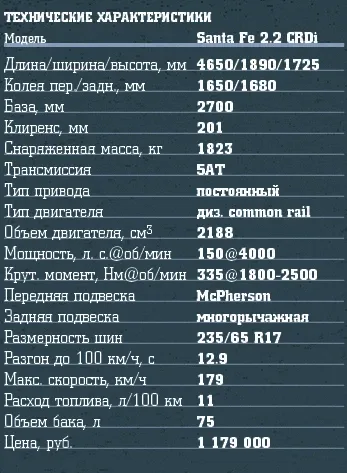
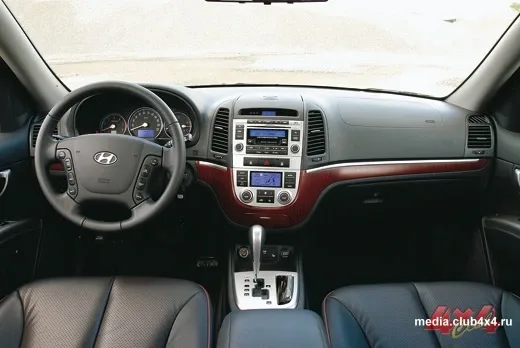
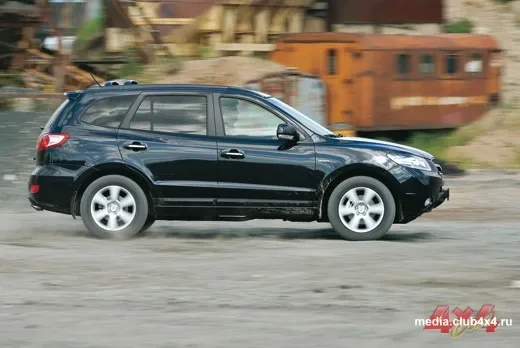
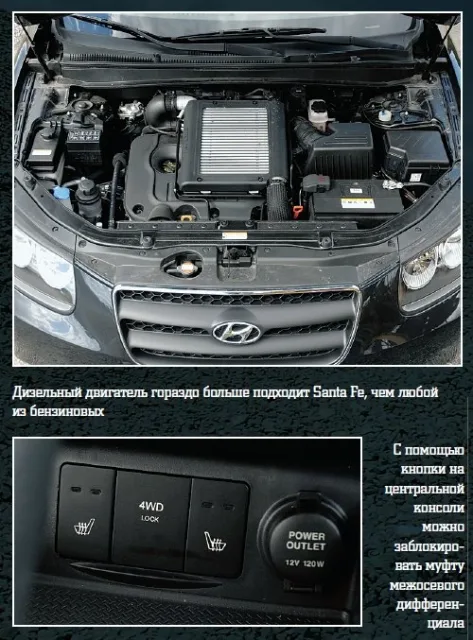
Until recently, choosing an engine for the Hyundai Santa Fe New was simple: only a 2.7-liter gasoline V6, which moved to the new model from its predecessor, albeit with some refinements. This state of affairs pleased neither buyers nor the brand itself. Finally, with the arrival of summer, it became possible to order a diesel modification — a two-liter unit with a small tail, producing 150 horsepower. The direction is correct, especially considering that the gasoline Santa, at nearly forty thousand dollars, clearly fell short of expectations. And it fell short, more importantly, literally: the outdated transmission with stretched first and second gears completely killed the potential of the peppy engine. The spectacular start from the traffic light, hinted at by the swift body lines, failed — some "nines" pulled ahead by almost a car length. Only when the speedometer needle crept up did the engine finally wake up and find common ground with the gearbox, turning the Santa into what it should have been from the start — a fast and confident car. But for the image, it's the first burst that matters... With the diesel, it's a completely different story! It picks up from the first meters and pulls the Hyundai, no matter how much it resists, until 100 km/h is reached in 12.3 seconds. It's also pleasant that after a hundred, the engine doesn't fade but continues to accelerate confidently and smoothly almost to the maximum mark. There's no noise, although the picture in the rearview mirror on heavy throttle is slightly hazy — I admit that. At idle, vibrations are almost imperceptible, and the characteristic diesel rumble even starts to appeal. The heavier unit, which added 73 kilograms to the curb weight, didn't spoil the handling, and at high speeds even strengthened directional stability. The Santa now copes more calmly with longitudinal irregularities and ruts, and in corners behaves more composedly, showing slight oversteer on throttle lift-off.
MORE TORQUE – DEEPER RUTS
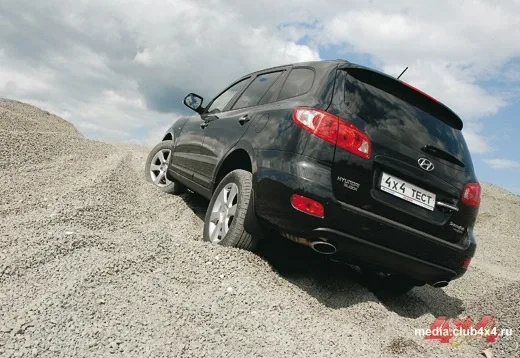
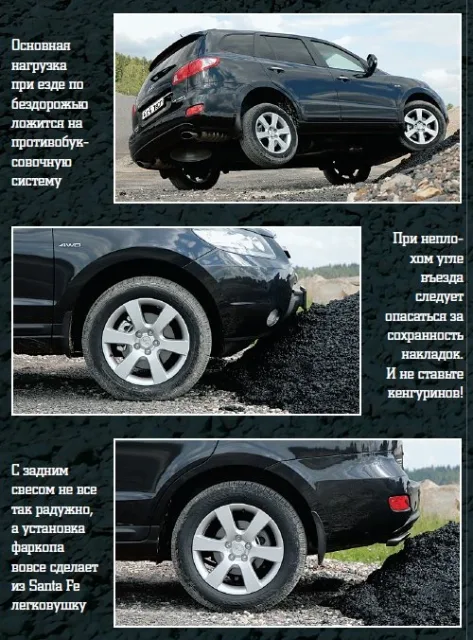
The arrival of the diesel changed the car's character not only on asphalt — to no lesser extent. Now the Santa, with adjustments for crossover limits, has become a quite tolerable all-wheel-drive wagon for light off-roading. The claimed 201 mm of ground clearance may be slightly overstated, but the real 19 centimeters under the floor are almost certainly there, and for most dacha routes, picnic outings, and other "directions," this is more than enough. The traction control system with the all-wheel-drive coupling lock now operates much more confidently, which is felt not only on rough terrain but also on loose sand. I'm convinced that the crossover's new engine will be good in winter on snow and in autumn on soggy ground. The main thing is to remember the overhangs, sills, plastic underbody protection, and bumpers, then everything will go smoothly.
SPECS: HYUNDAI SANTA FE
FIFTY GRAND FOR LOVE
The diesel Santa Fe in decent trim with an automatic gearbox will cost 50 thousand dollars. This, it must be admitted, is a bold claim — you can no longer dismiss the thought that Korea is not Japan. The inflated price tag on the new crossover, and I'm talking about the gasoline version, has already negatively affected Hyundai's sales, especially compared to the previous model. Will the diesel, which costs even more, save the situation — the question is almost rhetorical... For that kind of money, you can look not only at full-fledged SUVs like the KIA Sorento or something from the SsangYong lineup, but also at competing crossovers. Take the Land Rover Freelander, for example... If the Santa were seven-seat, as in other markets, one could discuss advantages, but as it is, I'll refrain from optimistic forecasts, no matter how well the diesel suits it!