
Hyundai Santa Fe diesel. Exceeding All Expectations
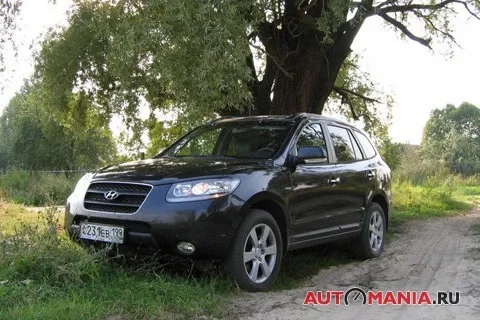
Massive, muscular, heavy — and yet elegant and commanding respect in dense traffic. At dusk, it can easily be mistaken for far more prestigious models. But unlike them, this crossover doesn't appear in crime reports, especially those related to thefts.
Which car is best suited for a seasonal trip to relatives in the Russian hinterland, say, to the Mordovian wilderness, where roads are roads only in name? You need to visit loved ones, bring gifts and scarce goods, and on the way back pick up jars of jam, compotes, baskets of apples, and bags of potatoes.
There was no need to ponder long over what to take on a 500-kilometer route to a region where the joke about "roads end — Mordovia begins" still holds true, and fuel supplies can be intermittent. The answer is obvious: Hyundai, and only diesel.
Finally we've waited
Since its debut in Detroit in 2006, Europeans have been waiting for this large crossover specifically in a diesel version. In the US, where about 70% of all Santa Fe production goes (assembly in Montgomery, Alabama), only the 3.3-liter gasoline modification with 242 hp is sold. But the diesel somehow took two whole years to reach Russia. Only this summer did official sales of the Santa Fe CRDi 2.2-liter with variable geometry turbo, common rail system (pressure 1,600 atmospheres), and 4-speed automatic start. The key feature of the engine is its simply incredible fuel efficiency. Over 10 days of testing, we drove more than 3,000 km, with the SUV constantly loaded to the brim.
But let's take it in order. First, our path lay to the Ryazan region almost light: minimal luggage, driver and passenger — my wife. After Kashira, we turn onto the federal highway M6 (Volgograd, Astrakhan). The fact that this is a "federal highway" is only reminded by the sign. By any other signs, it's impossible to guess. A former concrete road with two lanes, slightly dusted with asphalt, constant hills and turns. A solid dividing line is almost always present — meaning overtaking is prohibited. And if the road is in such a condition that the markings are simply indistinguishable, countless signs will remind you of the overtaking ban. An endless line of trucks with watermelons stretches along the highway. They move at a speed barely exceeding pedestrian pace, due to wild overloading and worn-out equipment. You can imagine what emotions this column evokes, and what zeal traffic police inspectors show, looking for violators trying to bypass trucks in unauthorized places.
Our Santa Fe goes surprisingly smoothly, slightly shaking, but no extraneous sounds are heard in the cabin. But the car responds reluctantly to overtaking — no matter how much you press the pedal, there won't be sharp acceleration. What can you do, it's a diesel, and it reveals its talents not on asphalt races, but off-road.
Almost Reached the Record
Now about fuel efficiency. The official consumption of the Santa Fe on the highway is 6.0 liters. We failed to achieve such a figure, but the road we drove on can hardly be called a highway. Plus, there was 30-degree heat outside, the air conditioner was working at full power, and overtaking uphill required effort. But even an average of 7.5 l/100 km is an excellent indicator, especially for a car that is 100 kg heavier than the gasoline version (due to the cast-iron cylinder block instead of aluminum, as on the V6 2.7). True, we got these figures on an empty car. Let's see what happens on the way back when we load up to the brim.
Knowing about fuel problems in Mordovia, before the border of the "unlucky 13th region" we fill a full tank of diesel (capacity — 75 liters). The computer promises a range of 710 km. Excellent!
Exceeding Expectations
We reached the destination without incident, time to get ready for home and load up to the maximum. Everything that fits in the cabin and trunk goes into use. And here I remembered Nissan's slogan — "Exceeding Expectations." The results truly exceeded all forecasts. The Santa Fe's trunk is not just huge, it's also "two-story." The floor is a lid, under which are hidden spacious plastic niches-containers of various sizes. All sorts of small items fit perfectly there: apples, loose vegetables, and small jars of pickles.
Having laid out the supplies, we close the lid and continue loading. We place potatoes and carrots in cardboard boxes as tightly as possible, supplementing everything with bags and packages. A huge TV settled on the back seat, becoming a third passenger. We put butter, sour cream, sandwiches, kefir, and glazed cheese curds in the mini-fridge under the central armrest (it maintains the same temperature as the cabin).
As a result, we may not have reached the official 642 kg payload capacity, but we were very close to it. We sit down: two in front, two in the back, or rather, three — considering the TV. The car noticeably squatted, but the ground clearance of 205 mm remained the same. That's such a magical property of the Santa Fe.
I remember one authoritative magazine wrote: "Sitting in the back is just terrible. The cushion is low and short, the floor is high, almost like in a pickup truck from ten years ago. Legs are uncomfortable, head hits the ceiling." Complete nonsense. Maybe that test driver mixed up the cars? In the back of the Santa Fe, it's not cramped at all. The seat backs are adjustable for recline, almost like the front ones, there's plenty of legroom, and enough headroom.
An All-Round Excellent Student
We head home. Fuel consumption increased slightly, but never exceeded 8.7 l/100 km. The car's behavior changed for the better. It became calmer and smoother. It feels like it's not a lightweight "parkette," but a huge "jeep." Reactions to steering turns are precise, without delays, but too smooth. You're not driving, you're floating, like on a yacht or a large boat. With a full load, the car rolls more in corners and doesn't like sharp braking. Passengers constantly reproached me for rough braking. But honestly, I didn't do it on purpose. It's not about my driving style, which my wife always criticizes, but about the characteristics of a loaded Santa Fe. The deceleration dynamics, especially at the beginning, require pressing harder on the stiff brake pedal. On an empty car, this is not the case — everything is predictable and the reaction is instantaneous.
With a load, you have to press the pedal more sharply, and the Santa Fe constantly noses down. There's a lack of experience driving with a full load — such situations are rare in everyday life. You have to be more careful and start braking in advance. But with a load, the car becomes softer, and the ride smoothness is noticeably higher. The suspension doesn't notice either broken roads, which now seem like Kutuzovsky Prospekt, or potholes, or joints. But light cars that brake before the slightest irregularities start to annoy. No complaints about the suspension at all. It definitely deserves a four plus. And for how the Santa Fe handles the transportation of goods and passengers — its main task — it gets a solid five.
A Little Tar
There are probably only two obvious drawbacks to this Korean SUV. When the steering wheel is turned all the way in any direction, the front wheels almost touch the fender liners. So if dirt or snow sticks, the fender liners will clearly suffer. The second drawback may appear in a collision, even the most minor one. The foot "handbrake" is located right in front of the shelf for resting the left foot. With a sharp movement, you can hit the bend of the foot hard. And getting out of the car, I often caught it with my foot. Maybe it's worth returning it to the usual place for Europeans? Let it still be a "handbrake," but located under the right hand.
Now about the price. Usually, diesel versions cost more than gasoline ones. With the Santa Fe, it's the opposite. The gasoline version, which we tested earlier, is priced at 1,189,900 rubles, and the diesel one at 1,179,900 rubles. Of course, against the background of such a price, 10,000 is a trifle, but as they say, "a trifle, but nice!" So think about which version to choose.
The diesel Santa Fe wins over with its impressive range (you can get to St. Petersburg on one tank), large payload capacity, and especially phenomenal fuel efficiency that exceeds all expectations. In the city, our average consumption was 9.2 l/100 km, which is even less than the official 9.6 liters. So if you're not bothered by the origin of this SUV and you've saved up a million, then the Santa Fe 2.2 CRDi is not the worst option.
Dmitry Shavyrin
We thank the "Blok Motors" car dealership for providing the car for the test.
Technical Specifications
The car's appearance is perceived ambiguously. The designers clearly took risks in creating this image, and calling it calm is hard. But in traffic, the car attracts glances, and there's a certain charm in that. Inside, you won't be bored either: the central console looks futuristic, and the trim materials, though not premium, are tastefully selected. The seats are comfortable, but in the back with my height of 180 cm, my knees already touch the front seat backs, which is unexpected for such a large car.
The cabin pleases with little things: there are spacious niches and well-thought-out compartments for small items. Ergonomics are top-notch, the instruments are perfectly readable, and the steering wheel feels pleasant in the hands. However, there are questions about build quality — a couple of parts on the dashboard emit an unpleasant creak when pressed. The trunk is huge, with a full-size spare wheel hidden under the floor, but due to the high loading height, throwing in heavy bags will be inconvenient.
On the move, this Korean surprises. The 2.2-liter diesel produces 150 horsepower and, crucially, 335 Nm of torque from as low as 1,800 rpm. Such thrust is enough to confidently haul a car weighing almost 1.9 tons. Acceleration to 100 km/h in 11.6 seconds is not impressive, but in city traffic you feel comfortable: the pickup from low revs is excellent, and on the highway, overtaking in fifth gear does not require nervous lane changes. The automatic transmission works clearly, but with a sharp press on the gas, it hesitates for a second before downshifting.
The suspension is a separate story. It is stiff, and this is felt at every asphalt joint. On small bumps, the car shakes, and on large potholes, the suspension responds with a dull thud, transmitting vibrations to the body. But at speed, the car holds the road like a glove, body roll in corners is moderate, and the steering wheel is filled with pleasant effort. The brakes are informative, but the pedal feels tight at the very beginning of its travel.
Off-road, this car feels more confident than you might expect. All-wheel drive with a clutch on the rear axle works promptly, and a ground clearance of 205 mm allows you to leave the asphalt without fear for the bumpers. On a dirt road with deep ruts, the car does not give up, although the stiff suspension forces you to drive slower than you would like. The claimed fuel consumption in the combined cycle from 6 to 9.6 liters per 100 km — in practice, closer to the upper limit, but for such weight, this is a decent indicator.
The price of 1,179,900 rubles puts this car in a difficult position. For this money, you can find competitors with a more prestigious brand or better trim, but few will offer the same set of qualities: a torquey diesel, honest all-wheel drive, and a spacious cabin. The main compromise is the stiff suspension. If you are ready to put up with the shaking for confident handling and off-road capability, this car will not disappoint. But for those who value comfort above all, it will seem too harsh.