
Once upon a time, cars from a distant Asian country were priced quite modestly. But the era of cheap cars has passed. The time of maturity has come, and dumping can be forgotten. The new Hyundai Santa Fe has become larger, and its price has increased by as much as eight thousand dollars.
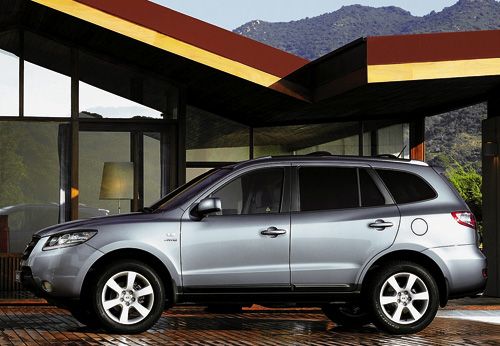
2006 Hyundai Santa Fe
© Photo: Hyundai
For a long time, Hyundai's marketing strategy in Russia looked rather strange: the company offered two very similar SUVs. The old Santa Fe was almost indistinguishable from the Tucson, which appeared here two years earlier. However, with the release of the new "Santa", the situation changed radically. Now the model is sold for $35,990–40,990, and everything has fallen into place. The newcomer has filled a free niche between the compact Tucson and the huge Terracan.
The development of the car took 26 months and $155 million. During this time, the wheelbase was stretched by eight centimeters, which automatically increased the length, width, and height of the body. The design, created at Hyundai's American center, turned out to be completely new.
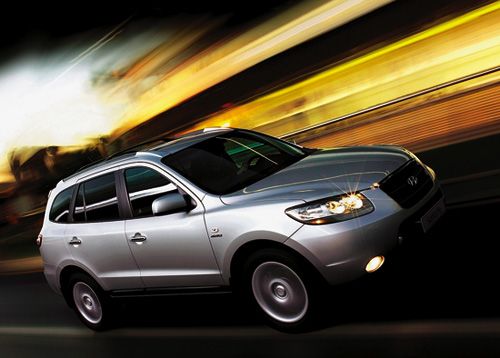
2006 Hyundai Santa Fe
© Photo: Hyundai
The exterior of the SUV has absorbed the best solutions from leading global concerns — a typical example of "synthetic" design that Koreans often order in America and Europe. Nevertheless, the appearance also has distinctive features: smooth lines of the side panels, a signature radiator grille, and horizontal headlight blocks. Similar artistic techniques were first applied to the NF sedan, which premiered last season.
At the technical presentation before the test, the developers stated that the Santa Fe combines the qualities of three types of vehicles at once. First, it is a full-fledged SUV. The distribution of torque is handled by electronics that control the center differential. For off-road conditions, a permanent all-wheel drive mode is provided, which is activated with a single button.
Secondly, according to company representatives, the Santa Fe offers the comfort and handling of a passenger car. This is facilitated by a seriously reworked chassis that ensures smoothness of ride. Rear passengers will especially appreciate this: instead of a double rear suspension of the lever type, a multi-link design has been installed, which significantly reduced noise and vibrations. When fully loaded, a self-leveling system automatically adjusts the ground clearance. And for greater stability of the McPherson struts at the front, the caster angle was increased.
Thirdly, the newcomer can be used as a minivan. In addition to the usual pleasant options, two additional seats can be installed in the trunk. My large colleague managed to settle into the third row without much difficulty. But getting back out turned out to be more difficult: Igor literally got stuck. True, after a minute he still managed to crawl out on his own, unlike Winnie-the-Pooh, who got stuck at Rabbit's. Despite some crampedness for large men, children and women of average build are unlikely to feel discomfort.
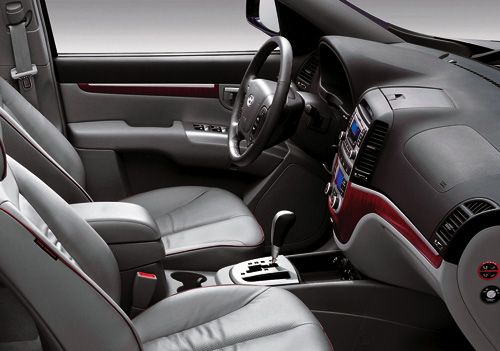
2006 Hyundai Santa Fe
© Photo: Hyundai
So, let's hit the road! The dynamics can hardly be called thrilling, although for an average SUV, the Santa Fe accelerates quite decently. With a manual transmission, it reaches 100 km/h in 10.3 seconds, and with an automatic — 1.4 seconds longer. Under the hood is a gasoline V-shaped 6-cylinder engine with a displacement of 2.7 liters, with variable intake manifold geometry and variable valve timing, producing 189 horsepower.
The Korean engineers did not deceive when they claimed that the Santa Fe handles like a passenger car. A huge role in this is played by the excellent braking system with a dual vacuum booster. ABS is included in the basic equipment of all versions.
The new SUV is easy to maneuver on narrow city streets. The minimum turning radius is only 5.45 meters. For comparison, this is five centimeters less than that of the classic "Zhiguli".
The disadvantages include aerodynamic noises that appear at speeds above 100 km/h. However, this is not surprising: the height of the car reaches 1725 millimeters.
As for safety, the developers expect at least five stars in the Euro NCAP crash test. In addition to dual front airbags, the Santa Fe is equipped with side airbags for front passengers and curtain airbags for protection in side impacts. The front airbag can be deactivated for installing a child seat. Active headrests on the front seats, protecting the cervical vertebrae, are offered as an option.
Among other pleasant little things, it is worth noting the onboard computer, mirrors with electric drive and heating, cruise control, a standard audio system with steering wheel controls, a steering column adjustable in two planes, a cooled glove box, dual-zone climate control, and an air purification system. The wiper rest zone is also heated.
The Santa Fe is a typical city car. It is perfect for a metropolis where heavy snowfalls sometimes occur. It is pleasant to drive it to the countryside, loading the trunk with shish kebab, charcoal from the supermarket, and a child's bicycle. The base version with a manual transmission costs $35,990. The mid-level GLS with an automatic is $37,990, and the top GLS is three thousand more expensive.
Technical characteristics of Hyundai Santa Fe
Body – station wagon
Number of seats – 5–7
Curb weight, kg – 1750
Gross weight, kg – 2325
Dimensions, mm:
- length – 4650
- width – 1890
- height – 1725
Wheelbase, mm – 2700
Trunk volume, l – 774/969
Maximum speed, km/h – 190
Acceleration time to 100 km/h, s – 10.3
Fuel consumption, l/100 km:
- city cycle – 14.2
- highway – 8.3
- combined – 10.4
Engine:
- type – gasoline
- displacement, cm3 – 2656
- power, hp at rpm – 188/6000
- torque, Nm at rpm – 248/4000
Transmission – manual, 5-speed
Tire size – 235/65R17
Suspension: – independent;
- front – McPherson struts with springs
- rear – multi-link
Brakes:
- front – disc, ventilated
- rear – disc
Steering – rack and pinion, with power steering
Price, $ – 35,990–40,990.
Advantages and disadvantages
+ Comfort, high quality of materials.
– Aerodynamic noises.
© 5 Koleso