
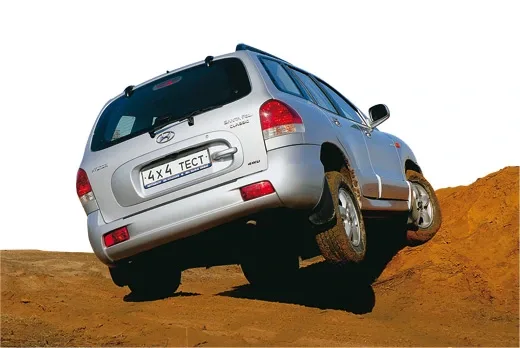
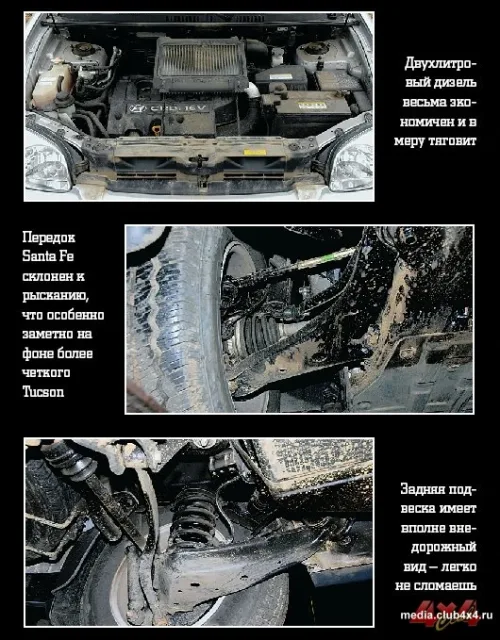
More affordable and stretched in length — this is the already familiar Santa Fe Classic, which is assembled in Taganrog. Both test vehicles received the same two-liter diesel engines and automatic transmissions. However, these gearboxes are not quite the same. Both are four-speed, with manual mode, but the Santa Fe has pseudo-manual shifting (with a rev limiter at maximum RPM), while the Tucson has a real one, allowing the engine to be revved to the limit. As a result, due to the rev limiter, the Santa Fe's gearbox gains an additional sport mode. Just move the automatic transmission selector from "drive" to the right, and "sport" is already engaged — you can forget about manual gear selection. On asphalt during dynamic driving, this is very convenient. But on rough terrain, such features are more of a hindrance.
FELL THROUGH THE ICE
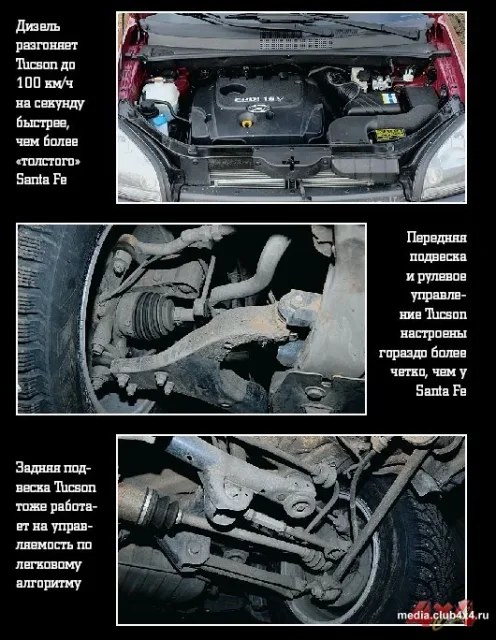
Asphalt races from traffic light to traffic light, maneuvering between lanes, and long overtakes in the left lane are much better for the Tucson driver. This crossover is lighter and more pleasant to drive on asphalt thanks to more composed suspensions and steering. The Santa Fe Classic reacts slower and less precisely than its younger brother. You need to get used to it a bit, but you understand the Tucson from the first minute.
Recently, I came across a comment on an internet forum roughly like this: "Explain how these cars differ. Just don't talk about handling, I'm sick of those words!" Okay. Especially for you, buddy, we'll take crossovers designed for smooth roads to the toughest off-road they can handle, and talk about off-road capability.
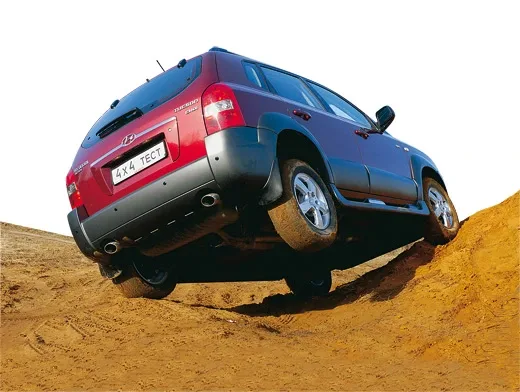
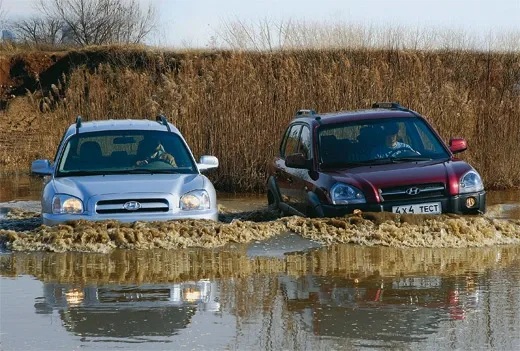
The Tucson gave up fairly quickly, falling with its wheels between two ice floes. At first, it seemed it should be the other way around: the Santa Fe Classic is 191 kg heavier, and with the same engines, such a difference off-road is serious. But the "Taganrog resident" confidently completed the entire route — both climbs, deep mud, and gullies with "pressure ridges."
Maybe it's the tires: the Tucson is on summer tires, and the Santa Fe is on all-season? No. The "Santa" behaved too confidently to blame everything on the tires. Most likely, it's the transmission. This version was confirmed at the dealership. It turned out that the rear axle ratio of the Santa Fe Classic is 3.8, while the Tucson's is 3.0. The final drive ratio in the gearbox is 4.3 and 4.0, respectively. It's clear that the traction characteristics are on the "Santa's" side. Therefore, despite the extra weight, it completely won the off-road part of our test.
DIESEL SAVED
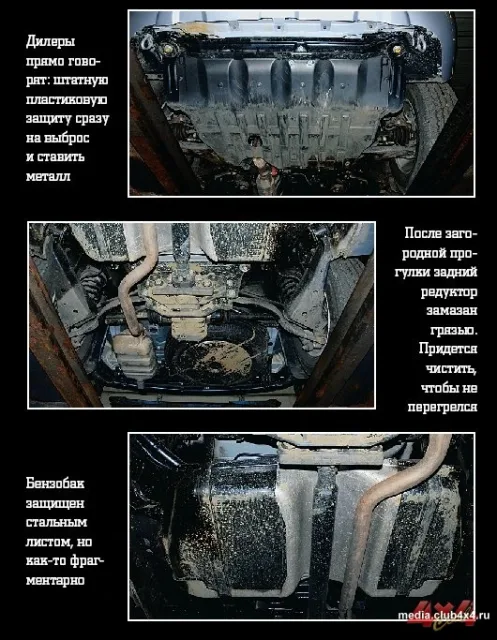
Usually, off-road, you feel sorry for crossovers, but the Santa Fe Classic never made us cry. It has neither a central differential lock nor an ESP off button (because there is simply no stability control system), yet it churns through mud excellently, once again confirming that the automatic transmission + diesel combination can turn any crossover into a serious off-roader. Plus, the ground clearance of 207 mm is a solid figure for a soft-roader. And don't forget the limited-slip differential at the rear and the viscous coupling that controls the center differential.
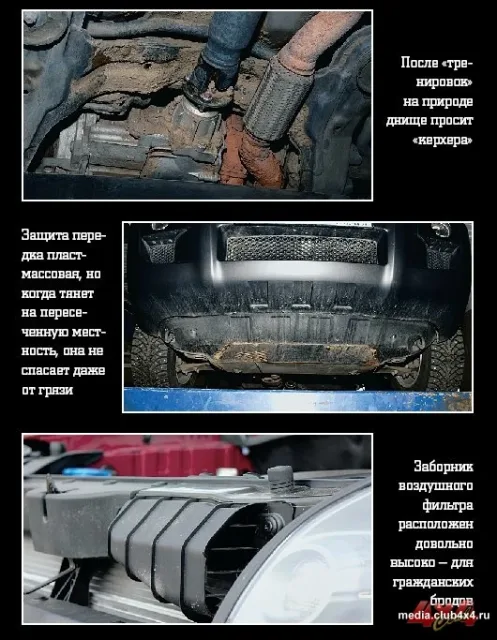
The Tucson's ground clearance is less — 195 mm, and it had to be pulled out of a gully, damaging the sills (who came up with them anyway?), but on the rest of the route it drove everywhere. Not as confidently as the rival, sometimes only with a run-up, but it reached the finish.
Of course, off-road is not its element, but you shouldn't write off the Tucson. It has a center lock and an ESP off function. You can improve off-road capability by installing AT tires, but then the viscous coupling will be at risk. Under heavy load, it will overheat and fail.
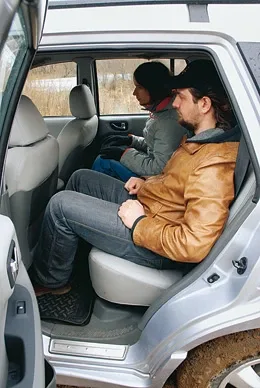
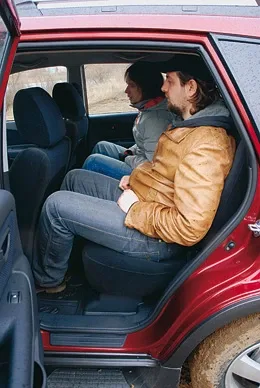
Many Santa Fe Classic owners say they chose this model because of the spacious interior. And indeed, there is enough room in the back — it's not just more than in the Tucson, it's truly a lot.
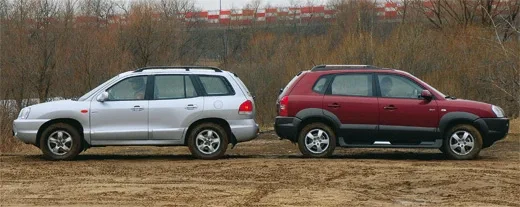 Despite its modest dimensions, the Tucson can boast a longer wheelbase than the Santa Fe. At the same time, the track width of both models is identical.
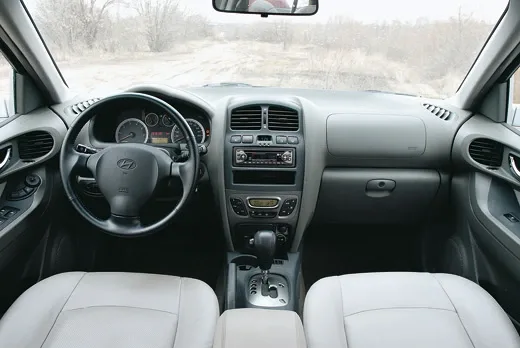
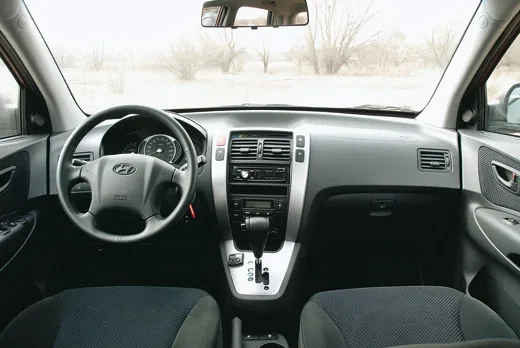
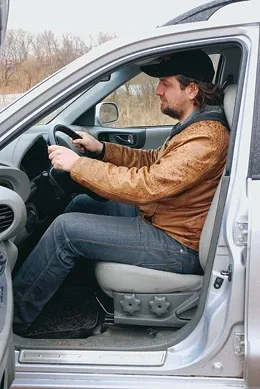
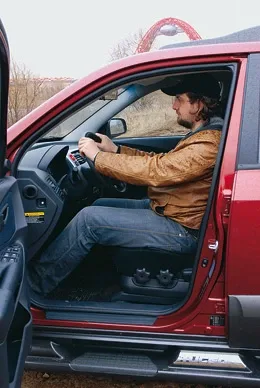
This result was achieved thanks to the longitudinal adjustment of the driver's seat: behind the wheel of the Santa Fe, a tall person constantly catches themselves wanting to move the seat back another ten centimeters. In the Tucson, however, the range of adjustments is noticeably wider. In fact, it's enough to just look at the photo on the next page — everything is clear there.
The bottom line is this: when capacity and off-road capability are a priority, it makes more sense to look at the classic Santa Fe. But the Tucson confidently holds the lead in asphalt disciplines — acceleration dynamics, course stability, and steering precision. As for off-road, here it loses more in the neatness of execution than in real capabilities.
Despite its modest dimensions, the Tucson can boast a longer wheelbase than the Santa Fe. At the same time, the track width of both models is identical.
This result was achieved thanks to the longitudinal adjustment of the driver's seat: behind the wheel of the Santa Fe, a tall person constantly catches themselves wanting to move the seat back another ten centimeters. In the Tucson, however, the range of adjustments is noticeably wider. In fact, it's enough to just look at the photo on the next page — everything is clear there.
The bottom line is this: when capacity and off-road capability are a priority, it makes more sense to look at the classic Santa Fe. But the Tucson confidently holds the lead in asphalt disciplines — acceleration dynamics, course stability, and steering precision. As for off-road, here it loses more in the neatness of execution than in real capabilities.
The Santa Fe has no traction control electronics, but thanks to the more "torquey" transmission, it overcomes obstacles under load. Plus, there is a limited-slip differential at the rear
The Tucson has traction control, although it operates on an algorithm that is not very suitable for off-road
The Santa Fe's automatic transmission can engage sport mode — for this, the lever is moved to "manual"
Judging by the final drive ratio, the Tucson's automatic transmission is more tuned for asphalt than the Santa Fe's. But it accelerates more briskly
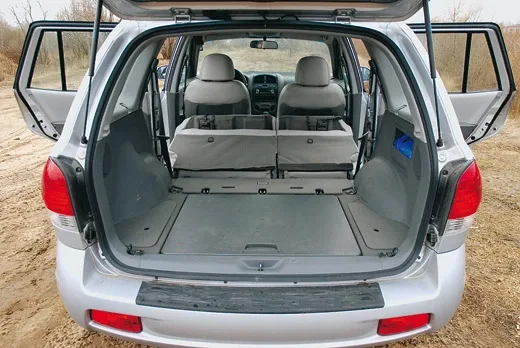
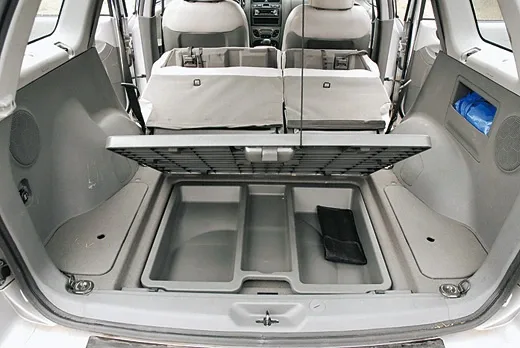
But the Santa Fe can only boast a larger trunk and an additional organizer
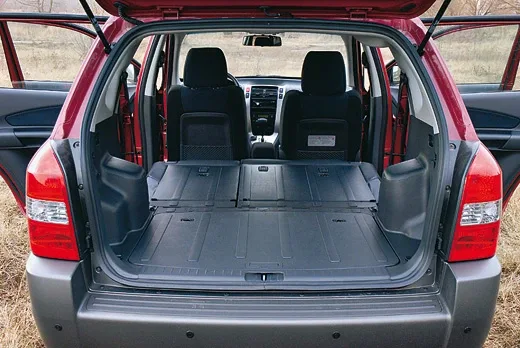
The Tucson's trunk is modest, but the seats fold into a flat floor
FELL THROUGH THE ICE
Asphalt races from traffic light to traffic light, maneuvering between lanes, and long overtakes in the left lane are much better for the Tucson driver. This crossover is lighter and more pleasant to drive on asphalt thanks to more composed suspensions and steering. The Santa Fe Classic reacts slower and less precisely than its younger brother. You need to get used to it a bit, but you understand the Tucson from the first minute.
Recently, I came across a comment on an internet forum roughly like this: "Explain how these cars differ. Just don't talk about handling, I'm sick of those words!" Okay. Especially for you, buddy, we'll take crossovers designed for smooth roads to the toughest off-road they can handle, and talk about off-road capability.
The Tucson gave up fairly quickly, falling with its wheels between two ice floes. At first, it seemed it should be the other way around: the Santa Fe Classic is 191 kg heavier, and with the same engines, such a difference off-road is serious. But the "Taganrog resident" confidently completed the entire route — both climbs, deep mud, and gullies with "pressure ridges."
The organizer in the trunk is an incredibly convenient thing. How many unnecessary items can you hide there!
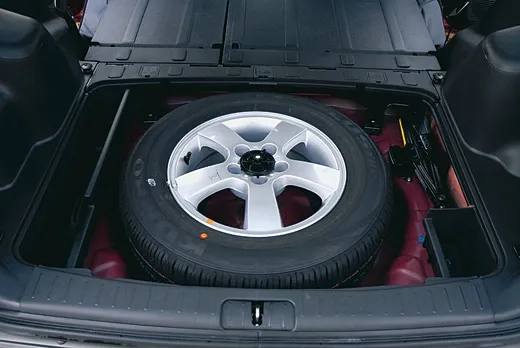
The spare tire in the Tucson lies in the trunk, while in the "Santa" it is suspended under the floor
Maybe it's the tires: the Tucson is on summer tires, and the Santa Fe is on all-season? No. The "Santa" behaved too confidently to blame everything on the tires. Most likely, it's the transmission. This version was confirmed at the dealership. It turned out that the rear axle ratio of the Santa Fe Classic is 3.8, while the Tucson's is 3.0. The final drive ratio in the gearbox is 4.3 and 4.0, respectively. It's clear that the traction characteristics are on the "Santa's" side. Therefore, despite the extra weight, it completely won the off-road part of our test.
SPECS: HYUNDAI SANTA FE
SPECS: HYUNDAI TUCSON
DIESEL SAVED
Usually, off-road, you feel sorry for crossovers, but the Santa Fe Classic never made us cry. It has neither a central differential lock nor an ESP off button (because there is simply no stability control system), yet it churns through mud excellently, once again confirming that the automatic transmission + diesel combination can turn any crossover into a serious off-roader. Plus, the ground clearance of 207 mm is a solid figure for a soft-roader. And don't forget the limited-slip differential at the rear and the viscous coupling that controls the center differential.
| For people taller than 175 cm, the adjustment range in the Santa Fe Classic may not be enough | Oddly enough, a tall driver is more comfortable in the small Tucson — there you can sit lower and further back |
| The rear seat in the Santa Fe is noticeably more spacious than in the competitor. As is the trunk… | In the Tucson, only passengers taller than 1.75 m will be uncomfortable; the rest will be quite comfortable |
Of course, off-road is not its element, but you shouldn't write off the Tucson. It has a center lock and an ESP off function. You can improve off-road capability by installing AT tires, but then the viscous coupling will be at risk. Under heavy load, it will overheat and fail.
Many Santa Fe Classic owners say they chose this model because of the spacious interior. And indeed, there is enough room in the back — it's not just more than in the Tucson, it's truly a lot.
• Bigger trunk, more space in the second row, higher ground clearance — these are the advantages of the old "Korean"