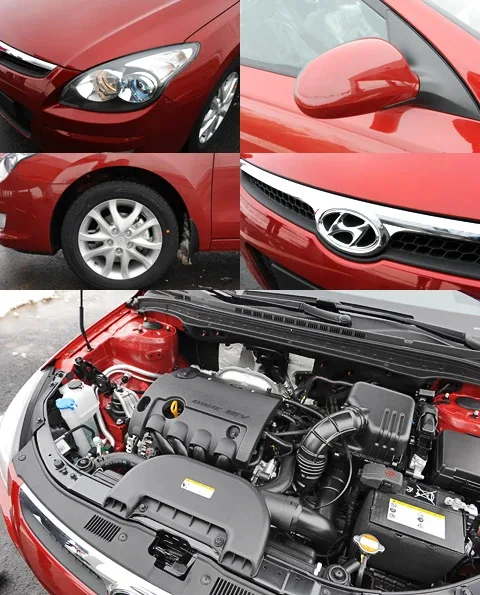
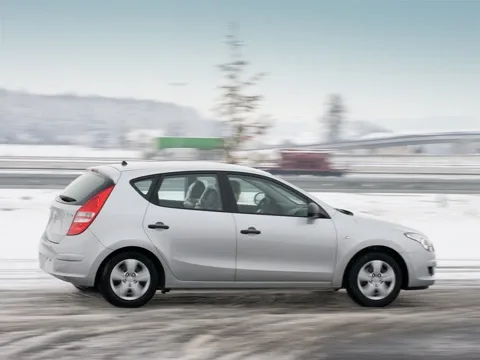
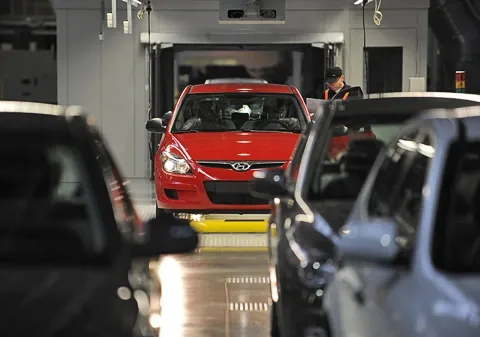
I was invited to the Czech city of Ostrava to get acquainted with the Hyundai i30, where a plant for producing this model was recently launched. In fact, cars are not just assembled here but manufactured from scratch: body panels are stamped, bodies are welded and painted. Even manual transmissions are made right here. However, automatic ones, which are not very popular in Europe (their share is less than 10%), are brought from Korea.
The range of versions is still modest: only the five-door hatchback is made at the Ostrava plant. The station wagon will appear by mid-year, but there are no plans for a three-door, convertible, or "hot" version in the near future.
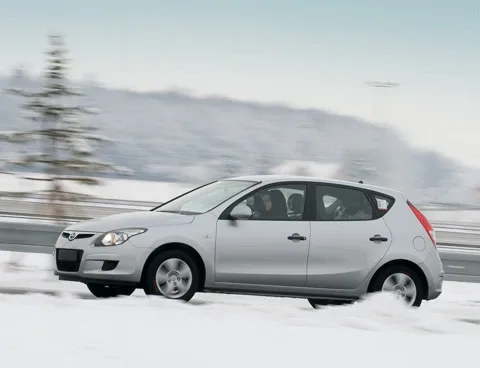
The choice of versions is not wide. For now, only the five-door is produced at the Ostrava plant; the station wagon will appear by mid-year. Neither a three-door hatchback nor a convertible based on the i30 is expected in the near future. And no "hot" version, by the way, either.
We were shown the facility. Nothing unusual — KIA has a similar plant in Slovakia, with the same investments, a billion euros each. The Korean giant, the largest car plant in the world, is, of course, much more extensive. For now, the workshops operate in one shift, employing about 1,800 people. Management plans to switch to three shifts by 2011 and hire another 1,400 workers. Then they will also start producing station wagons — they account for about a fifth of all "thirty" sales. The plan of 170,000 cars annually looks very bold: Koreans have never sold that many to Europeans. But they are determined!
Koreans have taken Europe seriously: the technical center in Rüsselsheim, where the Getz hatchback was born, is actively working. The i30 is also its creation.
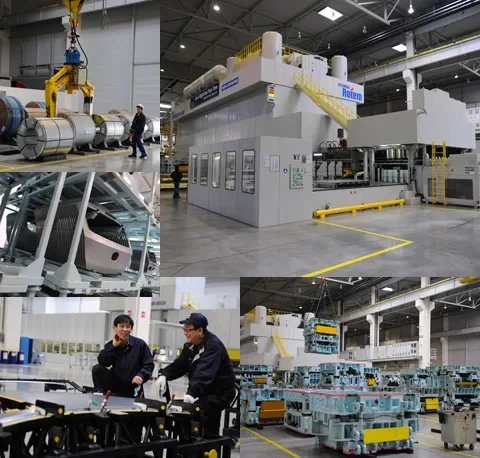
The heart of the stamping shop is a Rotem press with a capacity of about 470 parts per day. Several blanks are changed each shift. This takes about half an hour.
Since we're here, I asked the managers why they renamed the entire Hyundai lineup. What was wrong with names like Getz or Veracruz? The answer: "For consistency. It makes it easier for customers to understand the models. Everyone will know that i means Hyundai."
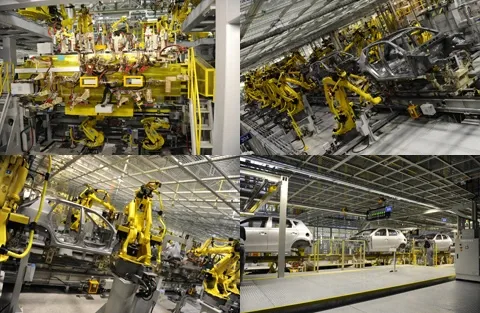
There are almost no people in the welding shop — 306 robots do the work instead.
Let me try to translate that into understandable language. How many Europeans know the difference between an Elantra and an Accent? Almost nobody! And ask what's better — Veracruz or Trajet, and you'll be looked at as someone interested in the difference between muons and pi mesons. At the same time, the Hyundai brand itself is well-known: Europeans buy more than 300,000 such cars annually. Now everything will be clear: the i20 is a smaller and cheaper model, the ix55 is larger and more expensive. The indices are well chosen: ix55 sounds almost like QX56, and i20 is subconsciously perceived as a golf-class hatchback with a two-liter engine. Cleverly done!
But the designers seem to have missed the mark: the i30 doesn't look expensive or stylish. However, inside, the car is quite pleasant. The plastic is interesting — its texture somewhat resembles fabric, like in the Peugeot 207. The mirror buttons are adorned with chrome rims, and the ceiling handles have a micro-lift (though not in the base version). The power window buttons with round finger recesses look amusing — such little details are pleasing.
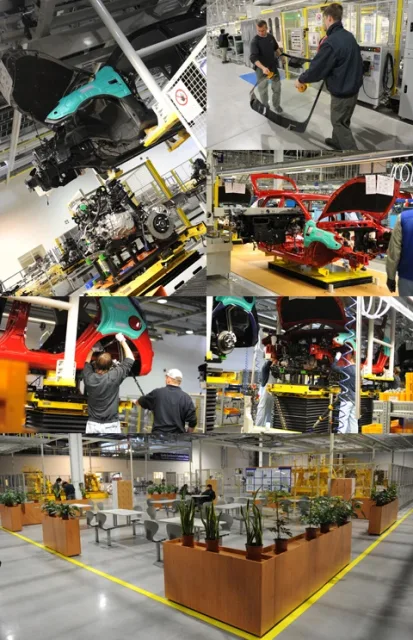
- The assembly area has the most manual labor, and there's essentially only one robot — it glues windshields into cars. Other operations, such as the "wedding" of the body and chassis or, for example, implanting the dashboard into the cabin (it arrives at the shop already assembled), are maximally automated, but workers still have to tighten a couple of bolts.
- Each of the plant's rooms has a small rest area: you can sit on a chair, have some tea, and relax to the roar of the conveyor.
The seating position is excellent. Dense, comfortable, and correct. The seats are good, and so is visibility. And in the back — it's just beautiful: there's a lot of space. But a fly in the ointment wasn't long in coming. The Volkswagen Golf was criticized for its poisonous purple backlighting, and the Koreans decided to do the same. Even more aggressively: besides the displays of the audio system and climate control, the information screen in the center of the instrument panel splashes non-contrasting acid into the driver's eyes. By the way, it's laid out in a very Volkswagen-like way.
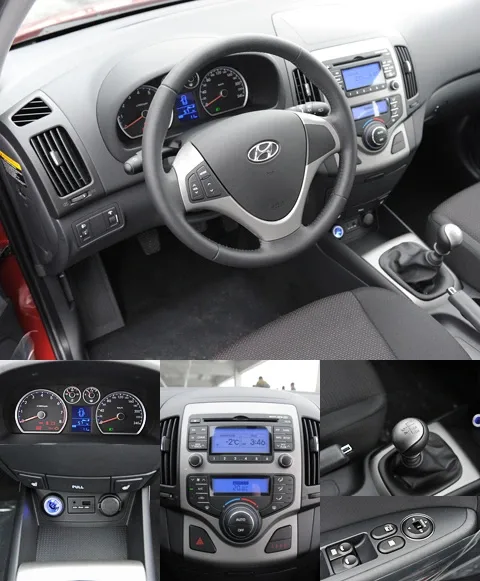
The interior leaves a pleasant impression primarily due to the seating position and ergonomics. But the trim is contrasting: good materials in one place combine with outright cheapness in another. And the climate control doesn't work perfectly.
The leather on the steering wheel is the eternal problem of Koreans. It used to be too slippery, now it's rough and "bumpy." And the gear shift lever is a separate topic. It's some kind of slippery stub, and not very precise either. Apart from these little things, you can't fault the interior. For its class, it's quite decent.
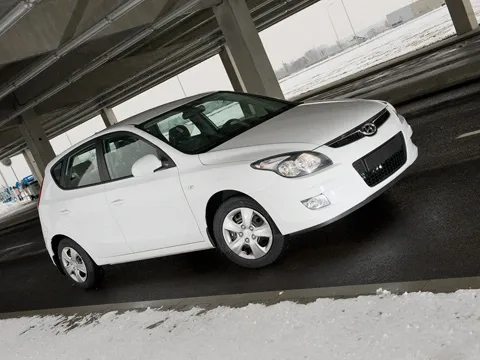
Hyundai's design is still unstable: after successful models like the Getz or the second-generation Santa Fe, something with too specific a "national spirit" may follow.
Having driven out of the plant gates, I realized the acquaintance would be short. Journalists were given only two cars for a few hours. Seizing the moment, I jump into the first one.
I start moving — and almost stall: the clutch pedal could be more informative. And the engine... Suffice it to say "gasoline, 1.4" — and you don't need to look at the power or acceleration to 100 km/h. For the i30, it's insufficient both on the highway and in the city. You try to drive fast... that is, "keep up with traffic"... and listen to its strained howl. Three hours of such driving — and it will haunt your nightmares.
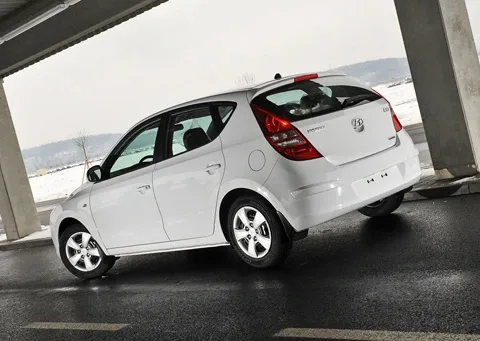
The rear of the i30 looks intricate, but the design lacks something. It's known what. Individuality.
Sound insulation is also a problem. The engine is annoying because it constantly has to be revved, and with the wheel arches, it's simpler: they simply forgot to put sound-insulating material there.
But driving is a joy. The steering wheel is filled with a pleasant, if not the most honest, effort, reactions are calm and precise, and body roll is within normal limits. Only the ride smoothness surprises. The suspension reacts too sharply to small irregularities, although it doesn't get hysterical on larger bumps. At speed, the steering wheel gains weight, and the i30 drives easily and confidently in a straight line. True, it accelerates with the intensity of a beach catamaran.
But somewhere, a feeling of a more expensive car emerges. Despite the engine and sound insulation! I drove one 30-kilometer loop, a second, a third... stop, time's up.
After the ride in the i30, I recalled a recent conversation with an engineer from a European company. We were chatting about the Japanese. "Yes," he said, "they are dangerous competitors. First, they produced very inexpensive cars and thus managed to enter all markets. Then they switched to quality and built a proper initial image. And now they've taken up innovation. Look: modern engines, hybrids, clever electronics... Soon, living with them will be a problem."
The first stage — the stage of cheap cars — Koreans have already passed. The i30 is not cheap. The second — quality — also: the i30 is excellently assembled, surely reliable, modern, and safe. Apparently, the posters hung around the Ostrava plant saying "No defects!" work. They have a little left: they already have a rear-wheel-drive Genesis with a V8 (and Honda has halted development of such a car), and they are preparing their own advanced transmissions...
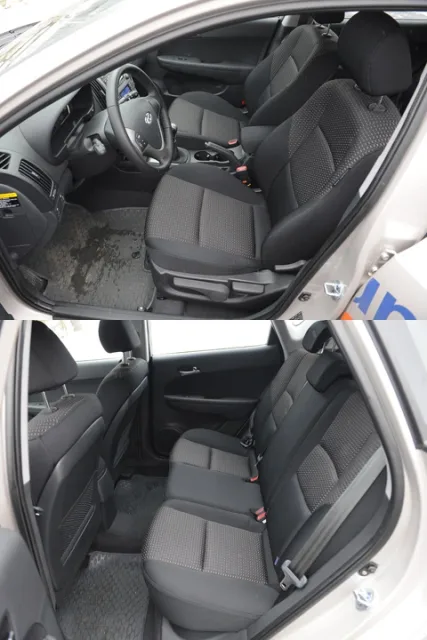
- The front seats are moderately firm and quite comfortable. Interestingly, the backrest angle is adjusted differently on different versions: either European-style, by turning a "knob," or Asian-style, with a lever-lock.
- There's plenty of room in the back! But in the base trim, passengers are deprived even of a central armrest.
But that's the future. For now, Koreans have enough only for a button with the mysterious name Dark, which simply turns off the audio system display, and for borrowing the Blue index for eco-versions. But I don't want to speak badly of the car. Especially since the masochistic 1.4 engine is only the base one (by the way, diesels will appear soon), and the sound insulation... should I hum how stones drum on the arches of a Mazda 3?
So, it's a normal car. And by no means in a bad sense. You don't need to get used to it, but you get on a plane... and on the way home, almost all impressions evaporate. Boring? But convenient. One question remains — why overpay compared to the Ceed, which is more attractive and drives no worse? And I think, looking at sales figures, Hyundai marketers will bite their elbows more than once.
Eight years ago, I had the chance to get acquainted with the first generation of the Hyundai i30 when it first hit the market. Since then, I've driven this car for many kilometers — from Moscow to Paris, on highways and through city traffic. The current i30 is already the second generation, and it has changed noticeably. The car has become 80 mm longer, 35 mm wider, and 10 mm lower. The wheelbase has grown by 50 mm. But the main thing is a completely different level of finish and materials.
On the outside, the i30 looks fresh and dynamic. The designers managed to find a balance between European restraint and Korean expressiveness. The car is recognizable on the road, but it doesn't look flashy. Sharp-edged headlights, sculpted sides, a compact rear overhang — all this creates the image of a fit and ready-to-go hatchback.
Inside — a pleasant surprise. The cockpit is logically designed, all buttons are in their places, and you quickly get used to them. The trim materials are solid, and the assembly is neat. The front seats have pronounced lateral support and are moderately firm. In the back row, there's plenty of space: enough legroom, and the roof doesn't press down. The trunk is 340 liters, and with the rear seats folded down, it's 1250. That's a good figure for the class.
On the road, the i30 feels composed. The suspension is firm but not harsh. On minor bumps, the body doesn't shake, and large joints and potholes are handled without excessive vibration. The power steering is well-tuned: light in parking lots, more informative at speed. But you shouldn't expect driving thrills: the car honestly does its job but doesn't provoke active driving. On the highway, though, it's stable, and directional stability is good.
Under the hood are gasoline engines with displacements of 1.4 and 1.6 liters. The base unit produces 109 horsepower and 137 Nm of torque. With it, the i30 accelerates to 100 km/h in 11.7 seconds, and the top speed is 187 km/h. In the city, such an engine is sufficient, but on the highway during overtaking, you have to shift gears more often. The official fuel consumption is 7.6 liters in the urban cycle and 5.2 on the highway. In practice, the figures are close to the claimed ones.
The more powerful 1.6-liter engine develops 122 horsepower and 154 Nm. It's noticeably livelier: acceleration to 100 km/h takes 11 seconds, and the top speed is 192 km/h. With a manual gearbox, the unit works perfectly in tandem — gears engage clearly, and the throws are short. Fuel consumption in the city is 8 liters, and on the highway, it's 5.2. For those who prefer an automatic transmission, a four-speed automatic is available, but it increases city consumption to 9 liters and acceleration time to 12.1 seconds. However, for calm driving, its capabilities are quite sufficient.
The brakes are disc brakes all around, with ABS and an electronic brake-force distribution system. Braking efficiency is good, and the pedal is informative. In expensive trim levels, a dynamic stability control system is installed, which provides support in corners and during sharp maneuvers.
The safety of the i30 is confirmed by Euro NCAP crash tests. In the first test, the car earned four stars for front passenger protection, but later, after refinements, the result improved to five stars. Child protection was also improved: 38 points versus the previous 34. Pedestrian safety is at an average level: 14 points out of the possible.
Prices for the i30 in Russia start at 530,900 rubles for the base Classic trim with the 1.4 engine and manual transmission. The Comfort version with the same engine costs 605,900 rubles, and with the 1.6-liter unit, it's 638,900. The top Style trim with the 1.6 engine and manual transmission will cost 680,900 rubles, and with the automatic, 715,900. For this money, the buyer gets a well-equipped car with modern electronics, heated seats, climate control, and an audio system with steering wheel controls.
The second-generation i30 is a serious bid for leadership in its class. It's not perfect, but its strengths — build quality, spacious interior, adequate engines, and a reasonable price — outweigh the lack of bright charisma. It's a car for those who seek practicality without unnecessary compromises.
By the way, about quality. After visiting the factory canteen in the Czech Republic, where the i30 is assembled, a colleague joked: "I know where the Koreans get such quality: they feed those who slack off here!" And indeed, even in the Czech Republic, workers are fed Korean food — specific and insanely spicy. The dragon in my stomach raged until the evening. True, as I was later explained, that canteen wasn't for everyone, but only for Koreans working at the plant. And there are quite a few of them there.