
Hyundai i20. The Sly One

We have been hearing from the Koreans for the last two years that the Hyundai Getz will be "retired" in the very near future — ever since the new i20 hatchback appeared in the company's lineup. But, as it turned out, we were in a hurry to part with the "old-timer." Maybe the crisis adjusted the Koreans' plans, or maybe they were inspired by the "farewell" performance of the Getz, when it once again dragged the entire imported model range of the company to the top of the final table. Be that as it may, we will be seeing the "veteran" in dealer showrooms for at least another year, and if the Koreans reach an agreement with TagAZ (which is quite possible), then for another five or six years. However, let's leave the discussion of this issue for our future materials and take a closer look at the Getz's successor — the compact hatchback i20, which has been trying its best to win the hearts of Russians for several months now.
It must be said that even if it doesn't repeat the success of its predecessor, the new car is quite capable of at least finding its own loyal circle of admirers. Take its appearance, for example. The Ford Fiesta and Mazda2 certainly look more interesting, but overall, the i20 can wipe the nose of most competitors. The car's appearance was designed at the company's design center in Russelsheim, where, by the way, the Getz was also created back in the day. In general, the car looks quite European, and this applies both to the details and the body as a whole. The shape of the headlights clearly "shows" one of the most popular cars in the segment — the Opel Corsa; the compact borrowed the front-end concept from the i30 and KIA Cee'd in a related manner; and from the side, it somewhat resembles the current generation of the Chevrolet Aveo hatchback. But at the rear, everything is more or less original, although similar-shaped lights were used in the exterior of the second-generation Nissan Murano, but that, as you remember, appeared about a year and a half ago, that is, around the same time as the Hyundai. However, all these borrowings do not spoil the car at all, especially since they can't really be called borrowings — there is too little "room for maneuver" left for designers in the compact classes.
As for the technical content, everything here is less subjective. The car is built on the same platform as the KIA Soul (or rather, it was the minivan that borrowed it from the compact). It will apparently also remain the foundation for other small models of the Korean concern. It is already known, for example, that the same "cart" formed the basis of the next-generation KIA Rio.
By the way, if you thought that the i20 resembles the Soul, you are greatly mistaken: in form and content, it is a logical continuation of the Hyundai Getz. True, the new model is 115 mm longer than its predecessor and 45 mm wider. The body height remained at the same level — 1490 mm, while the wheelbase and ground clearance grew by 70 and 10 mm, respectively. Agree, a good foundation. However, the main increase in dimensions went to enlarge the safety zones, so the interior ultimately got only a small part of it.
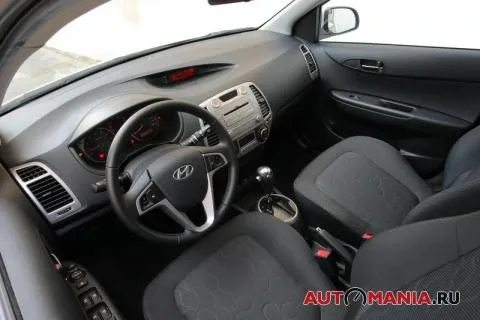
At least, if we are talking about length. On the other hand, Getz owners didn't complain about cramped conditions either. But in this case, the Koreans offer customers not only increased passenger space (that same 45-millimeter difference in width) but also a more car-like seating position. In the Getz, the driver sat almost vertically, as you remember. Combined with a steering wheel that adjusted only up and down, this interior feature caused quite a lot of trouble for very short and very tall people, and the excellent visibility, alas, could not compensate for this drawback. Now everything is different. The driver and front passenger, as we already said, sit in the i20 in a car-like manner, that is, like in a good home armchair. The second point regarding seating: there is no longer any need to forcibly set the backrest to a vertical position — the hatchback's steering wheel adjusts in both planes. As a result, the front seat occupants have more space both in front of their knees and above their heads.
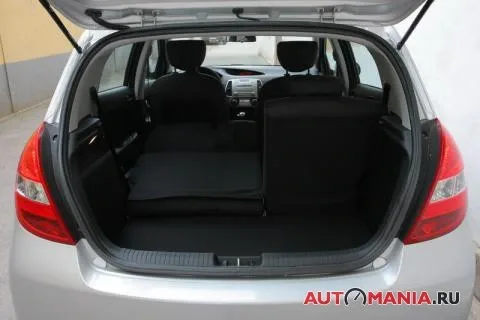
But there is not much to please the second-row passengers. The car's height remained the same, the width increased insignificantly, so there was no room for a third passenger here, and there still isn't. The legroom also remained unchanged. It is, as before, minimal. In general, rear passengers will feel relatively at ease only if people no taller than 170 cm are in the front row.
But the Koreans seriously worked on ergonomics and personal comfort itself. We already mentioned the steering column adjustments, but this is not the only innovation: one of the most important characteristics of the i20's interior is dynamic comfort. The Getz's seats did not offer particularly developed lateral support, which was generally typical for "Koreans" of the early century. The profile seemed to have been slightly changed during the restyling, but in reality, it didn't help much. The seats in the new model look the same at first glance, but in reality, they not only hold the mortal bodies of passengers better but also have a more friendly profile.

Some things, however, remained unchanged. Thus, the cushions will seem too short for tall people. Another point is adjustments. In the base trim, Classic, there is no option to change the seat height. It appears only starting with the more "advanced" Comfort version.
Unfortunately, the presence of air conditioning, electronic safety systems, "extra" airbags, and even a full-size spare wheel still depends on the chosen trim level (of which four are offered)… But the starting price of the i20 is set at 399,900 rubles, which cannot but please. In this situation, the Getz's price tag is puzzling: for the base "five-door," dealers today ask only slightly less — 387,900 rubles…
But let's return to the successor. In addition to quite good spaciousness by class standards, the i20's interior can also boast a very attractive design. The stylists managed, as they say, to "catch the wave": in the architecture of the front panel, they used the now-fashionable two-story layout, similar to the one that appeared a little later on the new Mazda3. However, unlike the "Japanese," only one monochrome monitor is hidden in the upper window here, responsible for the working indicators and the radio. But overall, the Hyundai's interior looks fresh and quite presentable, at least no worse than that of the same Corsa and Fiesta…
But in the choice of power units, Hyundai yields to both Opel and Ford. The "American," for example, offers four engines, and the "German" even five. Moreover, the lineups of both manufacturers include turbodiesels. The "Korean" has only three engines: the base 1.2 (78 hp), the "optimal" 1.4 (101 hp), and the "fast" 1.6 (126 hp). By the way, we would not categorically advise against buying a car with the initial engine. Firstly, it is a quite technologically advanced motor, as follows from the stated power (it won't give the hatchback sporty dynamics, of course, but it will provide an acceptable pace of movement). And secondly, it has very moderate fuel consumption, and the transport tax will also have to be paid minimal.
The car with the 101-horsepower engine, of course, drives better: sensible acceleration, good throttle response… True, all this applies exclusively to the "manual" modifications. The "automatic" frankly spoils this engine. Judge for yourself: the 1.6-liter i20 with an automatic transmission reaches "a hundred" in the same time as its "base" sibling. Although, it's clear that in this case, the Koreans thought primarily about economy.
The top engine, of course, is sportier than all, and these are not empty words. With a manual transmission, it exchanges the second hundred in less than 10 seconds, which is quite serious for a B-class car. By the way, this engine can already be safely ordered with an "automatic." It's clear that the car will lose in swiftness, but in any case, it won't be a shame to press the gas.
But the i20's chassis turned out to be not so unambiguous. It is tuned completely in a European manner. The suspensions are tightened to the limit, so body rolls are small, but ride smoothness is far from ideal. On the other hand, this allowed the Koreans to achieve good stability; at least, the chassis copes with standard situations without problems. It is quite difficult to knock it off balance, even despite the excessive sharpness of the steering wheel and the traditional lack of feedback. Yes, it's easy to over-twist the "wheel" out of habit here, but with at least minimal skills, you can handle the car without difficulty. But the brakes turned out to be quite adequate.
In general, the new model did not disappoint, so we can safely say that the i20 will not yield to its competitors. Moreover, its very affordable price, already at the initial stage, will cut off many of them. The question is how long the Koreans will be able to keep it at such a level.
Technical specifications
| Length, mm | 3940 | |||
| Width, mm | 1710 | |||
| Height, mm | 1490 | |||
| Wheelbase, mm | 2525 | |||
| Ground clearance (mm) | 150 | |||
| Curb weight, kg | 960 | |||
| Trunk volume (l) | 295 | |||
| Engine displacement, cm³ | 1248 | |||
| Max. Power, hp | 78 at 6000 rpm | |||
| Max. torque, Nm | 119 at 4000 rpm | |||
| Max. Speed, km/h | 170 | |||
| Acceleration time (0-100 km/h) s | 12.9 | |||
| Average consumption (l) | 5.2 | |||
| Price, RUB | from 399,900 | |||
Source – AUTOMANIA.RU