
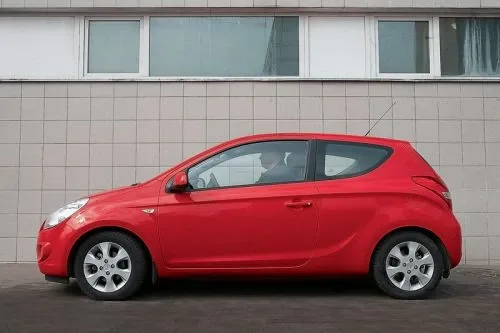
At first glance at the price list, it was a bit disappointing that almost all versions of the i20 do not have electronic stability control. Also, the precision of the gear lever leaves much to be desired: finding neutral right away is not always possible. Among other minor issues, it is noticeable that the front seat folding mechanism does not remember settings: the same levers are responsible for both adjustment and access to the second row. But, having listed the design flaws, one cannot fail to mention the undoubted advantages in everyday use.
The exterior and interior design of the i20 are among the most attractive and modern in its segment. Visibility, even in the three-door version, deserves only praise — a rarity for a compact city coupe. The electronics also please: automatic headlight shut-off when arming the alarm, a USB port that not all competitors have, and automatic door locking if you accidentally touch the key fob. And the glove box is simply huge — it resembles a cave in size: it can fit not only gloves but also hockey mitts.
Driving
In terms of the density of sensations behind the wheel, the i20 is one of the most composed cars in the B-class. The 1.6-liter engine gives it excellent dynamics.
Interior
One of the most harmonious and modern in its class.
Price
Positioned between the most affordable and mid-range segments of the B-class.
Advantages and disadvantages
- Pros: torquey engine, confident handling, affordable price.
- Cons: weak seat belt pretensioners.
Specifications
Make and model — Hyundai i20 1.6 3dr
Dimensions — 3940x1710x1490 mm
Engine — petrol, 1591 cm³, 126 hp/6300 rpm
Transmission — manual, 5-speed
Performance — 190 km/h; 9.5 s to 100 km/h
Competitors — Chevrolet Aveo, Fiat Grande Punto, Opel Corsa