
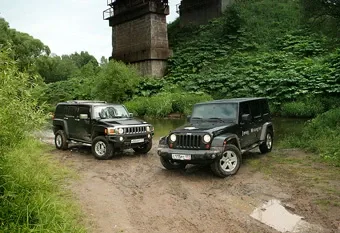
Looking for a prairie, found a swamp
These two have drained all our blood — both the Wrangler and the Hummer. So no "standard" test in the spirit of "first design, then handling, then off-road capability" will work. Only emotions. And there will be many of them.
The idea for this comparison was born at a Moscow region presentation of the Wranglers. It seemed then that people had started to forget about this incredibly charismatic and, without a doubt, very capable off-roader. We wanted to remind them. Especially since the Wrangler has changed a lot recently. On the outside, it's still the same "Jeep," and the transmission is also the same — a rigidly connectable front axle and a four-speed automatic. But inside, everything is different: the cabin has become noticeably more spacious than in previous generations. And most importantly, a four-door Unlimited version with a longer wheelbase and a removable roof has appeared.
Thinking about the Wrangler, we immediately thought: there is another equally charismatic American SUV of similar size on the market, in the same price category, and with equally excellent off-road capability, as is commonly believed. We're talking about the more familiar-looking but no less interesting Hummer H3.
Asphalt
It seemed that driving the Wrangler around Moscow would be sheer torment. But no. Visibility is quite decent, the steering wheel is light, and the dimensions are not intimidating at all. Plus, a torquey engine and a smooth four-speed automatic — on this rugged off-roader, you can carefully maneuver in tight city courtyards and move calmly in heavy traffic without risking hitting your neighbors.
| Hummer and Wrangler - photo gallery |
We expected the same "tractor-like" emotions from the Hummer. And we were wrong. Against the background of the Wrangler, the Hummer H3 is almost a comfortable passenger car, and even of a premium nature. Inside, there's decent plastic with aluminum inserts, soft leather seats, seating and steering wheel like a car, excellent sound insulation. And most importantly, it doesn't shake at all on the move. Another pleasant surprise is the sensitive and short-travel brake pedal. The brutal-looking Hummer turned out to be unusually friendly. Very!
Outside the city, at high speeds, the differences are felt just as much. The extended Wrangler drives quite tolerably on the highway. Unlike the short three-door, it confidently holds a straight line, doesn't "buck" on bumps, ignores ruts, and isn't particularly noisy up to 100–120 km/h. You can go faster, but then the roof starts to rumble, and wind whistles through the panel gaps.
The Hummer is still better. Even at high speed, it remains soft and quiet. The steering is more informative, and the brakes are excellent. However, don't forget: with such ground clearance and a high center of gravity, a sports car won't work out. You need to enter corners carefully, without tire squeal. Otherwise, it won't just slide — it will roll over! And on a straight line, you shouldn't get carried away with speed either: at 160 km/h, a limiter kicks in roughly, sharply cutting off fuel supply. The electronics wait until the speed drops to 155, and only then allow acceleration again. If you encounter this limiter during an overtake, the encounter will be not just unpleasant but dangerous.
Off-road No. 1
We left the asphalt — and the adventures began. First, on a muddy forest road, the Wrangler surprised us. It turned out that even in low range with the front axle engaged, it periodically shows rear-wheel-drive tendencies. What does that mean? Suddenly, the rear wheels try to overtake the front ones, and the car tries to go sideways. Right in the forest, among the trees.
| Hummer and Wrangler - photo gallery |
Driving the Hummer off-road is much easier: it has a different all-wheel-drive system — with a permanently connected front axle via a differential. In any mode — high or low range, with or without lockers, on sand or in mud — the H3 behaves extremely predictably. Even for someone who has never gone off-road before.
At first, we feared that the soft and complex suspension of the Hummer H3 could be easily bottomed out on a serious pothole. Nothing of the sort — it doesn't bottom out! The secret, it seems, is that it's not leaf-spring or coil-spring, but torsion-bar. The design is almost like on an infantry fighting vehicle, just tuned more delicately.
But that doesn't mean the Hummer H3 has no weak points off-road. There is one huge problem — it gets dirty instantly. You can slowly drive through a small, shallow puddle — and the Hummer is already covered in mud: side windows are splattered, clay slurry drips from the chrome rocker panels and rear wheel arches. You look at that tiny puddle and sincerely wonder: where did it get SO much dirt?
On the first day of "light off-roading," we had to wash the Hummer three times. And it never arrived at the shooting location clean. It managed to get dirty even on sterile asphalt with the most careful driving. Fantastic! Meanwhile, the Wrangler in the same conditions kept a decent appearance: side windows remained transparent, and the rocker panels and door handles were clean, so no one got dirty when getting in.
Off-road No. 2
We decided that the Wrangler's off-road capability should be "a little better" than the Hummer H3's. And we spent the whole next day looking for a place where one would pass and the other wouldn't. We struggled, but never found it.
The Wrangler got stuck in the same place for the same reason. Only we drove the Hummer into the mud on purpose, while we ended up there in the Jeep by accident. It again "wagged its tail" and went off course. At first, it seemed it would get out: the Wrangler was vigorously rocking and advanced about half a meter. But in doing so, it piled up a clay wall in front of the wheels and eventually got stuck. We could have taken a shovel, spread the clay, and driven out on our own, but we decided not to get dirty and easily pulled the Jeep out with the Hummer.
Overall, both SUVs behave very decently in "mud baths." The Wrangler's peculiarity is that it doesn't like to drive through such sections with momentum: if you fly into a puddle at speed, the front wheels seem to sink into the ground, and the car doesn't obey the steering well. But the Jeep is excellent at overcoming obstacles in a tight pull at low speed, almost without spinning.
| Hummer and Wrangler - photo gallery |
But how the "H-three" gets dirty! You can't grab the door handles, you slip off the clay-covered rocker panels, and you can't see anything through the side windows and mirrors. Not to mention the windows — even the sunroof becomes opaque brown.
Off-road No. 3
After the mud adventures, we headed to the car wash. Surprisingly, we dealt with the Hummer, which had no clean spot left, faster. But the clean-looking Wrangler, on the contrary, exhausted everyone. Its wheel arches turned out to have so many hidden corners where dirt accumulates that it took twice as long. After the wash, to our own misfortune, we decided to remove the hardtop and put on the canvas. For some reason, we thought it would take about fifteen minutes and two people could easily handle it. It turned out, it's not that simple. During this procedure, we cursed the Wrangler and its creators. Details are in the video clip.
However, we never made it to the ford itself: the Hummer suddenly had both the alternator and the air conditioning fail. And the Wrangler started stalling unexpectedly. When we opened the hoods again, we were simply horrified — we didn't expect to see so much dirt. Fortunately, the Jeep "came back to life" as suddenly as it fell ill, but the H3 couldn't make it to the wash on its own — the battery was almost dead, and the engine stalled a kilometer before the destination. We had to tow the poor thing. And honestly, it was quite an adventure: driving the Hummer with a failed power steering is quite a pleasure.
After washing the engine bay and "jump-starting" the H3, it was as good as new — everything worked. Just in case, we decided to flush the under-hood area of the Wrangler too.
Finally we reached the river and started crossing the ford. As it turned out, half a meter of depth and a sandy-silty bottom are mere trifles for both SUVs. They calmly darted back and forth along the riverbed, stopped and started again without any problems. The only thing that amused us was that the Hummer, even at low speed, with its flat front end raises such a wave that the river overflows its banks by a meter and a half.
Off-road #4
The final exercise was a simulation of rock climbing: on hilly terrain we tested the geometric cross-country capability and behavior of the vehicles during diagonal articulation. And here's a surprise: we never managed to 'hang' either of the vehicles. Even the steepest hills they stormed without a single scrape of the underbody — whether straight or diagonal. Boring, honestly!
Separately, it was pleasing how accurately and conveniently both vehicles manage traction. Want to move five centimeters — please, a light press on the gas, and without a single jerk, very smoothly, the vehicle moves exactly as much as needed.
Moreover, both the Hummer and the Jeep turned out to have ideal dimensions for off-road. On one hand, they are wide and tall enough to feel confident and stable. On the other, they are not so huge as to get stuck in forest corridors where the space between trees is too narrow and branches hang too low.
Epilogue
So which is better? They are equally good! The Hummer is more comfortable and convenient in everyday life, the Wrangler is more brutal, and also has a removable roof, and is not yet so familiar on the roads.
And remember: communicating with a serious SUV will sooner or later inevitably lead to adventures. And they will not always be pleasant.