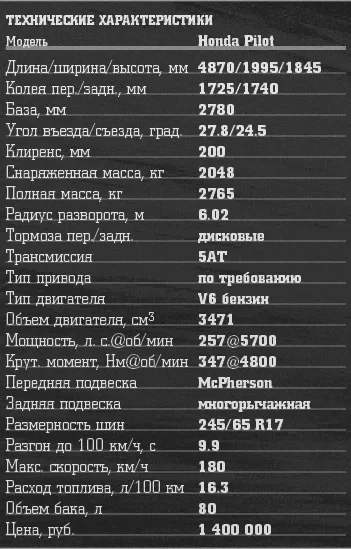
"Find me a straight stretch long enough to get over one hundred and forty!" — that was my mental plea to the Karelian forests as I wound along their twisting roads, seemingly designed to test all-wheel-drive machines. Here, smooth asphalt suddenly gives way to gravel with stones, and after the next turn, a perfectly smooth straight section unexpectedly appears, where the Honda Pilot can be pushed to its limit. Up to 150–160 km/h, the car drives steadily and confidently; beyond that, speed builds very slowly, until I struggled to reach 170–180 km/h. My personal record in this test was 185 km/h.
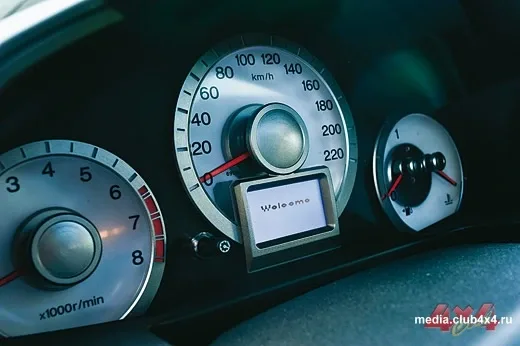
I never made it to the maximum 220 km/h indicated on the speedometer. It would have taken far too long to wait for the needle to crawl to the stop. Besides, my passenger — an instructor placed in the car by the Honda test organizers — fidgeted so nervously in his seat during every acceleration that he nearly wore through the leather upholstery.
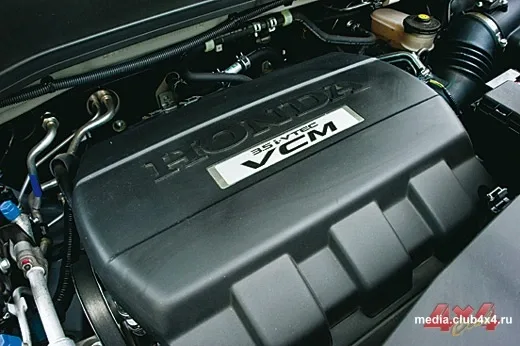
WORKING ON THREE CYLINDERS
To be honest, no road of ours requires such speed, and personally, I don't need it either. But it's just interesting to check how quickly the Pilot can reach that coveted number. I can assure you — not quickly at all. The engine here is tuned more for economy than for racing. Its main task is to deliver a family of eight to the nearest lake. It can deactivate some cylinders and run on four or even three. The manufacturer claims fuel consumption of 11.8 liters in the combined cycle, but during our trip, the minimum figure was 13.5 liters. But you've probably already guessed what mode we were driving in. Meanwhile, some colleagues who weren't shy managed to get at least 16 liters. Such is the appetite of the gasoline V6 with a 60-degree bank angle, 3.5 liters of displacement, and 257 hp.
EXCELLENT ON STRAIGHTS
The good asphalt ended as suddenly as it had appeared, and the car immediately announced it with a thud of the front control arms against the bump stops. Independent suspension all around, unibody construction, and the absence of a low-range gearbox unequivocally classify the Honda Pilot as a crossover, or, as detractors call them, a "parketnik." But with one important caveat: the Pilot handles broken roads quite decently. It only dislikes deep potholes with sharp edges. On roads with moderate damage, the Pilot rides comfortably, provided, of course, you enjoy the constant longitudinal rocking of the body on waves typical of Russian highways, plus nose dives during braking and acceleration.
After 20–30 kilometers of such shaking, you start to feel anger toward the Americans, for whom this car was primarily created. These harmless people apparently see no difference between comfort and looseness. Or maybe they sincerely believe that the driver of such a large car has no need for sharp maneuvers at all? That is, if I have, say, five children, then I no longer have the right to enter a controlled drift? Overall, the approach is reasonable; there are other cars for driving excitement. Well, I'll have to say goodbye to youthful ambitions and enjoy the directional stability — and it's really quite good here. On a straight line, the Pilot goes just wonderfully.
SIX WILL FIT
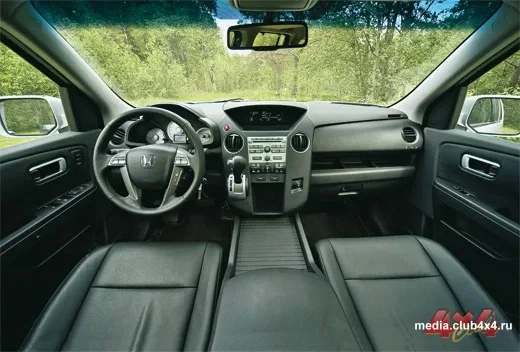
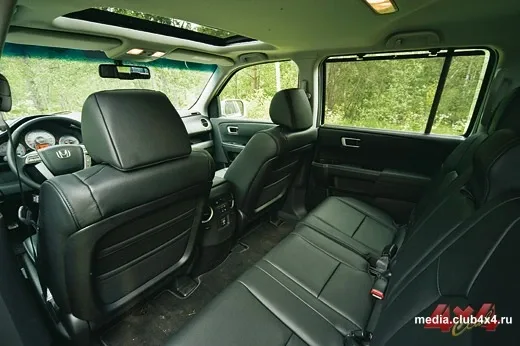
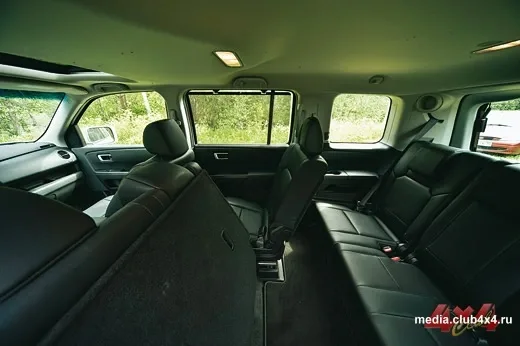
Two wives and five children (just kidding, of course) will find plenty to do on a long journey. And if the heirs calm down a bit and stop fighting, you'll be able to appreciate just how quiet the Honda Pilot's cabin is. A serious noise-combat package is applied here, so much so that it even gets a bit eerie. In the Executive trim, the Pilot boasts an acoustic windshield. An electronic active engine mount control system is installed to dampen vibrations. And, of course, Active Noise Cancellation works in full glory, generating sound in the cabin opposite in phase to the noise, reducing noise levels by up to 10 dB.
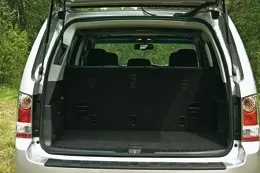
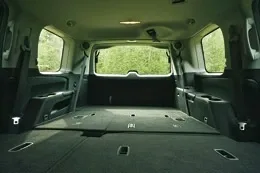
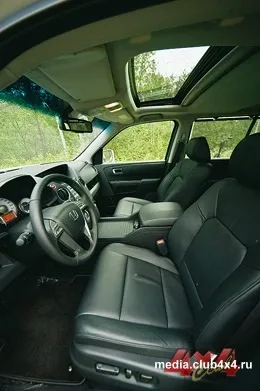
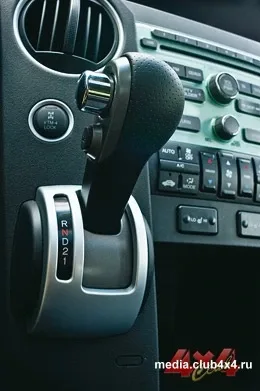
Inside, it's spacious and cozy. The second row is specially made movable. The third row is not cramped. The manufacturer particularly emphasizes that the car seats eight. So, six adults will easily fit inside, and that's a pretty good indicator. The trim pleasantly surprises too: plastics of different textures look nice and feel pleasant to the touch, though they are all hard. The instruments simply delighted me — I haven't seen such a perfectly readable speedometer in a long time. It's simple, clear, huge, and positioned right in the center.
GODZILLA FOR GAIJIN
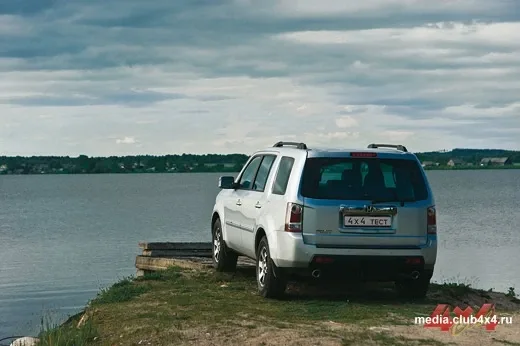
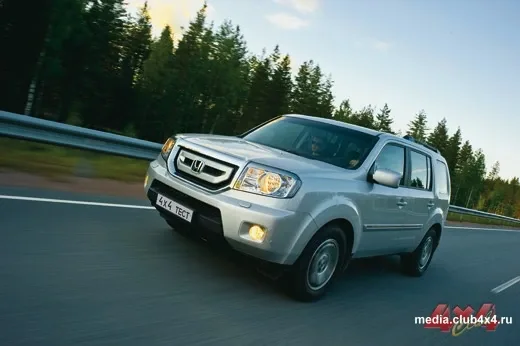
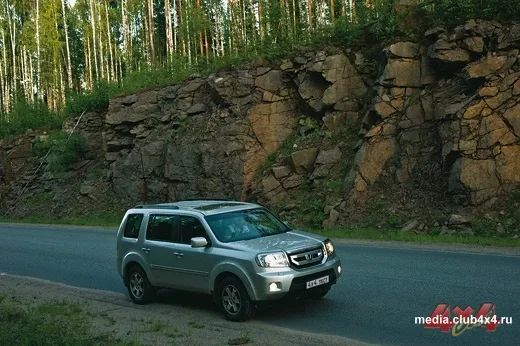
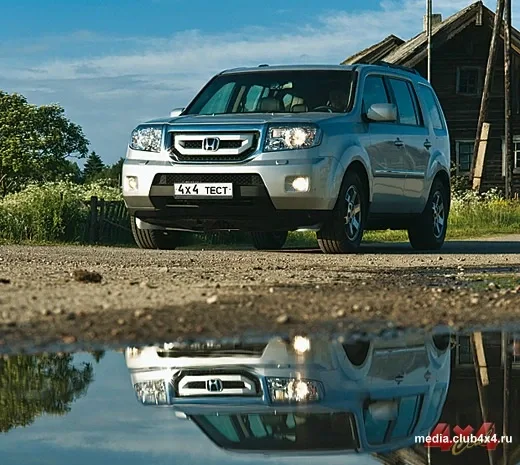
If market conditions allowed the Japanese, they would make exclusively rectangular cars. In Japan itself, such a look enjoys steady demand. But due to the large number of buyers in other countries, Honda is forced to think about design for gaijin (as the Japanese somewhat ironically call foreign oddballs living outside the Japanese islands). The Japanese don't know how to think in that vein, so the Pilot was invented for them by Americans from Honda's California studio. However, the idea from the Los Angeles designers turned out to be quite simple too. The Pilot should look rugged — that is, moderately rough and reliable, like a rugged laptop or a dive watch. The concept partially succeeded — whether it's a parketnik or not, it's definitely not a girl's car. You could also say the Pilot looks like a heavily stretched Nissan X-Trail with a "face" from a spaceship attached. I'm sure this image will appeal to many in Russia — including the fair sex, who in our country actively gravitate toward brutal SUVs at the first opportunity.
JUST WAIT A BIT
I'd gladly end the article with an effective period on the previous paragraph, but I need to dot the i's: the Honda Pilot will cost $47,251 (378,000 UAH) in the Elegance trim and $50,626 (405,000 UAH) in the Executive trim. And one more point: since the first acquaintance was strictly regulated, we'll tell you about the operation of the Honda Pilot's "smart" all-wheel drive a bit later, when autumn truly sets in. For now, all that's known about it is that the hydraulic clutch lock automatically disengages via electronics at speeds above 29 km/h, which is already alarming. Because this means the manufacturer doesn't provide for fast off-road driving.