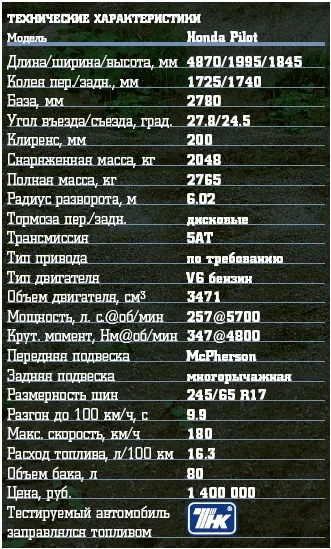
9.9 SECONDS – IS THAT NOT ENOUGH?
The very first Honda Pilot test drive, published in the August issue, was essentially a presentation: we were taken along a calm route, without sharp maneuvers or off-road excursions. Many important features of this car remained behind the scenes then. And readers are already asking specific questions – they are interested in how the underbody is arranged, what the geometry of the suspension arms is. But first – a bit of road impressions.
Honda engineers, adapting the Pilot for our market, clearly tried to make the steering informative. In a turn, the steering wheel feels like a springy expander that persistently pulls the wheels toward a straight-line position. At the Karelian presentation, this was not so obvious – the roads there did not allow us to feel it.
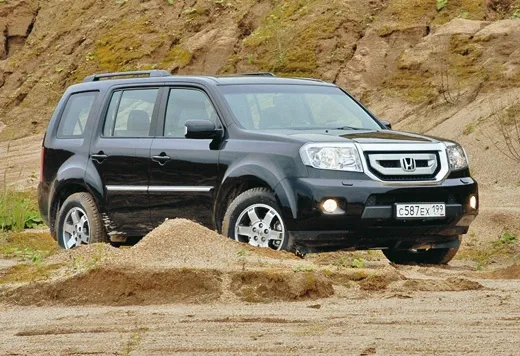
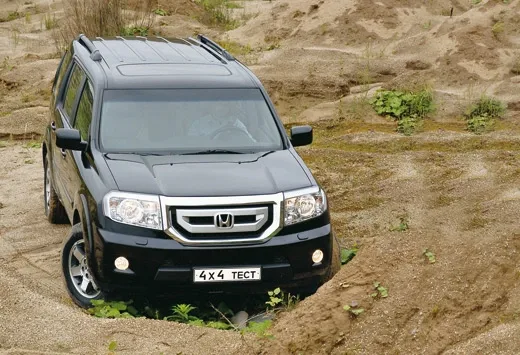
I remember complaining about the sluggish acceleration of this crossover, but that time each car had four people in it (and some journalists, it seems, are not on good terms with a sense of proportion). Now, when I am alone in the cabin, my attitude towards dynamics has changed. Reaching 100 km/h in 9.9 seconds is a quite respectable figure.
So, we have an energetic crossover with excellent handling: the steering is precise, body roll in corners is almost imperceptible. The only thing that spoils the picture is strong vertical pitching on uneven asphalt and nose dives during hard braking or acceleration. Apparently, it was simply not possible to fully retune the American, assembled in Alabama, for European roads.
PROTECTION IS INSUFFICIENT
What about off-road? We will definitely check! But first, we put the car on a lift and inspected how prepared it is for a harsh life. The Honda Pilot has a unibody construction, but it is immediately clear that the power frame is very similar in shape to a classic ladder frame. In any case, the design commands respect. If you hit a stump or a rock, the main impact will be taken by the structural elements.
So, we have an energetic crossover with excellent handling: the steering is precise, body roll in corners is almost imperceptible. The only thing that spoils the picture is strong vertical pitching on uneven asphalt and nose dives during hard braking or acceleration. Apparently, it was simply not possible to fully retune the American, assembled in Alabama, for European roads.
PROTECTION IS INSUFFICIENT
What about off-road? We will definitely check! But first, we put the car on a lift and inspected how prepared it is for a harsh life. The Honda Pilot has a unibody construction, but it is immediately clear that the power frame is very similar in shape to a classic ladder frame. In any case, the design commands respect. If you hit a stump or a rock, the main impact will be taken by the structural elements.
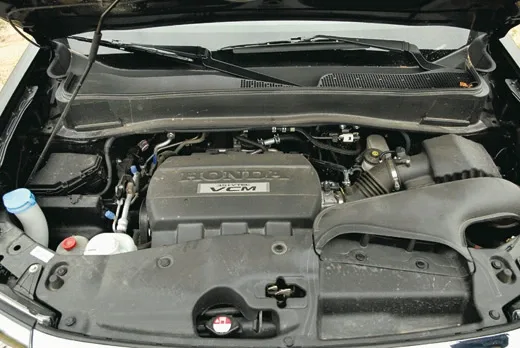
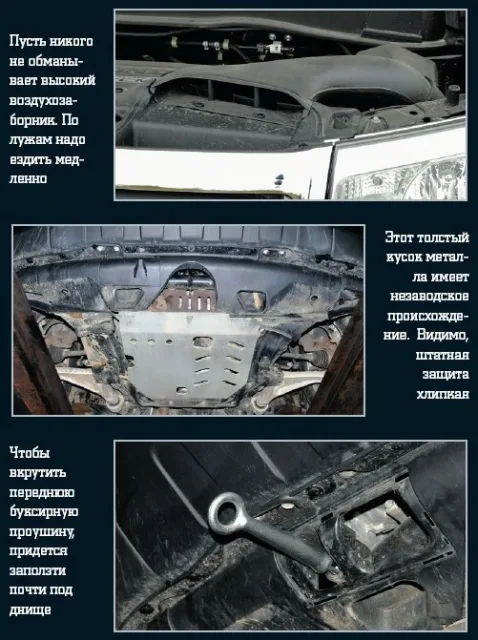
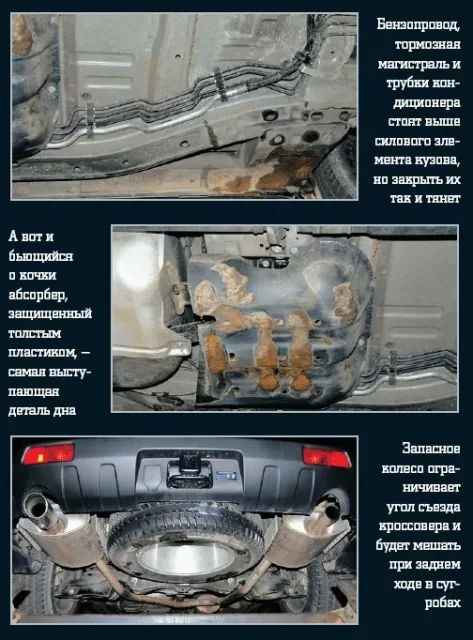
From below, everything is not so smooth. In the middle, closer to the left edge, there is a fuel vapor absorber covered with a plastic shield. How many times did I catch it in ruts – I can't count! Good thing the plastic is quite durable. The muffler can also hangs quite low, though on the right side. The rear air conditioning tubes can be damaged by one unsuccessful hit on a rock, and the parking brake cable can easily be caught on a snag or rebar. The fuel tank is only covered by a heat shield.
The engine compartment is protected by a thick metal plate, clearly not of factory origin, which hints at the weakness of the standard protection. The spare tire hangs at the rear, seriously reducing the departure angle and hindering reverse driving in snow. The front tow hook is hidden so that you can only reach it by lying on the ground. In short, I would stay on asphalt in such a car. But then why all-wheel drive and 203 mm of ground clearance?
The engine compartment is protected by a thick metal plate, clearly not of factory origin, which hints at the weakness of the standard protection. The spare tire hangs at the rear, seriously reducing the departure angle and hindering reverse driving in snow. The front tow hook is hidden so that you can only reach it by lying on the ground. In short, I would stay on asphalt in such a car. But then why all-wheel drive and 203 mm of ground clearance?
TECHNICAL PART: HONDA PILOT
THE FIRST TO GIVE UP WAS THE AUTOMATIC TRANSMISSION
We headed to the "village", occasionally catching the hanging absorber on bumps. How much easier would the Honda Pilot be if it were lighter! It stopped at the very place where a Subaru Forester had recently passed calmly. Or rather, it didn't exactly stop – it just needed to accelerate before the maneuver. The illogical operation of the traction control system during diagonal rocking also played its role. If you simply hang one wheel, the crossover copes, but as soon as rocking begins, it gives up. It also lacks low-end torque: the 347 Nm of torque appears only after revving the engine to 4800 rpm.
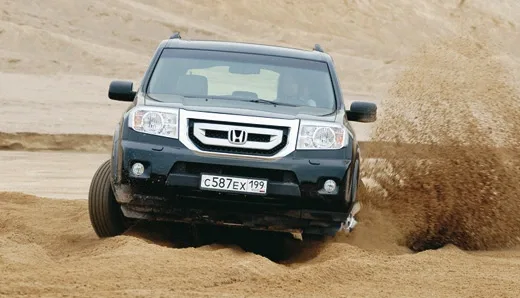
Where you can accelerate and have a margin of travel, the Pilot can even please. For about fifteen minutes I stormed sandy slopes of varying steepness – the crossover did not give up, just asked for more revs. Logically, in this mode, the rear axle coupling should have overheated, but the hydraulics held up. Only the automatic transmission gave up: a warning "A/T temp high" appeared on the display – the gearbox overheated.
We headed to the "village", occasionally catching the hanging absorber on bumps. How much easier would the Honda Pilot be if it were lighter! It stopped at the very place where a Subaru Forester had recently passed calmly. Or rather, it didn't exactly stop – it just needed to accelerate before the maneuver. The illogical operation of the traction control system during diagonal rocking also played its role. If you simply hang one wheel, the crossover copes, but as soon as rocking begins, it gives up. It also lacks low-end torque: the 347 Nm of torque appears only after revving the engine to 4800 rpm.
Where you can accelerate and have a margin of travel, the Pilot can even please. For about fifteen minutes I stormed sandy slopes of varying steepness – the crossover did not give up, just asked for more revs. Logically, in this mode, the rear axle coupling should have overheated, but the hydraulics held up. Only the automatic transmission gave up: a warning "A/T temp high" appeared on the display – the gearbox overheated.
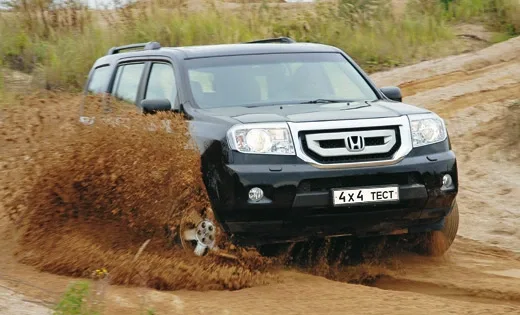
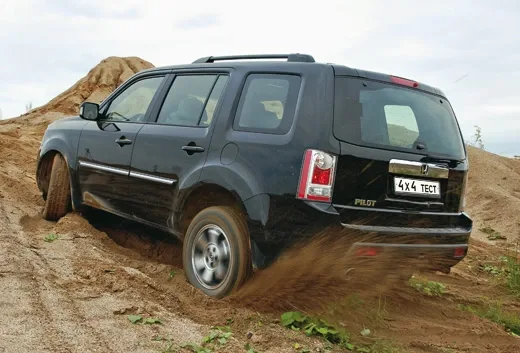
Next, we faced a broken country road – an ideal place to test the energy intensity of the suspension. Huge thanks to Honda for bringing the car on proper tires 245/65 R17, and not on those "parket" low-profile tires that they love to install at dealerships. Soon I understood what the trick was. With a low profile, the Pilot's suspension would have to be broken at every step – here it is simply not needed.
Ahead – a water obstacle. The high air intake (and here it is really high) should not be misleading. It is not needed for fording meter-deep fords, as it might seem, but to prevent dust and dirt from getting into the air filter. Crossing a medium puddle suddenly caused interruptions in the engine's operation – perhaps moisture got on the high-voltage wires. After five minutes the problem disappeared, but I no longer wanted to repeat the experiment.
ADVICE TO YOU, ROMALE, AND LOVE
Should we give advice to off-road gypsies? Install proper engine protection. Do not change the correct wheels to low-profile ones under any circumstances. Avoid narrow sections off-road with diagonal hanging. Everywhere you need good traction, look for a place to accelerate. Into the ford – with great caution. Screw on the front tow hook in advance. Well, and multiply and be fruitful – eight seats after all.
Ahead – a water obstacle. The high air intake (and here it is really high) should not be misleading. It is not needed for fording meter-deep fords, as it might seem, but to prevent dust and dirt from getting into the air filter. Crossing a medium puddle suddenly caused interruptions in the engine's operation – perhaps moisture got on the high-voltage wires. After five minutes the problem disappeared, but I no longer wanted to repeat the experiment.
ADVICE TO YOU, ROMALE, AND LOVE
Should we give advice to off-road gypsies? Install proper engine protection. Do not change the correct wheels to low-profile ones under any circumstances. Avoid narrow sections off-road with diagonal hanging. Everywhere you need good traction, look for a place to accelerate. Into the ford – with great caution. Screw on the front tow hook in advance. Well, and multiply and be fruitful – eight seats after all.