
Honda Pilot. Suitcase Mood
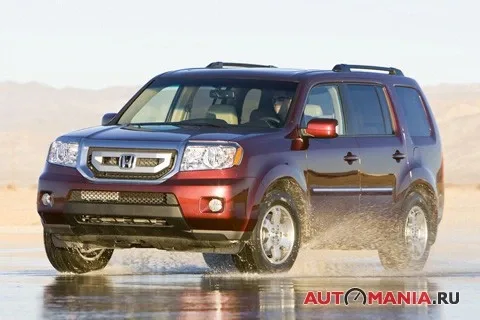
It's a well-known truth: a car's status is largely determined by its looks and price tag. So when I saw this huge black SUV, I immediately imagined myself as a cool guy, catching admiring glances and ready to give a couple of pretty female passengers a thrilling ride. But every car has its own character... And within an hour behind the wheel of the 'Pilot', I felt a change coming on: I wanted to take out my earring, grow a belly, swap my worn jeans for a strict business suit, and find somewhere in the bottom of my pocket a wedding ring that I think I lost before this test.
The explanation for this strange transformation was found in a Honda press release: 'The Pilot is designed for discerning and practical drivers with an active lifestyle. These are men aged 35–40 with high income who drive a lot in the city and beyond, spending time with family or friends.' That's it! Since the car affects me this way, I won't argue — better to make the most of it...
'And why do we need this "suitcase"?' my wife asked skeptically, examining the black giant, its wet sides glistening in the streetlights after the rain. 'What do people usually do with suitcases?' I was surprised. 'Travel, of course!'
A Family Man in Military Style
When the 'Pilot' (this is the second generation; the first was never officially imported here) appeared in Russia, fierce battles erupted on forums over its appearance. Particularly sensitive aesthetes grimaced: 'What a monster.' Yes, it's not a beauty, but who said a big family crossover has to look like a Barbie toy? After all, the 'Pilot' was designed in America and for Americans.
So the SUV turned out massive, almost without smooth lines, simple and chunky, with a fair share of self-assured arrogance. That's how US military vehicles are usually shown in movies. The Japanese pleased the Yankees again. Yes, not for that their grandfathers bombed Pearl Harbor... However, our compatriots also took a liking to the 'Pilot' — lately, its heavy silhouette has been appearing more and more often on Moscow streets.
By the way, on the road, this car is noticeably respected and given way — perhaps thanks to that same intimidating appearance. And rightly so: messing with such a 'bruiser' is not worth it.
But after sitting behind the wheel of this monster for a while, you'll noticeably temper your fighting spirit. The 'Pilot' is clearly made for calm, leisurely movement. It's a car for a person who has no need to fuss, rush, or prove anything to anyone.
Where to Put the Selector
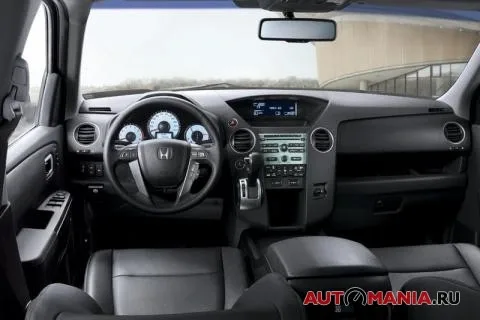
We've dealt with the exterior, but what awaits our 'discerning and practical' driver inside? He'll see a multitude of buttons, a large comfortable steering wheel with metal inserts and controls for the audio system and onboard computer, as well as slightly outdated high tech on the center console. The materials and build are solid, but nothing more. You wouldn't call the interior luxurious. The automatic transmission selector (and the 'Pilot' comes to us only with an automatic) is surprisingly small and, even more unusual, located right on the center console. For brand fans, this is nothing new: Honda engineers love to hide the gearshift lever anywhere but in the usual place. However, here the solution turned out to be successful, especially when maneuvering in tight spaces (and such a 'suitcase' needs a lot of room to turn around) — switching between 'D' and 'R' can be done without strain. True, due to the short throws, you initially keep missing the desired mode. The rearview camera image, which is projected directly onto the interior mirror, also helps. It's just a pity the image is too small to accurately judge the distance to obstacles.
On the instrument panel — three white dials and a multifunction display screen that resembles forgotten pagers. The similarity is enhanced by periodically appearing 'urgent messages' about unfastened seat belts or low fuel levels.
Overall, the front panel is massive and continues the 'chunky' style of the exterior. Everything here is deliberately large: the steering wheel, buttons, and instruments. The exception is that 'twig' of a selector. On the other hand, controlling the transmission on a large SUV doesn't require a lever the size of a pipe. But the miniature and unusually placed selector, along with the absence of a 'handbrake' in the usual place (the parking brake is a small pedal), allowed for a practical box with two cup holders between the front seats. And that's not counting the huge compartment in the armrest!
There are also oddities in the cabin: for example, an incomprehensible shelf above the glove box, divided into three small 'salad bowls'. Or a paradox: there's a cigarette lighter, but no ashtray. Though perhaps we just didn't look hard enough...
Kids in the Trunk
Now, smoothly, like the ride in the 'Pilot' itself, let's move on to its cargo and passenger talents. Here our hero has something to boast about. As my wife rightly noted, the 'Pilot' is essentially a self-propelled suitcase. First, it's just as huge; second, it's full of compartments of various sizes for all sorts of road trifles (from a spare tire to coins); and finally, it also has wheels (!). Although the 'Pilot's' off-road capability is about the same as a suitcase's, but more on that later.
If an ordinary suitcase can fit at most one person, and not the largest one, then the 'Pilot' can load up to 8 travelers. True, then you'll have to solve a difficult question: where to put their luggage? After all, with all seats occupied, only 560 liters remain for cargo — exactly like a Skoda Octavia. Only a trailer will save you: the 'Pilot' is equipped with a tow hitch and can pull 2,040 kg behind it.
'And how will passengers, freed from the shackles of belongings, feel?' you might ask. I answer: easy and free, and not just morally. For example, even a fairly large person in the driver's seat will feel like a child who climbed into daddy's chair. Sitting here is a sheer pleasure, and not just sitting, but driving. There are plenty of adjustments, all with electric drive and memory for two positions. In short, the front is very comfortable and cozy. The high seating position and the feeling of a Big Car give pleasant calm. True, not very tall drivers will have to stretch to the pedals with all their might.
In the back row, the space is simply fantastic. The seats, of course, slide longitudinally, and the backrests fold in a 60:40 ratio (this also applies to the third row). With simple manipulations, you can create a full double bed in the back (a note for newlyweds and sympathizers). Instead of bedside tables, there are storage compartments in the rear doors and side panels of the trunk.
On the third row, if desired, a couple of short adults can fit, but riding and especially climbing into the gallery will not be very comfortable for them. Better to set up a kids' area there... or rather, give it to the younger generation. Our offspring, who no longer need a child seat but whose parents are still under Article 12.6 of the Administrative Code, we advised, just in case, to hide under a blanket when seeing traffic police officers — a kind of game of 'little illegal'. In short, the third row of the 'Pilot' is ideal for children. And good: there are no doors or power windows there, nothing to fool around with, and you can observe the restless inhabitants of the gallery through a panoramic reflector in the glasses case. You can also send your mother-in-law there (though not too bulky) — her grumbling won't be as annoying, especially since the stereo in the 'Pilot' plays excellently. Moreover, the Active Noise Cancellation system creates an acoustic signal opposite in phase to the noise. Thanks to this, the level of unwanted sounds is reduced to 10 dB. That's how, brother, 'Honda' takes care of you!
An inquisitive reader will surely note at this point: 'Well, okay, there's a lot of space in the car, but what else can it offer?' The question is legitimate, because even an ordinary freight car is not lacking in space, yet for some reason no one wants to travel far in it. Let's figure out how the 'Pilot' differs from a freight car. First, the cabin has three-zone climate control, and the seats of the first two rows are heated. Second, as mentioned above, there's an incredible number of compartments: drawers, pockets, shelves, and cup holders for any small items, totaling almost 15 liters of volume. Third, the trunk. Imagine: you're driving past a grandmother selling suspiciously cheap potatoes, and you decide to drop off all passengers to load bags of harvest instead. At your disposal — a whole 2,436 liters (with the seats of the second and third rows folded). If the 'Pilot' were an aquarium, it would be a Very Big Aquarium. Plus, the trunk door closes and opens with an electric drive — a small thing, but nice. And, of course, safety: 10 airbags, including curtains for the gallery, active headrests, and a bunch of electronic assistants that steer and brake. The American NHTSA crash test rated this hotel on wheels a well-deserved 5 stars.
Come on, 'Pilot', Don't Let Us Down!
So, things are packed, supplies are taken, as usual, for three years ahead (and already partially eaten), the crew is counted and seated. Time to hit the road. I'll say right away: a driver unaccustomed to such giants will have a hard time at first — the side mirrors folding by themselves and the howling of other people's alarms will be frightening. You need to get used to the dimensions. Large exterior mirrors and a rear-view camera make life a little easier. But in tight courtyards packed with cars, you'll have to stay alert. There is another driving feature: the steering wheel makes a full 3.8 turns from lock to lock — that's too much. At low speeds it's not very informative, and during active driving it lacks sharpness.
By the way, about active driving. The gas pedal is heavily damped: your foot seems to sink into cotton wool. At first, the lack of response is annoying. Between pressing the accelerator and the actual acceleration, the "Pilot" manages to think: "Well, where are you flying like a boy? You're a respectable person, it's not your style to race... Okay, you've convinced me, let's go...". Then, of course, it accelerates (it has no choice!), doing so smoothly and quite intensely. At such moments it resembles a locomotive, but in this acceleration... how to put it... there's no spark.
It so happened that we set off on the trip in a convoy of several Mitsubishi Outlanders of different generations. When it was our turn to overtake a truck, we felt a little awkward. From the outside it looked like this: a flock of lean athletes in colorful suits, urging each other on with hazard lights, and behind them, wiping sweat with an expensive tie, a hefty guy was puffing. Maybe he was once an athlete, but the agility is no longer the same. Nothing to be done — this is not a racing car!
But this "guy" forgives inexperienced drivers many mistakes. The "Pilot" allows quite risky things to be done with it. Sharp and clumsy maneuvers are smoothed out by the proprietary Vehicle Stability Assist system, and ABS even activates from not-too-hard brake pressure.
On the "Pilot" on autopilot
Under the hood is a 3.5-liter i-VTEC with 257 hp. The engine is not new; it was installed on the American Accord and the Odyssey minivan. This would be enough if not for the improved Variable Cylinder Management system, used since 2008. According to Honda, all six cylinders only work when starting the engine and during sharp accelerations. The rest of the time, the two-ton car is pulled by only three "pots". At cruising speed, only two cylinders work at all.
The fact that the "Pilot" cares about your budget is indicated by the "ECO" indicator, which many mistake for "ecology" due to its similarity. In fact, it means a more pleasant word — "economy". The light comes on when you release the gas and coast. That the VCM system actually deactivates cylinders, and not just pleases the eye with a green light, is confirmed by the onboard computer: in the city, fuel consumption is quite acceptable for such a volume at 16 liters.
There are no complaints about the 5-speed automatic: it shifts smoothly and on time. The cruise control with buttons on the steering wheel pleased me. Speed can be adjusted with the "plus" and "minus" keys. It seemed to me that several quick presses on "plus" accelerate the car faster than a simple press on the gas. You can entertain yourself with such games on a long road to avoid falling asleep. And falling asleep is easy: the seating position is relaxed, the ride is smooth, and the cabin is quiet.
Not a fighter
The idyll ends on broken roads. On the patched-up asphalt of the Ivanovo region at a speed of 100 km/h, the car was thrown from side to side like a boat on waves. You might get motion sickness. Good thing the leather interior is easy to clean...
The "Pilot" enters corners clearly, but does not encourage sharp maneuvers due to the "cotton" steering wheel. I repeat: this car is for an adult who is in no hurry and doesn't ask the question: "Am I driving too slowly?".
Now about the sad part. As unfortunate as it is, the "Pilot" relates to SUVs roughly the same way youth clothing in military style relates to real army uniforms. Between the rear wheels is a simple electromagnetic clutch that helplessly disengages after 30 km/h. So on serious off-road, despite its menacing appearance, the "Pilot" is not a fighter. Probably the same disappointment is felt by women when a courageous-looking character turns out to be... Well, you get it.
The Variable Torque Management 4-wheel-drive (VTM-4) all-wheel drive system sends torque to the rear axle only during acceleration or when the front wheels slip, and does so with a noticeable delay up to the same 30 km/h. But that's not the worst: in America, front-wheel-drive versions are also sold! As Zadornov would say: well, dumb!.. However, it's unknown what Americans would say seeing a strange car with a familiar emblem and a "Chevrolet Niva" badge. Better a single-drive "Pilot"...
***
Around the middle of the journey, I came to terms with the role of the "daddy". I even liked the stately, adult driving style. What can I say: comfortable, spacious, moderately fast, moderately capable, ideal for the city and country outings. And that it's not handsome — well, as they say, you don't drink water from a face. Feel at home, but don't forget you're on the road!
CONCLUSIONS
Looking for serious flaws in a car worth one and a half million is stinginess. I'll be brief. The main drawback stems from the plus — 257 hp. A tax receipt for 34–39 thousand rubles (depending on the region) can spoil the mood. Moreover, if there were just 7 fewer "horses" under the hood, the tax would be more than halved. Whether the car is worth such costs is up to you to decide.
The "Pilot" has many competitors, and each is fiercer than the other. From the new KIA Sorento to the veteran Volvo XC90. You'll have to choose with your heart. If you approach rationally, for similar money you can take a diesel Nissan Pathfinder with "tax-friendly" 174 hp (though the "Pilot" is noticeably more spacious). The most dangerous rivals are the Russians' favorites Mitsubishi Pajero IV and Toyota Land Cruiser Prado with 250 and 249 "horses" respectively. They have slightly less functionality, but instead of a rear-view camera and electric seat adjustments, the buyer gets permanent all-wheel drive with a low range.
P.S.: Maybe instead of the little-known "Pilot", Honda should have officially brought the Element or Acura MDX to Russia (on whose platform, by the way, both generations of the Honda Pilot are built)?
Alexey Mogusev
I had the opportunity to spend several days behind the wheel of an SUV that still makes passersby turn their heads. We're talking about a model that the manufacturer positions as a universal vehicle for any conditions. The appearance of this car is brutal, with a pronounced grille and massive wheel arches, which immediately hints at its character.

Inside, everything is subordinated to the idea of functionality. The trim materials are simple but solid, and the seating position is high, as befits a real off-roader. The instruments are perfectly readable, although there is not a gram of luxury in the finish — everything is designed for long and hard work. But at the same time, the cabin is quite spacious, and thanks to the large mirrors, visibility is good despite the impressive dimensions.
Under the hood of this beast is a gasoline V-6 with a volume of 3.5 liters, producing 257 horsepower. The dynamics for a car weighing more than two tons are quite decent: reaching 100 km/h takes 9.9 seconds. But the main thing here is not acceleration figures, but the torque, which is felt from the very bottom. The gearbox is a classic five-speed automatic, which works predictably and smoothly, although it sometimes hesitates when you sharply press the gas pedal.
On asphalt, the car behaves as you'd expect from a tall and heavy SUV: body rolls in corners are noticeable, and the steering wheel is not very informative. But off-road, the true talent of this machine is revealed. The all-wheel drive with an electromagnetic clutch on the rear axle works flawlessly, and the ground clearance of 200 millimeters allows you to confidently move along broken dirt roads and not fear deep ruts.

The suspension here is independent on both axles: McPherson in front, multi-link in the rear. It's tuned quite stiffly, so small bumps are transmitted to the cabin without compromise. However, on large waves and potholes, the car doesn't break through and holds its trajectory confidently. The brakes with ventilated discs in front reliably handle deceleration, although the pedal seems a bit soft.
Fuel consumption is predictably high: in the city, the appetite reaches 16.3 liters per hundred, on the highway it's possible to keep it to 9.2 liters. In the combined cycle, it comes out to about 11.8 liters. The unit can be filled with 92-octane gasoline, which is a little comforting with such expenses. The trunk volume is 588 liters, which is quite enough for trips to nature or transporting large loads.
The maximum speed is electronically limited to 180 kilometers per hour, and that's more than enough for such a heavy machine. Overall, the car leaves the impression of an honest and uncompromising tool that doesn't try to seem like something else. It's created to overcome obstacles, and it does this brilliantly. And everything else is compromises that you have to make for the opportunity to turn off the asphalt anywhere.