TRIUMPH OF ERGONOMICS
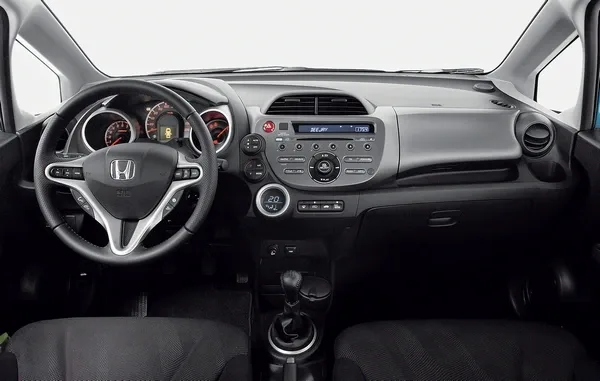
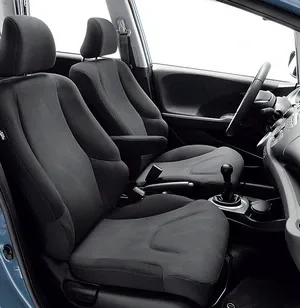
The dashboard and the entire front part of the cabin are thought out to the smallest detail: every button is in its place, all controls are logically divided into functional groups.
The updated Jazz looks most advantageous from the side, although the front part is also attractive — the headlights, elongated and almost pressed against the windshield pillars, deserve special attention. Because of this, the hatchback has become even more like a minivan: a short sloping hood smoothly flows into a huge windshield that rests on noticeably forward-protruding pillars.
There are, of course, no revolutionary design solutions here, but, honestly, it's been a long time since we came across cars with such smooth, almost flawless in their simplicity lines. In addition, this body shape allows you to use the interior space as efficiently as possible without sacrificing aerodynamics.
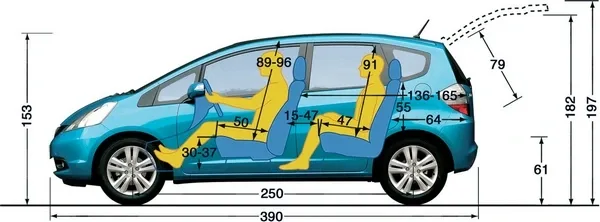
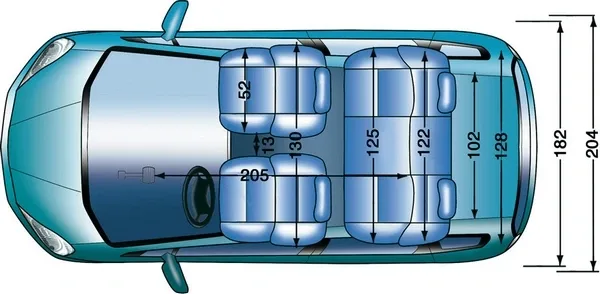
The dimensions of the car have indeed increased. The length is now 3.9 meters — 55 millimeters more than its predecessor. The width has increased by two centimeters. The wheelbase has grown from 2450 to 2500 millimeters, and the front row has shifted forward, making the cabin noticeably more spacious — four passengers have become significantly more comfortable, and only very tall people, perhaps, will still be a bit cramped. Due to the large glazing area, there is even more light in the cabin.
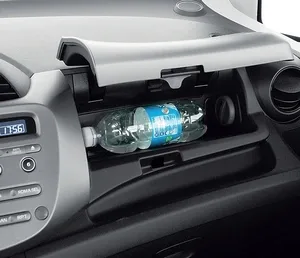 |  |
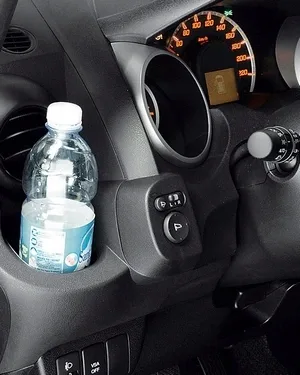 | WATER RESOURCE
The driver and passengers definitely won't have to suffer from thirst: there are enough places for drinks. The glove box can work as a refrigerator if desired. The seats allow you to sit comfortably |
MASTERING SPACE
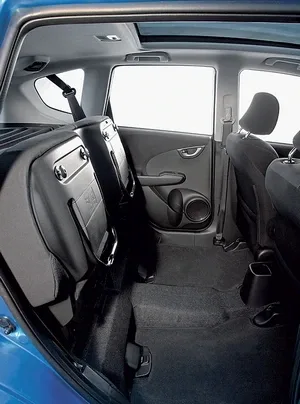
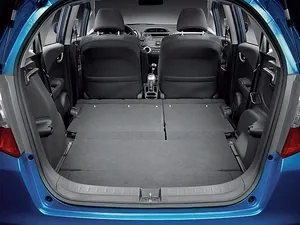
It's worth telling separately about how the cabin transforms. If you fold the backrest of the rear sofa (it is divided into two parts), the seat lowers down — and you get a large completely flat loading area. This effect was achieved thanks to the fact that the engineers placed the fuel tank under the front seats. And for transporting long items, the rear sofa cushion can be lifted up and fastened to the backrest. The rear doors open 80 degrees, which greatly facilitates loading and unloading.
|  |
 | |
 | AMAZINGLY PRACTICAL
By folding the rear sofa backrest, you get a large flat area. And if you lift the second-row cushions up, a tall compartment forms behind the front seat backs — another version of the luggage compartment |
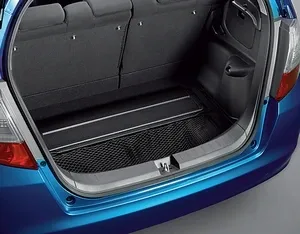
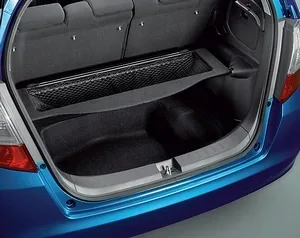
The trunk with a volume of 357 liters is divided by a movable partition into two parts, and under it is hidden access to an additional niche. Usually in such a place you expect a full-size spare wheel or at least a space-saver. But not this time. Jazz, as expected, does not use run-flat tires, so in case of a puncture, the driver will have to make do with a repair kit.
The interior trim is done neatly, looks stylish and modern. The main role is played by the massive original front panel, and the driver's seat clearly indicates that the developers paid special attention to ergonomics. The seat with firm padding holds the body well and prevents fatigue even after a long trip. The steering wheel adjusts over wide ranges both in tilt and reach, so finding a comfortable driving position won't be difficult.
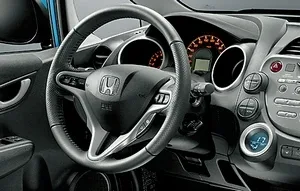
You get used to the driver's seat almost instantly: all buttons and keys are logically grouped and laid out by zones. The multifunction steering wheel, borrowed from the Civic, turned out to be not only attractive but also very practical.
DYNAMICS GROWTH
The 1.4 engine remained the same in displacement, but the intake and exhaust systems underwent serious modernization. Japanese engineers abandoned double ignition in favor of the classic Honda scheme with four valves per cylinder and the i-VTEC variable valve timing system.
The output increased from 83 to 99 horsepower at 6000 rpm, and the torque is now 127 Nm at 4800 rpm. This is quite enough to make the Jazz noticeably more lively: the little "Japanese" reaches 100 km/h in 10.8 seconds, and the top speed just slightly falls short of 180 km/h. The four-cylinder engine pulls smoothly, without dips at low and medium revs.
The car handles easily and effortlessly. The five-speed gearbox with short and precise throws perfectly matches the character of the engine. But on the highway you begin to understand that a sixth gear would not hurt: it would allow a slight reduction in fuel consumption and noticeably improve acoustic comfort, which, frankly, is not a strong point of the car — the Jazz is quite noisy inside.
The third generation of the urban compact has made a big step forward in terms of handling. The fairly stiff suspension minimizes body roll, the "Japanese" confidently holds the road both in a straight line and in corners.
But the steering with electric power assist clearly lacks sensitivity and feedback. The brakes also raise questions: in normal mode you can't fault them, but during intense driving they quickly begin to lose effectiveness.
The proprietary VSA (Vehicle Stability Assist) stability control system is ready to help in a difficult situation, although it works too intrusively. It's a pity that Honda includes it in standard equipment only for the most powerful versions, and on modifications with the 1.2-liter engine it is not available even for an extra charge.
 | LIKED
The very pleasant steering wheel from the Civic model features a modern design, optimal diameter, and a set of buttons that are very convenient for everyday use |
| DIDN'T LIKE
The hazard warning button is in plain sight, but the sound signal of the system's operation is barely audible. Having turned it on, you risk forgetting about it for a long time | 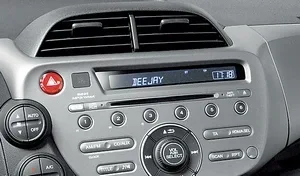 |
PLUS-MINUS
The Jazz developers really tried to make the third generation of the Japanese compact attractive – there are no complaints about the appearance. But there are claims to a more important property – braking efficiency, which decreases too quickly under intense loads.
Technical specifications provided by the manufacturer
Honda Jazz 1.4 i-VTEC
• Engine: front transverse, 4 cylinders, cylinder diameter – 73.0 mm, piston stroke – 80.0 mm, displacement – 1339 cm3, maximum power – 99 hp at 6000 rpm, maximum torque – 127 Nm at 4800 rpm, compression ratio – 10.5:1, cylinder block and cylinder head made of light alloy, 4 valves per cylinder, overhead camshaft and variable valve timing system (toothed belt), electronic injection
• Transmission: front-wheel drive, single-disc clutch, manual gearbox, 5 gears: I) 3.307:1; II) 1.750:1; III) 1.235:1; IV) 0.948:1; V) 0.809:1; VI) 3.307:1, final drive cylindrical pair 4.294:1
• Tires: 185/55 R 15 82 V, wheels 6JJ; on the tested car repair kit
• Body: 5 doors, 5 seats
• Suspension: front – independent, transverse arms and telescopic struts (MacPherson), coil springs, anti-roll bar, rear – semi-independent, trailing arms, coil springs, anti-roll bar, telescopic hydraulic shock absorbers
• Brakes: disc, front ventilated, ABS and stability control system
• Steering: rack and pinion with electric power assist
• Dimensions and weight: wheelbase – 2500 mm, front track – 1492 mm, rear track – 1475 mm, length – 3900 mm, width – 1695 mm, height – 1525 mm, curb weight – 1083 kg, trailer weight – 1000 kg, trunk from 399 to 1300 dm3, tank – 42 l
• Place of production: Suzuka (Japan)