
The hybrid Civic doesn't shine either — its sales are five times lower than the Prius. And what's the point that the first Insight with an average consumption of 3.4 l/100 km still remains the most economical hybrid?
The schematic diagram of the IMA (Integrated Motor Assist) powertrain is the same as that of the first Insight and the hybrid Civic. But 95% of the components are new.
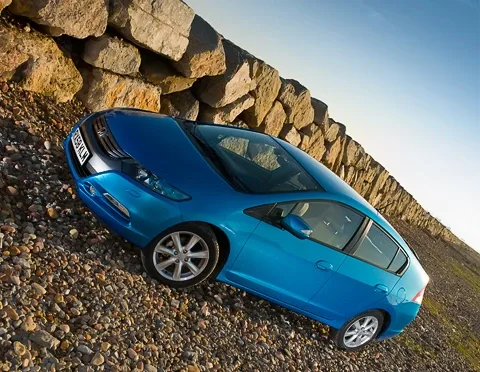
Honda representatives claim that the Insight's body shape is dictated by aerodynamics. They say this achieves the best result. I won't argue. A drag coefficient Cx of 0.28 is a quite respectable figure. But what do records have to do with it?
I see it differently: the main advantage of such proportions is that they strongly resemble Toyota's.
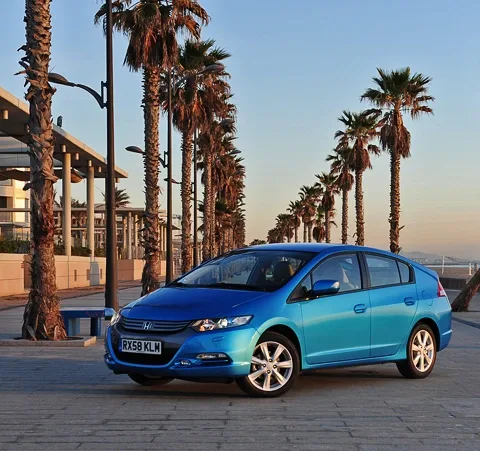
After all, it's unlikely anyone would buy a hybrid solely for the ecological idea. I don't recall topics on the Toyota Prius owners' club forum like "shouldn't we all get together tomorrow as a club and picket near the oil refinery!" Image is another matter. Therefore, an eco-friendly car must look unlike any other. The Prius stands out, and the question immediately arises: what's the point of buying a hybrid Civic if externally it's still indistinguishable from the regular one? Drive around the streets and shout through a megaphone: "Look, I have a hybrid!"?
I see it differently: the main advantage of such proportions is that they strongly resemble Toyota's.
After all, it's unlikely anyone would buy a hybrid solely for the ecological idea. I don't recall topics on the Toyota Prius owners' club forum like "shouldn't we all get together tomorrow as a club and picket near the oil refinery!" Image is another matter. Therefore, an eco-friendly car must look unlike any other. The Prius stands out, and the question immediately arises: what's the point of buying a hybrid Civic if externally it's still indistinguishable from the regular one? Drive around the streets and shout through a megaphone: "Look, I have a hybrid!"?
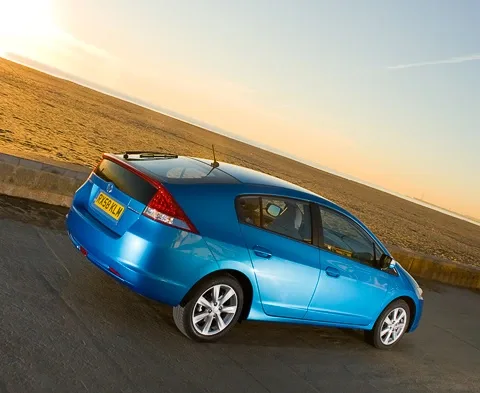
Honda plans to sell 200,000 new Insights per year — not much less than Toyota. About half of them will go to the States. The second most important market is Japan, followed by Europe.
So, the Insight has the right appearance, even if inspired by you-know-who. And the futuristic interior in the Civic style looks not just appropriate — it's a mandatory attribute. But the materials... can't be compared with the Civic. It's immediately clear that Americans are supposed to buy every second Insight. They don't care whether the plastic is cheap and noisy or not. And the climate control works accordingly — blowing cold air right into your face.
But the Japanese are proud that they managed to provide full seat transformation. Although it's not as good as in the Civic, where the loading height is lower, the trunk itself is more convenient, and when folding the rear seatbacks, the cushions automatically slide down. There's frankly little space in the rear seats, and the rear wiper looks like some kind of mockery. However, the Prius has exactly the same one, and the Civic hatchback doesn't have it at all.
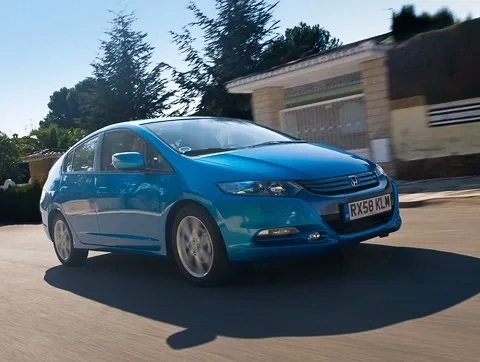
Handling, comfort, dynamics — qualities commonly used to describe the pleasure of driving a car. But in the case of a hybrid, the criterion is different.
Let's go through the hybrid component. Everything here is very, very simple. The 1.3-liter engine (88 hp, 112 N•m) was borrowed from the Jazz hatchback. A thin disc of the motor-generator is rigidly attached to its flywheel — that's another 14 hp and 78 N•m. The electric motor is connected to a belt-driven CVT, again from the Jazz. And a nickel-metal hydride battery in a cooled housing. Quite compact and light, weighing only 38 kg. Only the electric motor can draw power from it; the other systems sip energy from a regular 12-volt battery.
The engine itself, when not running, is not disconnected from the wheels; its valves simply close. That's why, by the way, it's made with eight valves — otherwise, the extra cams of the VCM system wouldn't fit into the cylinder head. But the situation where the car runs only on electric power is practically impossible. You stop at a traffic light — the engine stalls. You press the gas a little — it comes alive.
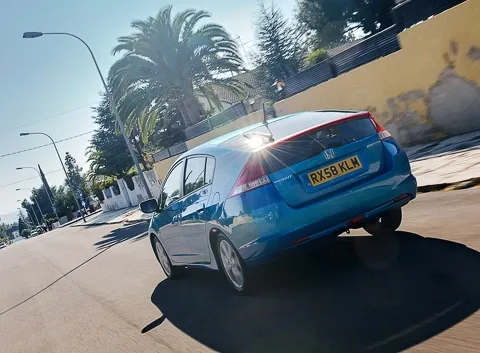
Contrary to common practice, the Insight is fitted not with low-rolling-resistance tires like the Michelin Energy Saver, but with the most ordinary ones — Bridgestone Turanza.
The motor works rather sluggishly: after a hundred, it becomes harder and harder for it to pull a car weighing over 1200 kg. A city option. "Yes, yes!" echoes Hiroshi Yoneguchi, deputy chief engineer for powertrains, "that's why we stayed true to the simple hybrid scheme: it works most efficiently exactly where such cars are used. Moreover, it's significantly cheaper than Toyota's. If the Prius costs $22,000 in the States, the Insight will be about three thousand cheaper. And if you often drive on the highway, it's better to take a diesel."
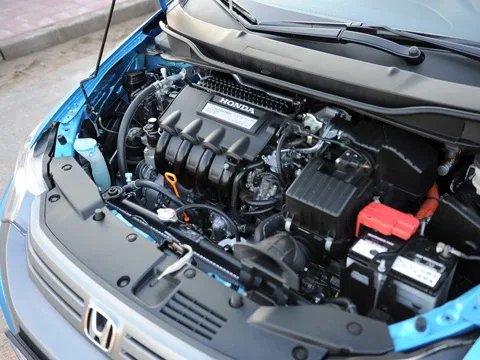
At this point, many immediately have a question: why not make a hybrid with a diesel engine? "Oh, there are many reasons," Yoneguchi replies, "firstly, in Japan and the States, such engines are unpopular in themselves. Secondly, there are problems, for example, with the start/stop system: on a vibration-loaded diesel, achieving its smooth operation is difficult. And thirdly, the most important thing — price. A diesel already costs several thousand euros more than a gasoline engine of similar power. Add the cost of the electric motor, battery... too expensive!"
So — a simple scheme with a simple engine.
Honda managed to cut the price primarily by making almost all components of the Insight's hybrid powertrain themselves, buying only batteries from Sanyo. And otherwise — the car is just a car. No excesses, no exotic metals or composite materials.
Honda managed to cut the price primarily by making almost all components of the Insight's hybrid powertrain themselves, buying only batteries from Sanyo. And otherwise — the car is just a car. No excesses, no exotic metals or composite materials.
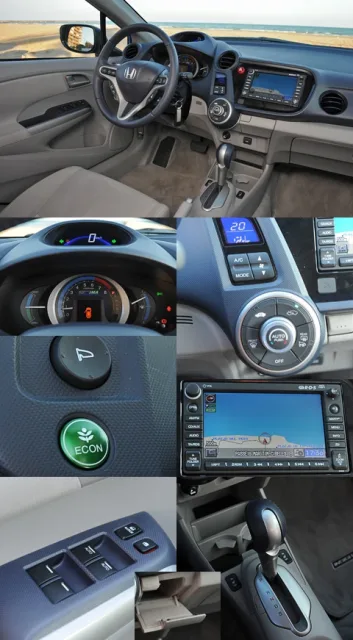
Although the hatchback body is clearly aimed at Europe, the interior trim is plain. The design and ergonomics save the situation — not a single serious flaw.
But the design — it could star in a sci-fi movie right now. I can see the scenes: a car silently rolls up that was last at a gas station five thousand years ago.
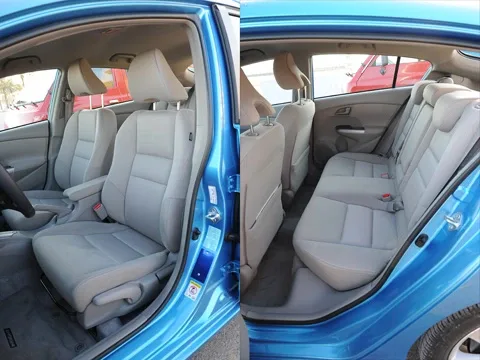
The front seats are almost like the Civic's: comfortable, quite firm, and with moderate lateral support. But the rear seats are much more cramped.
But in practice, we couldn't achieve the claimed 4.4 l/100 km in the combined cycle, no matter how hard we tried. Our result was 5.5 l. On the highway, if you maintain a speed of 85–90 km/h, you can keep consumption around four liters per hundred, and if you go faster, about 120, it comes out to a bit over five. And that's with the Econ button pressed, which slightly chokes the engine (torque drops by 4%), changes the CVT and air conditioning operation modes, and more actively uses the electric motor's assistance.
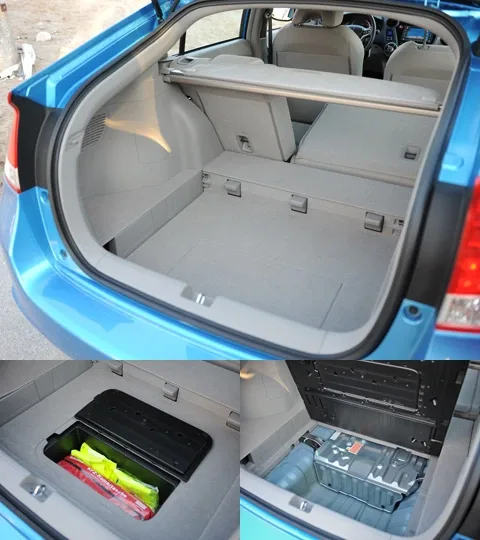
- The trunk has a small underfloor compartment, volume — 408 liters.
- The Japanese assure that the battery should work normally at temperatures down to minus 35 degrees Celsius. The factory warranty on it is 8 years or 160,000 kilometers.
And how is the Insight better than the Prius? Honda has a weaker powertrain, a simpler transmission, and a smaller battery. What besides price? Yoneguchi says the Insight is more pleasant to drive, and more practical primarily due to the trunk with convenient transformation.
What is that "more pleasant to drive"? In the chassis? Yes, it's good. The Insight doesn't suffer from excessive stiffness, nor from pitching or body roll, although the balance is clearly shifted toward comfort. All controls are extremely clear, you don't need to get used to anything. Everything is like in a regular solid car. And that's exactly what bothers me about hybrids!
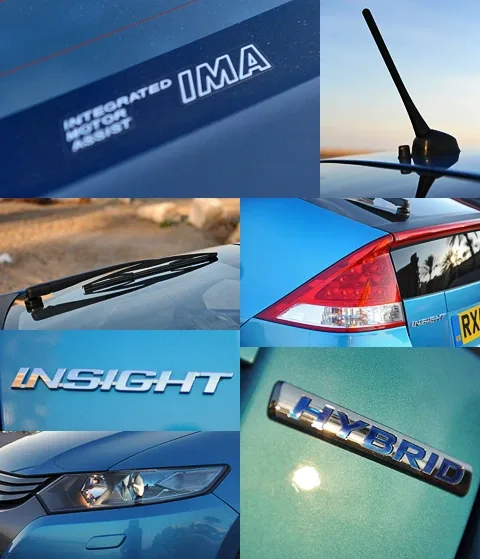
And Yoneguchi, like any other engineer, admits that hybrids are only a transitional stage to electric vehicles, and a forced one, one might say. But cunning marketers present them as something special. Okay, be cunning, but then make economical driving interesting!
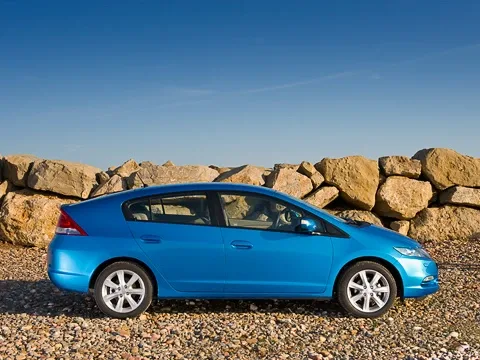
And here Honda adds a game element. First, a digital speedometer with a function to measure the driver's righteousness. You drive economically — the background turns green; you sin — it turns blue. But the most interesting thing is on the display in the center of the tachometer. Everything is right in your driving — and on the small screen, certain plants begin to grow one after another. First, two leaves. You collect five, move to the next level: grow four-leaf clovers. And for dessert, five-leaf clovers: when you have enough of them, you get a drawn cup! Moreover, the Japanese promise the game is not easy. To make the monochrome screen show the main reward, you need to drive in strict economy mode for at least 10–20 thousand kilometers! Now that's a toy!
I didn't even pass the first level. I grew five flowers, but they refused to branch further: I drove too little. However, I got a peculiar pleasure from driving the hybrid! And I just leisurely got from one point to another.
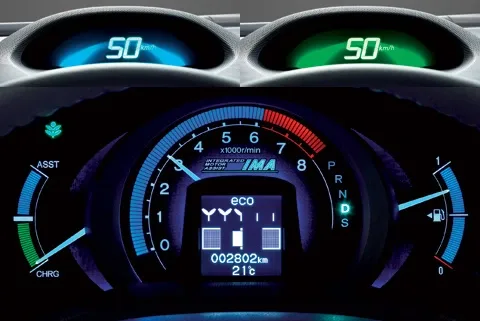
So what if the engine is weak? Let it be! But when the fuel consumption reading (I would, by the way, make a separate large display for this) drops by even 0.1 l/100 km, you rejoice like a child. And what will happen if you get the coveted cup... I wonder, are there cheat codes for the Honda?
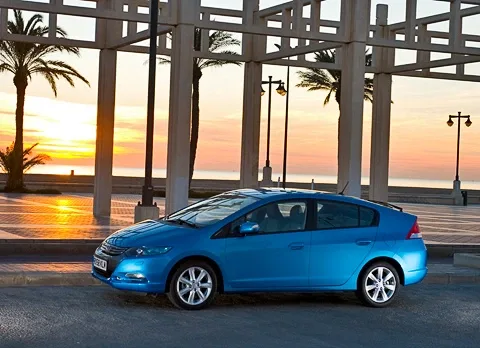
A hybrid is always a toy, and a toy must be engaging. And now we're not just talking about acceleration and handling. Sure, the Toyota has more power and less appetite. But sitting behind the wheel of a Honda is like playing a level in a video game. So I wasn't surprised at all by the ten thousand orders for the Insight in the first week and a half of sales in Japan.
But the fact that the model will appear in Russia "no earlier than in a couple of years" is surprising. I agree, we don't have benefits for low CO2 emissions like in Europe or the States. But even here, it would be interesting to play with the Insight, and there will be those who want to. Let us play too!
Specifications
| Characteristics | Honda Insight |
|---|---|
| Body | |
| Number of doors/seats | 5/5 |
| Length, mm | 4375 |
| Width, mm | 1695 |
| Height, mm | 1425 |
| Wheelbase, mm | 2550 |
| Curb weight, kg | 1204 |
| Gross weight, kg | 1650 |
| Trunk volume, l | 408–1017 |
| Gasoline engine | |
| Type | gasoline, with distributed injection |
| Location | front, transverse |
| Number and arrangement of cylinders | 4, in-line |
| Number of valves | 8 |
| Displacement, cm3 | 1339 |
| Max power, hp/rpm | 88/5800 |
| Max torque, N•m/rpm | 121/4500 |
| Electric motor | |
| Type | three-phase, alternating current |
| Max power, hp/rpm | 14/1500 |
| Max torque, N•m/rpm | 78.5/1000 |
| Transmission | |
| Gearbox | continuously variable transmission |
| Drive | front |
| Chassis | |
| Front suspension | independent, spring, MacPherson |
| Rear suspension | semi-independent, spring |
| Front brakes | disc, ventilated |
| Rear brakes | disc |
| Performance characteristics | |
| Maximum speed, km/h | 186 |
| Acceleration time 0–100 km/h, s | 12.6 |
| Fuel consumption, l/100 km | |
| — urban cycle | 4.6 |
| — suburban cycle | 4.2 |
| — combined cycle | 4.4 |
| Toxicity standard | Euro-4 |
| Fuel tank capacity, l | 40 |
| Fuel | AI-95 |
Technology 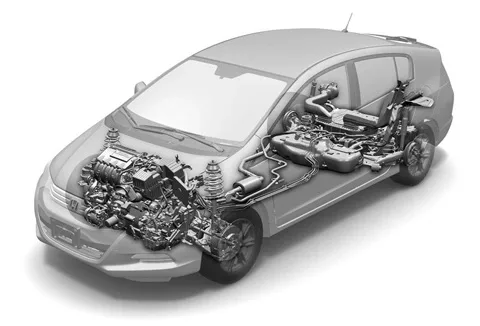
In terms of its internals, the Insight largely echoes other Honda small cars. The suspension layout is familiar — MacPherson struts at the front, semi-independent torsion beam at the rear. Compared to the Civic, the fuel tank is moved back and hidden under the rear sofa.
Design 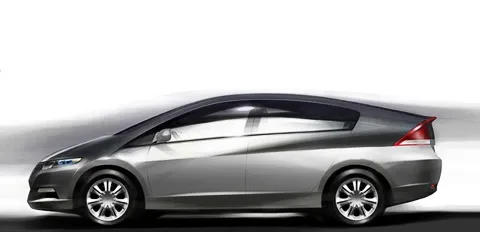
The Insight's appearance has similarities not only with the Prius, but also with another Honda model — the hydrogen hatchback FCX Clarity.
History 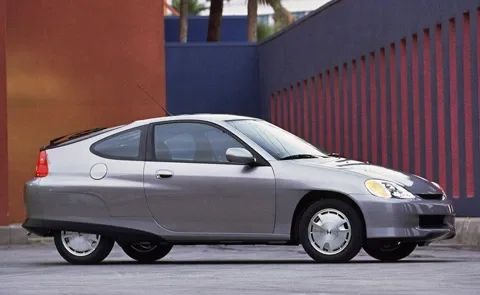
The first generation Honda Insight was produced from 2000 to 2006 and became the first hybrid to appear on the American market. The car's length was only 3945 mm, and its weight was about 800 kilograms. The 1-liter gasoline engine produced 70 hp, plus another 13 hp was added by the electric motor. Interestingly, the first-generation Insight could be equipped not only with a CVT, but also with a manual gearbox.
Behind the scenes 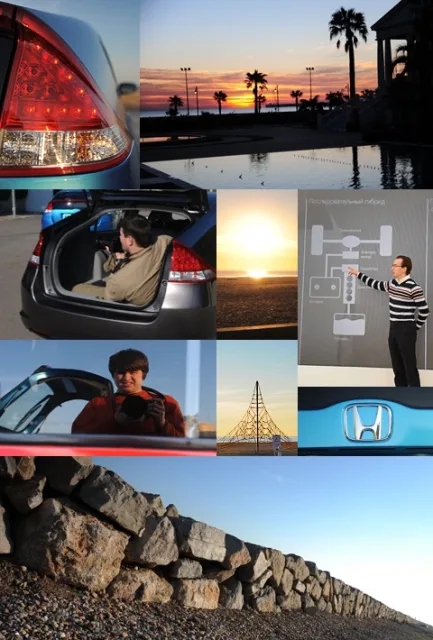
The presentation of the Insight took place on a weekday in Valencia: we managed to drive both on high-speed Spanish highways and in city traffic jams. We wish we had such traffic jams! No matter how hard we tried, we couldn't get stuck tightly — only a couple of short traffic jams.