ALL THE WAY DOWN
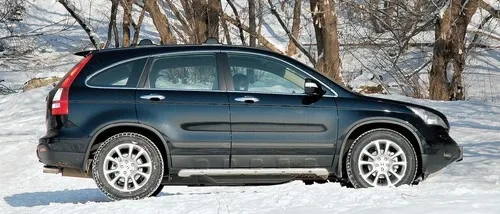
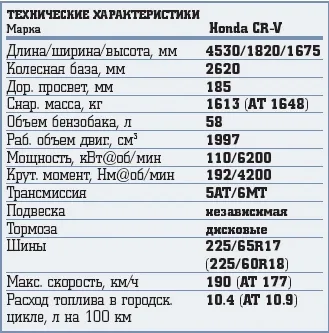
To achieve their goals, Honda engineers chose a proven strategy. The main focus was on lowering the center of gravity. Everything possible was moved as low as possible. Even the spare wheel (or rather, the space-saver spare) was removed from the tailgate and placed in a recess in the trunk floor. To improve stability, the body became slightly wider, but the ground clearance was reduced. Now, when tackling curbs, let alone on dirt roads, you need to be extremely careful. From the engine oil pan to the asphalt in curb weight is 185 mm, and the mandatory for our realities engine protection will take away another couple of centimeters. As a result, the ground clearance will become like that of some sedans. In short, despite its attractive appearance, this CR-V is somewhat reminiscent of a dachshund: sturdy paws at the corners of the body and a belly that almost drags along the ground.
HIGHTECH IN FENG SHUI
As before, nothing inside gives away the crossover. Except for the high seating position and excellent visibility, and also the huge side mirrors with an aspherical zone clearly hint that this is not a sedan. The floor is completely flat, and if it weren't for the central console, you could freely move between the rows from the front seats to the rear bench.
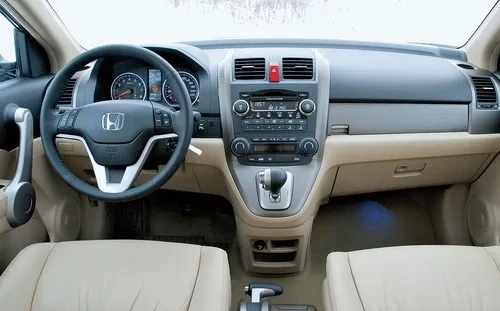
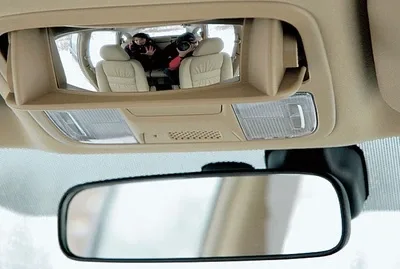
The three-tone interior uses hard plastic. But that's no reason to drum on the panels and worry that crickets will appear over time: even old Hondas usually don't befriend this creature. There aren't that many niches and compartments by today's standards – honestly, a couple more hidden drawers would have been useful. But there is a nice feature that parents of small children will surely appreciate. It's a panoramic rearview mirror that lets you keep an eye on the kids without taking your eyes off the wheel.
NO BEDS
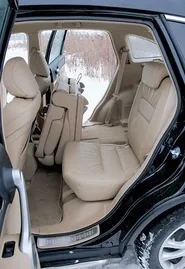
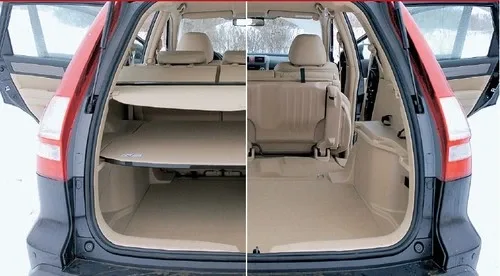
The rear bench cushion is divided into two unequal parts, each of which can be independently slid forward and backward by 15 cm. The backrest consists of three sections – the middle one can be folded down to create a comfortable armrest. The backrests can also be slightly reclined within a small range. But you won't be able to fold the seats to get at least one sleeping place. And that's logical: a modern person buying a trendy crossover is unlikely to plan on sleeping in the car. But in the trunk, he probably should have order – tennis rackets separately, a pool bag separately. Therefore, the cargo area has a light removable shelf, many tie-down hooks, and a net for securing items. By the way, access to the trunk is now opened by a liftgate: earlier, for those who don't remember, it opened sideways, and the spare tire hung on it. It's a pity that after all the transformations, the picnic table that used to cover the trunk niche has disappeared.
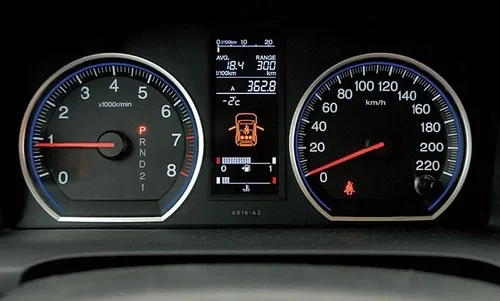
For the test, we got a car in the top Executive trim for $39,500. It has everything a car of this class should have: xenon with light sensor, dual-zone climate control, cruise control, MP3 stereo controls on the steering wheel, automatic transmission. There are also heated front seats and mirrors, a rain sensor, eight-way power driver's seat, remote central locking, and other power features. The activation of the front or rear parking sensors is displayed on a pictogram in the center of the instrument panel. Among the electronic assistants are a switchable VSA stability system and even TCA, which dampens resonant trailer sway. With this trailer stability, Honda made an excellent marketing move. The fact is that the car is popular among people with an active lifestyle who use it as a tow vehicle for motorcycles and ATVs. Although in practice, between us, trailer sway during normal driving is extremely rare.
There is also a simpler and cheaper version – Comfort, with air conditioning, six airbags, power accessories, a two-way adjustable steering column, an audio system with MP3, 17-inch wheels, VSA and TCA. It costs $33,800, and the gearbox there is a manual six-speed.
For other markets, adaptive cruise control is available, which uses radar readings to maintain a safe distance on its own. The radar also supports the Collision Mitigation Braking System (CMBS). It warns the driver of danger, and if he doesn't react, it tightens the seatbelt and then starts braking on its own. Fantastic! But for now, that's not for us, because there are issues with the use of these radio frequencies by law enforcement agencies.
TAKE IT ALL
The familiar 2.0-liter engine with variable valve timing from the previous generation has been modernized. By feel, low-end torque has improved, and with the top end, Hondas have always been fine. The new five-speed automatic shifts so smoothly that it gives the impression of a CVT. There's no manual mode for it, but by and large, it's not needed. Is 150 horsepower enough for this car? Yes and no. On one hand, the dynamics are decent, but on the other, the excellently tuned chassis begs for more. Oh, if only the CR-V had around two hundred horsepower, it would be great, but life is a compromise, and in this case, not the worst one. Especially considering that fuel consumption in the city cycle according to the passport does not exceed 10.9 liters. Although it's actually strange that there's no more powerful engine in the lineup – it would have been a killer advantage against the eternal rival Toyota RAV4. There's also a 2.2-liter turbodiesel with 140 hp in the range, but they won't offer it here yet.

MORE GAS, FEWER POTHOLES
The suspension has not fundamentally changed, but it has been slightly refined. The shape of the arms and the size of the bushings have changed, providing even better handling. An adaptive electric power steering has appeared in the steering system. It's very pleasant that the designers managed to achieve clean, non-artificial reactions from it. In parking lots, the steering wheel is super light, and as speed increases, informative heaviness appears. On asphalt, the car drives the way the driver wants: if you want, you can take corners on the edge, if you want, you can move with the flow of traffic, everything is equally pleasant. Well, the only price for this is the stiffness of the suspension. But even here, everything is ambiguous. At low speeds, it shakes on road irregularities, but as soon as you speed up a bit, potholes are flown over almost without sensation.
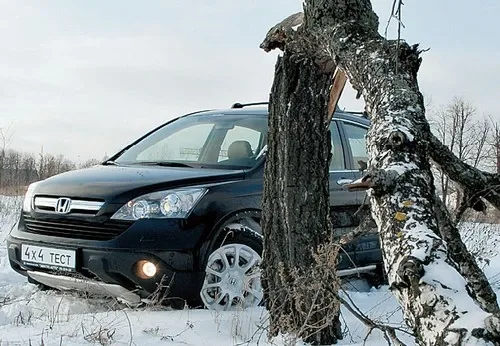
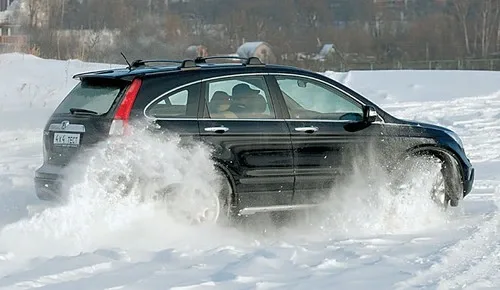
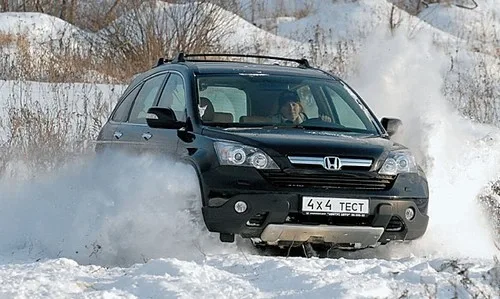
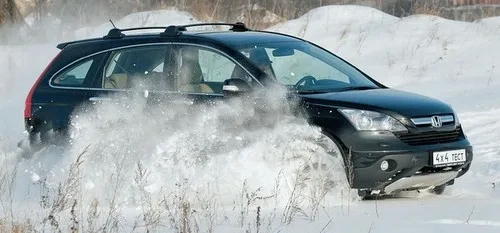
On snowy dirt roads, the CR-V showed itself well. Despite the low ride height, the front overhang is small, and the bumper is positioned well, so it's quite difficult to catch it on the terrain. A couple of times it seemed that we wouldn't be able to get out of a steep snowy climb, but on the next attempt, the car drove up. With wheelspin, of course, but without outside help. The secret here lies in the updated all-wheel-drive system, which has finally gotten rid of excessive thoughtfulness. In normal conditions, the crossover is front-wheel drive, and the rear axle engages when the front wheels slip. Moreover, no more than 35% of the torque can go to the rear. During active driving, the car demonstrated a predictable character and showed very clear understeer, that is, it tended to drive on a larger radius, but didn't surprise with sudden activation of the viscous coupling.

TREACHEROUS ABS
On asphalt, the brakes (all-disc) performed admirably, and the operation of the ABS with EBD brake force distribution raises no complaints. But on a broken dirt road, the electronics become "inadequate." It looks like this: you press the brake (whether hard or soft) – the pedal becomes stone-like, slightly taps your foot, and the car doesn't even think about braking effectively. Moreover, rapid step braking only slightly improves the picture. This is not the first time I've encountered this phenomenon, and I still can't get used to it. This kind of ABS operation doesn't appear in all brands. The conclusion is one – on roads without asphalt, you shouldn't rely on the brakes. Only steering can pull the car out of a potentially dangerous situation.