

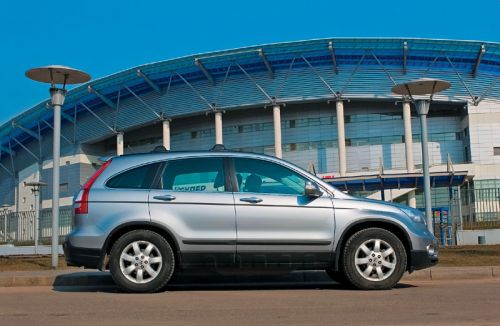
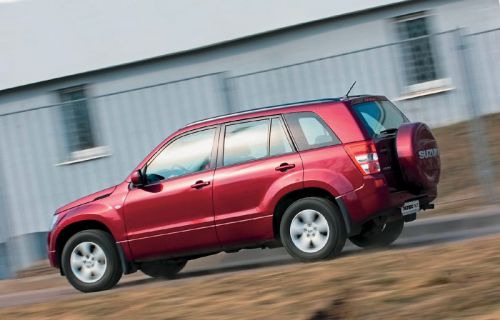
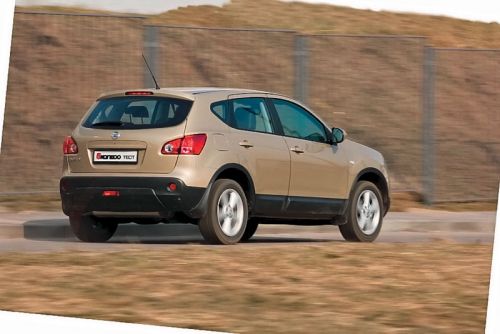
Nissan Qashqai is a newcomer to our market, but it has already managed to build up queues several months in advance. However, one should not think that the debutant is destined for a cloudless life: it faces a battle with the time-tested Suzuki Grand Vitara and Honda CR-V.
This test brings together three all-wheel-drive crossovers with two-liter gasoline four-cylinder engines of roughly equal power. But their transmissions are all different: the Suzuki Grand Vitara has a classic automatic with a torque converter and planetary gearset, the Honda CR-V has a regular manual, albeit a six-speed one, and the Nissan Qashqai has a CVT, exotic for our region, that is, a continuously variable transmission.
The gear ratios of the Honda CR-V's manual gearbox are selected to extract maximum acceleration. Each successive gear is longer than the previous one. After 120 km/h, the thrust is no longer as confident, and acceleration noticeably slows down. Sixth gear is purely "economical," and the car reaches its top speed in fifth. On a long journey, this is a real lifesaver — you can save a decent amount of fuel. The advantage of a traditional manual is that the driver decides how to manage the power: you can, for example, accelerate in first gear up to 60 km/h, engage sixth, and cruise at a constant speed without burning excess fuel. The Suzuki automatic, working in tandem with a longitudinally mounted engine, offers more comfort. But getting used to its shift logic is not easy. Sometimes you are tempted to abandon "drive" mode and take control into your own hands, but there is simply no manual mode here. And four gears are clearly no longer enough these days — that is a weak point.
Suzuki Grand Vitara vs Nissan Qashqai vs Honda CR-V. Battle of the Samurai
© Photo: Sergey Krestov, 5 Koleso
Suzuki Grand Vitara vs Nissan Qashqai vs Honda CR-V. Battle of the Samurai
© Photo: Sergey Krestov, 5 Koleso
Suzuki Grand Vitara vs Nissan Qashqai vs Honda CR-V. Battle of the Samurai
© Photo: Sergey Krestov, 5 Koleso
But the Qashqai's CVT can bring real pleasure to those who like to drive fast. It manages to combine the smoothness of an automatic and the power control of a manual. Avid drivers might try the six programmed virtual gears, but more out of curiosity — they will quickly return to automatic mode. If you floor the gas pedal, the engine revs up briskly to 6,700 rpm and delivers all its power. During acceleration, there is no hint of dips in "revvy strain" — that is a hallmark of a continuously variable transmission.
The steering wheel of the Nissan Qashqai is perhaps the most comfortable. But the buttons for controlling onboard systems are poorly placed — on the hub. To, say, lower the radio volume, you have to take your left hand off the rim. You cannot reach them with your fingers. And the instrument panel is tilted at too steep an angle — you feel like stretching your neck to see the two "wells" where the tachometer and speedometer dials are hidden. However, you quickly get used to it. But the onboard computer screen glares mercilessly — unlike the main information, which reads perfectly. Overall, the instrument panel design looks outdated and unattractive, but it is very functional.
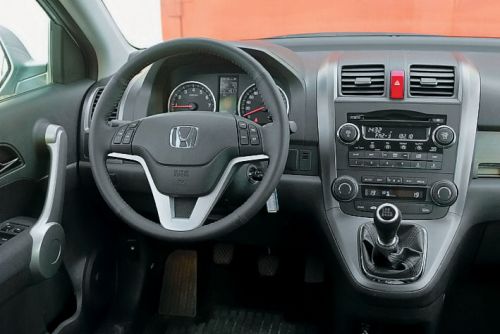
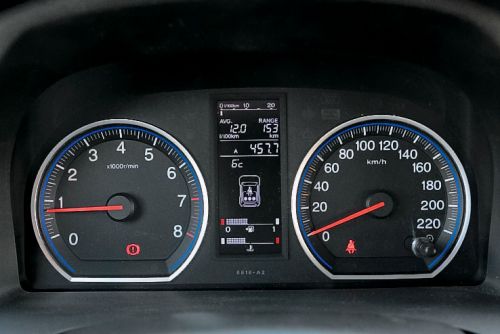
From an ergonomics standpoint, the Honda CR-V looks best. The dashboard and steering wheel here are a model of a successful solution. The hub is not cluttered with buttons — they are spread across the spokes. The color scheme of the instruments is the most successful and comfortable. At first, it seems like a Christmas tree, but you can spend the whole night behind the wheel and not get tired of perceiving the necessary information. If you look closely, the driver constantly sees only three colors: the speedometer and tachometer needles are highlighted in red, the dial rims in blue, which nicely "separates" the main from the secondary, and the main backlight is white-moon.
Suzuki Grand Vitara vs Nissan Qashqai vs Honda CR-V. Battle of the Samurai
© Photo: Sergey Krestov, 5 Koleso

Suzuki Grand Vitara vs Nissan Qashqai vs Honda CR-V. Battle of the Samurai
© Photo: Sergey Krestov, 5 Koleso
Suzuki Grand Vitara vs Nissan Qashqai vs Honda CR-V. Battle of the Samurai
© Photo: Sergey Krestov, 5 Koleso
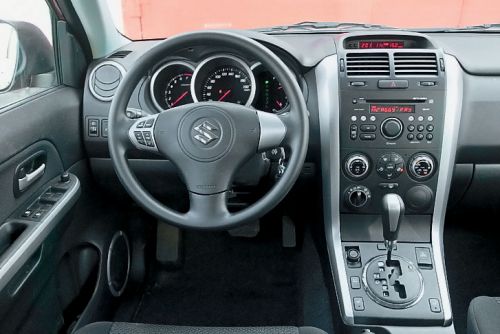
But the Suzuki Grand Vitara's steering wheel turned out to be the most uncomfortable: slippery, thin, and without thickening at the proper grip points. However, the instrument panel is constantly illuminated, and information from it is easy to read.
The Grand Vitara's main trump card is its transmission. It has both a low-range gear in the transfer case and a forced locking of the center differential. But the handling let it down: the steering wheel has no feedback, the suspension is wallowy, and as a result, at speed, the car behaves inadequately during maneuvers. The Honda's steering responses are a bit "cottony." Body roll in corners is inevitable, but the car confidently holds its intended trajectory. True, on off-road, the CR-V has nothing to do: there is no drive control here at all. When driving calmly in a straight line, it is a front-wheel-drive vehicle, and only if the front wheels start to slip does the clutch (with hydraulic disc compression, not a fashionable electromagnet) transfer up to 70% of the torque to the rear axle. That is enough to get to the dacha along a broken road.
The Nissan Qashqai cannot boast a center differential, but it offers three drive modes to choose from: front-wheel drive only, automatically engaged all-wheel drive, and permanent all-wheel drive with a locked clutch. In the latter case, the clutch rigidly connects the axles without a differential, which noticeably enhances off-road capabilities. Moreover, the Qashqai has the best handling: the suspension allows fairly brisk driving, but frequent bottoming-out is disappointing. In the end, the Nissan showed a good result and shared first place with the Honda. But the Grand Vitara, despite its off-road talents, remains in third place.
Suzuki Grand Vitara vs Nissan Qashqai vs Honda CR-V. Battle of the Samurai
© Photo: Sergey Krestov, 5 Koleso
Suzuki Grand Vitara
The Grand Vitara was last updated in 2005, but demand for it remains consistently high. Largely thanks to its expressive appearance, which, combined with the low-range gear, looks like a good offer. Prices start from $30,475 (792,350 rubles) and go up to $36,692 (954,000 rubles).
Driving
It is a bit heavy to drive in the city — all the unit settings are tuned for off-road.
Interior
The trim is without frills, and on a long trip, the driver constantly wants to stretch.
Comfort
The interior ergonomics are in a traditional vein.
Safety
Body with reinforced frame and programmed deformation zones.
Price
Given that the arsenal only includes full-fledged all-wheel drive, the price seems inflated.
Suzuki Grand Vitara vs Nissan Qashqai vs Honda CR-V. Battle of the Samurai
© Photo: Sergey Krestov, 5 Koleso
Nissan Qashqai
The completely new Qashqai crossover debuted at the beginning of the year. The car attracts with its pleasant design, a rich choice of trim levels, a set of options, and, most importantly, adequate prices. The most affordable all-wheel-drive version with a CVT costs $28,300.
Driving
It is a pleasure to drive, and the steering is informative.
Interior
Compact dimensions always require concessions, and in this car, the trunk became one.
Comfort
Inside, not everything is so simple: you need to get used to the ergonomics; it cannot be called ideal.
Safety
When creating the new model, all modern safety standards were taken into account.
Price
A wide range of trim levels provides the opportunity to choose across a large price range.
Suzuki Grand Vitara vs Nissan Qashqai vs Honda CR-V. Battle of the Samurai
© Photo: Sergey Krestov, 5 Koleso
Honda CR-V
The Honda CR-V appeared in Russia a little earlier than the Qashqai. The car received a completely new design, becoming bolder and more dynamic. At the same time, prices have practically not changed. However, this does not mean that the model has lost its consumer qualities. Everything is done with the usual Japanese meticulousness. The price tag ranges from $33,800 to $39,500.
Driving
The manual allows precise dosing of thrust and gives the car brisk dynamics.
Interior
Inside, it is spacious and comfortable. Everything is at hand, and the many shelves, armrests, and niches turn the CR-V into something like a minivan.
Comfort
There is plenty of free space in the cabin, but the seats themselves could be more comfortable.
Safety
The car is equipped with a large set of active and passive safety systems.
Price
The change of generation of the CR-V did not lead to a noticeable increase in prices.
Our opinion
Suzuki Grand Vitara vs Nissan Qashqai vs Honda CR-V. Battle of the samurai
© Photo: Sergey Krestov, 5 Koleso
Nissan Qashqai performed excellently and shared first place with the Honda CR-V. The newcomer wins over with a reasonable price, a wide choice of versions, and the option to order a CVT. The CR-V will cost more, but this overpayment is justified by the spacious cabin and roomy trunk. The Suzuki Grand Vitara is inferior to its rivals in handling on dry surfaces. Its only significant argument is the transfer case with a low range. But with such a modest set of advantages, you won't get far.