
While governments of all countries are struggling to improve the quality of road surfaces, laying new highways, building bridges, and cutting tunnels through mountains, time in people's minds seems to turn back. Paradoxically, there are more and more people wanting to buy an SUV, crossover, or high-clearance station wagon. Forecasts for the near future: the market in this segment will grow! So why are they building?
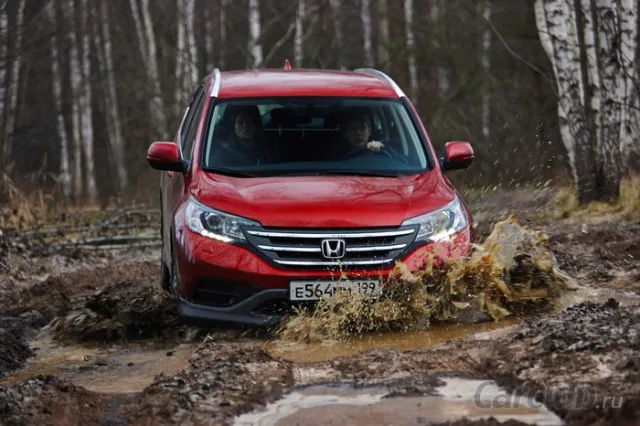
They build for them, and the new generation Honda CR-V is direct proof of that. The Japanese crossover has never been on the list of desirable cars for desperate trips through mountains and forests, but now it is even less suitable for that. Ground clearance has been reduced to just 170 car-like millimeters, the permanent all-wheel-drive system has lost two hydraulic pumps, gained an electronically controlled multi-disc clutch, become 17% lighter, and is now more inclined to support safety on slippery asphalt, while the engine protection and rubber mats for the cabin are sold separately for 8,500 rubles.
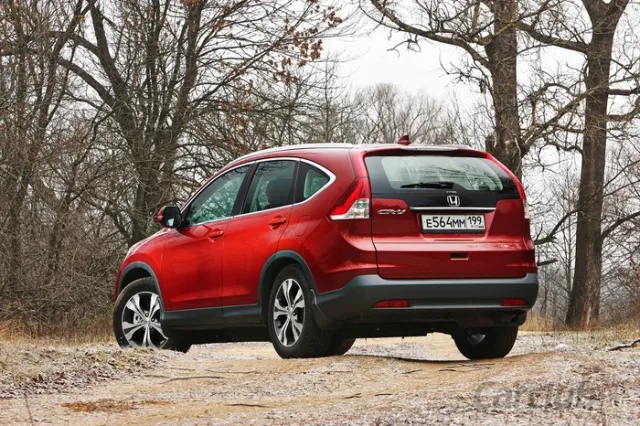 The aerodynamics of the new Honda CR-V body have been improved by 6.5%
But as if anticipating such thoughts, the organizers of the Russian test lay out the test-drive route through a forest thicket – breaking ice on puddles with road tires and churning mud with the wheels. Here's the first of them: a dull thud hits right under the floor of the Honda CR-V, we carefully roll over ruts, afraid of damaging body panels only slightly protected by plastic trim. Suddenly, the frozen ground makes the stability system loudly crunch its brake pads. We turn off the ESP, or rather only the traction control system, because nothing else can be turned off here. The wheels of the front and rear axles start to slide, trying to pull the crossover's body out of the mud trap. Surprisingly, it all works out.
Almost all automakers now use a similar scheme, and as practice shows, this is the best alternative to outdated hydraulic clutches. But if the Volkswagen Tiguan, in addition to connecting the rear axle and distributing torque between each wheel, also has different ABS operation modes, imitation of the inter-wheel differential lock, and a different transmission algorithm, then in the Honda in this regard there is complete calm. But on asphalt, predicting the behavior of the Honda CR-V has become easier. Previously, when starting from a standstill, the rear axle remained inactive, but now you can press the gas pedal to the floor, and part of the traction will instantly transfer to the rear, preventing the car from spinning its wheels. Solid pluses from the distribution of torque between the axles also when cornering.
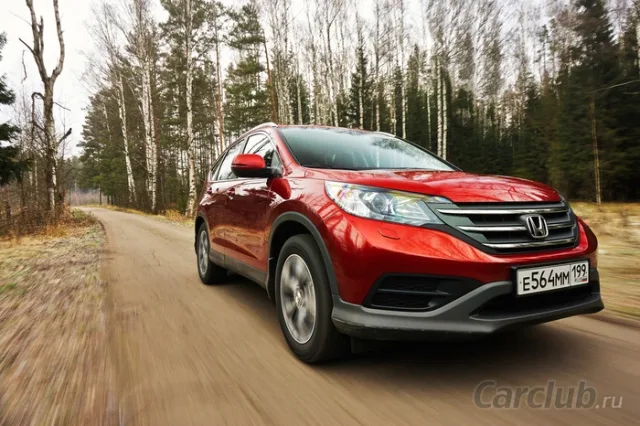
The car has become 16.3 kg lighter than its predecessor, and now its weight with the automatic transmission is 1580 kg
The Japanese expect that the Honda CR-V in its fourth generation will rejuvenate its audience by at least a few years. To do this, the team of the crossover's chief designer, Konaka Manabu, has done, without exaggeration, a huge amount of work. The exterior has become much more expressive, the shapes have transformed, and all this – for Japanese pennies. The body itself has almost completely retained its structure: the length has decreased by only three millimeters, the width and wheelbase have remained the same, and the height has increased by a centimeter.
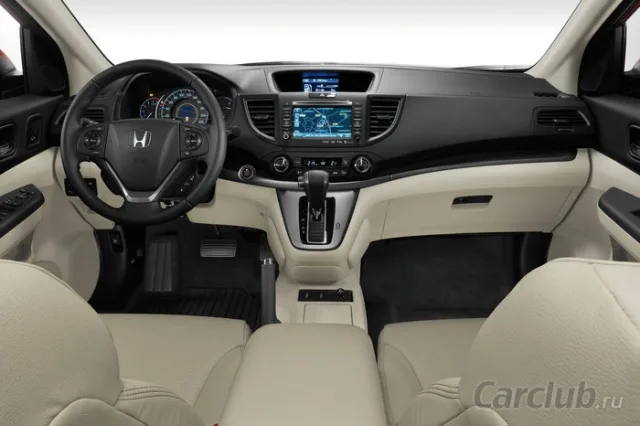
What am I talking about? Ah, the interior has become more spacious, although the predecessor also had one of the most "airy" cabins in the class. It's not just about the dimensions, but also the layout: the rear sofa, for example, is lowered down, so there is more space above the head – though kids and short passengers will now see the road ahead worse. The front seats are also spacious and comfortable, but you can no longer roam around in the literal sense of the word. Previously, you could park with the left side close to a fence or house wall and move from the driver's seat (yes, yes, exactly move) to the passenger seat. In the new generation of the car, the central tunnel with the handbrake lever and seat heating buttons will not allow this.
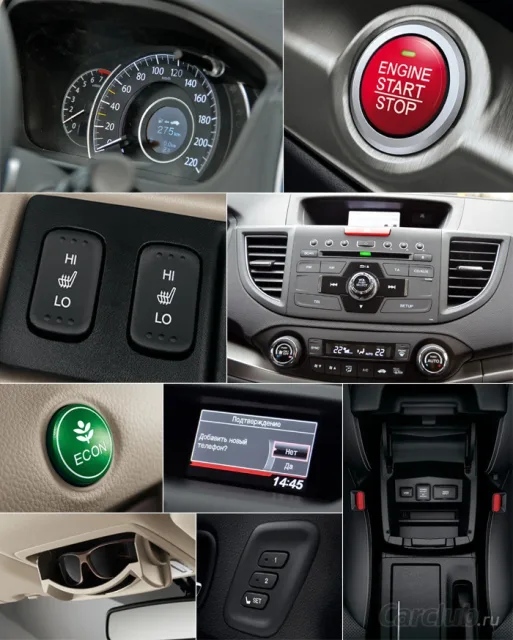 The Honda CR-V menu is Russified, but controlling it is a bit tricky: sometimes it's simply impossible to exit a section. The instrument panel, though compact, is easy to read. In the expensive trim, there is an engine start button and seat memory. The ECON button allows you to save a little fuel, but makes the CR-V's dynamics completely sluggish.
The Honda CR-V can boast not only an almost perfectly flat floor when the rear seat backs are folded, but also one of the lowest-positioned trunks. To load suitcases and bags, you won't have to lift them above the knee! The minimum volume of the compartment is 589 liters, and the maximum is 1669 liters. There is only one negative point: after a dirty road, you can touch the rear door handle only with rubber gloves up to the elbow.
The credit for the successful layout belongs to the new design of the rear multi-link suspension. Its travel has been increased by 10%, thereby also improving ride comfort. At the same time, handling has not suffered. Unlike American cars, Russian ones are equipped with shock absorbers with 10% increased stiffness and larger-diameter anti-roll bars. In corners, the body tries to keep itself level, not swaying from side to side.
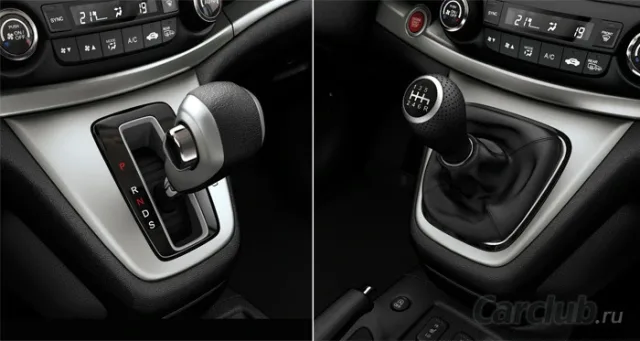 The manual transmission is noted for its precise shifts and well-chosen gear ratios. The automatic transmission is more tuned for comfort, although it has decent shift speed. True, this does not save the Honda from mediocre dynamics.
But all the technical delights can be spoiled by the only engine currently available for the car, the 2.0 i-VTEC. Its power in Russia is 150 hp (at 6500 rpm), and the maximum torque is 190 Nm (at 4300 rpm). It seems to have become nine percent more economical and according to the specs should consume 7.7 liters of gasoline in the combined cycle, but in reality the onboard computer showed a figure close to 10 l / 100. In Europe, this engine is even five horsepower more powerful, but we have taxes...
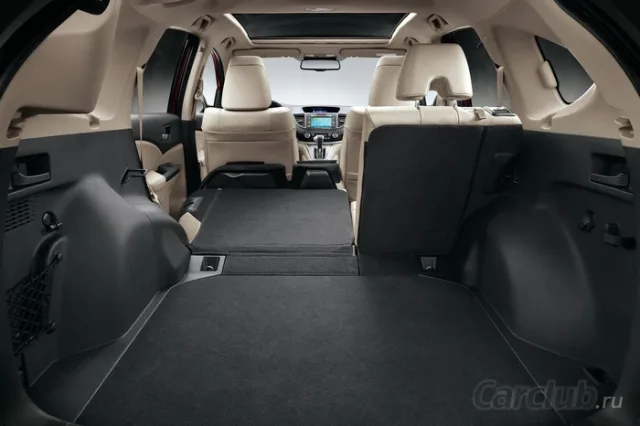 The minimum volume of the trunk is 589 liters, and the maximum is 1669 liters. There is only one negative point: after a dirty road, you can touch the rear door handle only with rubber gloves up to the elbow.
Acceleration from standstill to 100 km/h in 12.9 seconds in the case of the Honda CR-V is a depressing feeling. The gas pedal seems to live its own life, detached from the driver: you press the gas to the floor, wait for the command to reach the 5-speed automatic transmission. Having downshifted, the crossover does not come alive, the acceleration remains just as endlessly long, and an unpleasant and useless hum begins to come from under the hood.
The sport mode of the "automatic" does not help either. It does not affect anything except gear changes, which occur when the maximum rpm zone is reached. If you additionally resort to the paddle shifters, the tachometer needle will just hang in the red zone, and the automatic transmission will not upshift on its own, hinting at its desire only with a green arrow on the instrument panel.
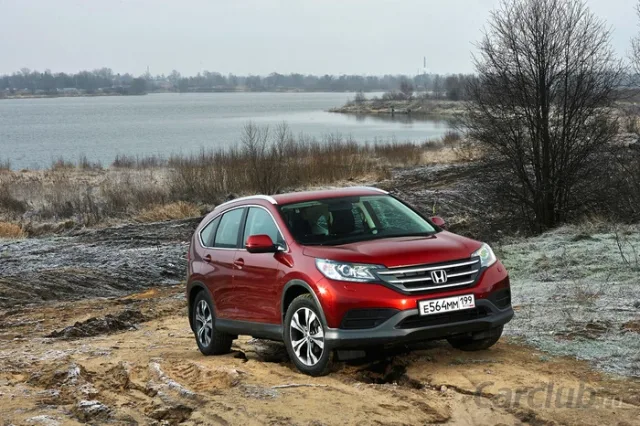 The car has become 16.3 kg lighter than its predecessor, and now its weight with the automatic transmission is 1580 kg. The turning radius is small – only 5.5 meters, and the steering wheel makes 3.16 turns from lock to lock.
The car has no other reserves. But Honda has taken care of fuel consumption and introduced a green "ECON" button to the right of the CR-V's steering wheel. I'm not sure that the prospect of saving half a liter of fuel outweighs the even sadder behavior of the car. But the button heats up strongly after half an hour, as if demonstrating its efforts. At least you can pour 92-octane gasoline into the tank, and thanks for that.
The Honda CR-V has remained a car that recognizes comfort first and foremost, not sport. It's pleasant to be inside, to hold the leather steering wheel, to look at the glowing bluish instrument panel, and even more pleasant when a greenish halo lights up around the speedometer. This means your nerves are in order, and you can quite pass the fitness test for elementary school teachers. Additional sound insulation in the doors allows you to talk without raising your voice, and the mirror in the glasses niche lets you spy on rear-seat passengers: kids in child seats, so they don't misbehave, or teenagers, if one of them is your daughter and the other is not your son.
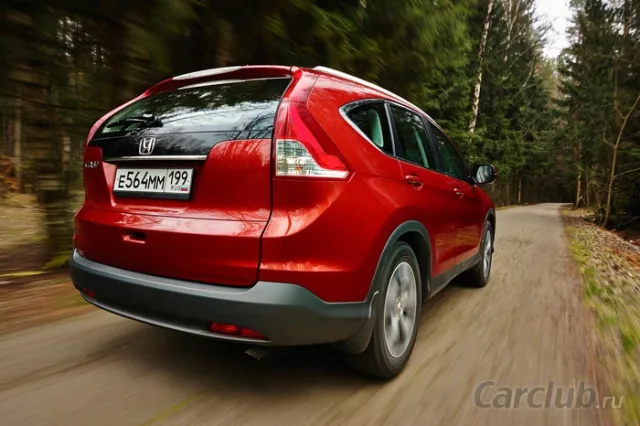 Nine body colors are offered for the car. The surcharge for metallic is 12 thousand, for pearl shade – 18 thousand rubles. For 13 thousand rubles, you can purchase engine protection, cabin mats, and a trunk tray, and for 55 thousand, an exterior tuning package is offered: more aggressive bumpers and a spoiler on the fifth door.
For the pleasure, you will have to pay at least 1,149,000 rubles. This is a good price considering the equipment: stability system, eight airbags (with a deactivatable "airbag" for installing a child seat on the front passenger seat), audio system with USB, AUX and MP3, 18-inch alloy wheels, 5-inch i-MID display, dual-zone climate control, power and heated mirrors, power windows on all side doors, cruise control, speed limiter, and a 6-speed manual transmission.
For the slow 5-speed automatic transmission you need to pay an extra 70 thousand rubles, and the Lifestyle trim will cost at least 1,299,000 rubles (the surcharge for the automatic in this case is 50 thousand rubles). In the top version, the car will be equipped with fog lights, six speakers instead of four, an alarm, a leather gear shift lever, power-folding exterior mirrors, electric adjustment of the passenger seat lumbar support, rain and light sensors, an auto-dimming rearview mirror, Bluetooth, a rearview camera, parking sensors, and a leather steering wheel.
 For 13 thousand rubles you can purchase an engine protection plate, interior mats, and a trunk tray, and for 55 thousand an exterior tuning package is offered: more aggressive bumpers and a spoiler on the fifth door.
Honda also promised to start supplying crossovers with a modernized 2.4 i-VTEC engine producing 185 horsepower and a 5-speed automatic transmission to Russia from spring 2013. But that will be a completely different story…