Today, the hot segment of the golf class is a real diversity of power. Some models are content with 200 hp, like the Golf GTi or Octavia RS, others approach 220–225 hp (Focus ST, Volvo C30), others prefer 240 hp (Opel Astra OPC), and some go all the way to 250 (Audi A3 Sportback 3.2, VW Golf R32). At the top are the Mazda3 MPS with 260 hp and the BMW 130i with 265. Our hero, the Civic Type R, has 201 hp. Is that enough? With its entry into the Russian market, fans finally got to see the three-door version. In Europe, this body style is also offered for the moderately sporty Type S, but here, three doors are exclusively a sign of the most powerful modification.
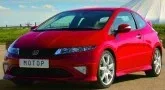
It must be admitted that in this body, the car looks magnificent. The five-door version is also good, but the "cut-down" version feels much more sporty. Especially when the car is bright red and complemented by a laconic, stylish body kit. Just a sight for sore eyes! The alloy wheels are also pleasing, though their design is a bit simple. The futuristic look of the standard Civic has been slightly toned down by the developers. The front "crystal chandelier" now looks more prosaic: the elongated, slanting headlights are no longer connected by a transparent bridge; between them sits a black radiator grille. But the Honda emblem on it is red.
At the rear, there's a new, striking spoiler that, fortunately, doesn't worsen the already poor rear visibility, and the trunk lid bears the "Type R" inscription. The exhaust system is still styled as striking triangles integrated into the bumper. Inside, there's less "glass." In the regular Civic, the instrument panel is entirely made of shiny plastic resembling tinted glass, but here, the outer sections are made of a pleasant gray material that doesn't glare or scratch. The steering wheel rim is thicker, and the gearshift knob, which previously had an intricate shape, now looks like a metal ball—very convenient. The lever travel is shorter, and the shifts remain perfect in effort and precision of engaging the right slot.
Changes also affected the gearbox internals: the final drive ratio is shorter. The sport seats with the "Type R" logo on the backrests are made by Honda itself. They hold you excellently in corners. Red dominates the interior trim, and the instrument lighting is also red. The interior, like the exterior, deserves the highest praise—sporty, cozy, beautiful, and very high quality. A pleasant surprise is the space in the second row. Two people of above-average height fit easily there, even if the front seats are occupied by not the shortest drivers. Given Honda's traditions in sport engine building, the most interesting detail in the cabin is the tachometer. It takes the main place on the instrument panel, right in front of the driver's eyes. Its feature is that the red zone starts at 8000 rpm. This is a eloquent hint that the engine needs to be constantly "revved." Which I did with great pleasure throughout all six days of the test.
Honda implemented the idea of hybridization in the character of the engines installed in sport models. The temperament and sound of the Civic Type R's engine brought to mind the legendary Japanese motorcycles. Although in the latest Type R generation, the engine's character has been slightly softened (the control program was changed and balance shafts were added for smoothness), it still reveals its best qualities in the upper range—roughly from 5700 to 7600 rpm. It's still the same two engines in one, but with a less abrupt transition between them.
An acquaintance of mine who owns a Honda Accord asked for a ride in the new car, and I couldn't refuse. At first, the road conditions didn't allow revving above 6000, which didn't stop the car from going fast. The passenger was slightly disappointed—saying it doesn't push you into the seat. But as soon as the road cleared, I immediately floored the accelerator. The needle quickly passed the 6 mark, the engine howled like a motorcycle, and the Civic lunged forward. A quick shift, the naturally aspirated engine didn't drop out of the productive rev range, and after the clutch release, the car sharply accelerated again. "That's the Honda way..." the passenger said with a blissful smile.
Yes, that's it. Rev it to go! This is true sport philosophy. The philosophy of asphalt "rings" and small, ultra-powerful, high-revving engines. The 200 hp under the Type R's hood are delivered in a 2000-rpm band with a captivating racing sound.
Despite not having the most power, the dynamics of the small hatchback are very good—claimed 6.6 seconds to 100 km/h. However, the concentration of power in a narrow rev range (and the lack of turbo-like torque at mid-range) means the Type R either flies at full tilt or moves calmly in economy mode. At least, that's how it always worked out for me.
In small sporty cars, I primarily value balanced characteristics. In some of the models listed above, the power didn't always find a full ally in the chassis. But in the Civic, all its 200 "horses" are in complete harmony with the suspension's capabilities. The chassis is tuned filigree. Even the stock version (which we had on a long-term test) could boast excellent handling. In the "hot" version, it was improved. For the Type R, the body stiffness was slightly increased, the suspension was lowered by 15 mm, more energy-intensive shock absorbers and stiffer springs were installed, the rear track was widened by 20 mm, and the electric power steering settings were changed. As a result, the Type R's handling is perhaps the most transparent and sharp in its class. Any trajectory can be traced with micron precision.
The suspension is energy-intensive, and body roll is minimal. This is especially evident during a "slalom"—the car barely squats on the outer wheel. Only in photos can you notice that the Type R does lean a bit. Despite the structural simplicity (MacPherson up front, semi-independent torsion beam at the rear), it's tuned very well. In a limit corner, the hatchback's behavior can be called almost ideal. On lift-off, the rear axle starts to slide smoothly. If you add throttle, the car straightens the trajectory. Fighting understeer is even easier—just load the driven wheels at turn-in, and the Civic dives into any bend. On straight-line driving, the car is stable, and high-speed arcs are also taken confidently—I'll note again the precision of the electric power steering.
The "hot" hatch from Honda costs significantly more than Japanese and some European competitors. However, given the above circumstances, this doesn't cause protest or surprise—the price seems adequate, even if you forget about the inadequacy of Russian pricing.
**PRICES AND TRIM LEVELS**
The car is offered by dealers in a single trim level, priced at $37,800. It includes, among other things, dual-zone climate control, a cooled glovebox, rain and light sensors, and cruise control. Front seats are "Alcantara" Type-R with memory, Bluetooth preparation, and 18-inch alloy wheels (option—19-inch wheels). The default color is red, but for an extra charge, you can choose silver, "black pearl," and "deep bronze with pearl."
**EXPERT OPINION**
Alexey Kolontai, head of the "MasterClass" center for counter-emergency driver training.
The miniature Honda looks so attractive from the outside that you can't take your eyes off it. Every body line is crafted neatly and clearly with soul. At first glance, it seems this elegant little car has a docile nature and is made exclusively for ladies. However, just open the driver's door, and all doubts about its sporty nature dissipate—the engine is started by a button to the left of the steering wheel, a manual gearbox is installed, and the tachometer has a red zone from 8000 rpm. Additionally, the manufacturer claims 200 hp from the naturally aspirated engine.
If you floor the gas pedal, the Type R truly shines after 5000 rpm. At six thousand, there's a real "shot"—as if a turbocharger kicks in, which isn't actually there. The steering wheel turns equally comfortably and easily in all driving modes. I was especially pleased that countering a deep rear-axle slide can be done effortlessly with one left hand, using the technique of rolling over the back of the palm. The wheel doesn't interfere with this complex maneuver at all—it doesn't resist, and the effort builds smoothly, without "steps." Both the diameter and the rim cross-section are perfectly chosen.
However, the location of the parking brake drew criticism—in cars of this class, the "handbrake" often serves as a control element. Here, it's pressed against the driver's seat, and the side bolsters somewhat restrict access to it. That said, you can get used to it. It's also worth noting that the Honda allows you to easily control a "rhythmic slide," which can be used to combat understeer.
"9 Friends of the Civic Type R"
Volkswagen Golf GTi
Engine 2.0 turbo (200 hp, 280 Nm)
235 km/h, 0–100 km/h – 7.2 sec
Starting price $33,624
Skoda Octavia RS
Engine 2.0 turbo (200 hp, 280 Nm)
240 km/h, 0–100 km/h – 7.3 sec
Starting price $33,690
Ford Focus ST
Engine 2.5 turbo (225 hp, 320 Nm)
241 km/h, 0-100 km/h – 6.8 sec
Starting price $30,450
Volvo C30 T5
Engine 2.5 turbo (220 hp, 320 Nm)
240 km/h, 0–100 km/h – 6.7 sec
Starting price $38,400
Opel Astra OPC
Engine 2.0 turbo (240 hp, 320 Nm)
244 km/h, 0–100 km/h – 6.4 sec
Starting price $31,330
Audi A3 Sportback 3.2 quattro
Engine 3.2 V6 (250 hp, 320 Nm)
250 km/h, 0–100 km/h – 6.4 sec
Starting price $50,900
Mazda3 MPS
Engine 2.3 turbo (260 hp, 380 Nm)
240 km/h, 0–100 km/h – 6.1 sec
Starting price $31,900
BMW 130i
Engine 3.0 V6 (265 hp, 315 Nm)
250 km/h, 0–100 km/h – 6.1 sec
Starting price (6-speed, manual) $43,400
VW Golf R32
Engine 3.2 V6 (250 hp, 320 Nm)
250 km/h, 0–100 km/h – 6.2 sec
Starting price (6-speed, manual) $52,500