

The new-generation Honda Civic debuts on the Russian market as a sedan with a 140-horsepower engine. The new car has demonstrated at a modern level all those family traits that once made the Civic name famous.
2006 Honda Civic
© Photo: Igor Kuznetsov, 5 Koleso
I wear neither top hats nor bowlers. I am not a gentleman and, therefore, can quite afford to get into a car rather than "step into" it. And my height does not exceed 1.8 meters by much. Perhaps only because of these "unique" traits of mine, I do not feel much enthusiasm about the widespread trend among mass-market golf-class cars to match the height of highway buses. The new Honda Civic, despite being a sedan with an automatic, is a centimeter lower (!) than the previous generation cars. Today this is almost unbelievable. But even though the Honda Civic has little chance of becoming the official car of the national basketball team, the car makes the most pleasant impression.
Over the past twenty years, adherents of a formal approach to assessing a car's class affiliation have tried to prove to the world that the name Honda Civic must necessarily imply a quality but ordinary little "Japanese car." They try to prove this with such blind arguments as the ratio between the number of cars sold in utilitarian versions and the population of various, in their opinion, renegades like Type R, Vti, Si, CRX, Del Sol (depending on the era and continent). However, this claim is not true at all. From an engineering, aesthetic, and emotional point of view, the Honda Civic in utilitarian versions, unlike the vast majority of classmates, are shadows of the gods descended to everyday life. Not the other way around, as is more often the case in the automotive world. Even modest versions of the car had an independent double-wishbone suspension as early as 1989, and a variable valve timing system since 1991...
The car's charisma, initially emotional and fast, has been preserved to this day. It is felt even in the appearance of the sedan:
— Wow, a new one! How many "horses" does it have? Probably 200?
It is this monologue that talkative passersby lingering near the car exhale, under the influence of the laconic language of harmony of the clean lines of the Honda Civic's body.
For now, there is only one engine: an aluminum power unit with a displacement of 1.8 liters and a power of 140 hp. Like all Honda engines, it is 16-valve. With a single overhead camshaft and i-VTEC system.
The proprietary system has been modernized to improve fuel economy at low engine loads. In a steady driving mode at low revs (1000–3500 rpm), i-VTEC keeps one of the intake valves open at the beginning of the compression stroke, reducing the trapped volume and, consequently, compression losses when operating under low loads. In addition, thanks to the ability to manipulate the intake valve opening phases, in cruise modes the engineers managed to use the effect of artificial backpressure in the intake tract to reduce the actual volume of the combustible mixture entering the cylinders. At the same time, the throttle is open wide enough: managing traction no longer requires millimeter movements of the right foot from the driver. "On the pickup," i-VTEC works with an intake manifold with two channels to each cylinder: up to 5200 rpm only the long "tunnel" is used, and with further revving, a shorter channel is additionally opened.
2006 Honda Civic
© Photo: Igor Kuznetsov, 5 Koleso
Despite the fact that the throttle drive is electronic, the Civic wins over with both the responsiveness and precision of its responses to the pedal, and the materiality of the driver's sensations: there is no longer the feeling that you are controlling the dynamics with a ship's telegraph, as was the case with the first electronic systems. The new Honda five-speed automatic debuts on this car: a solid modern automatic transmission with a torque converter. A pleasant circumstance is that the manual mode here is "honest": if you want, hang on the limiter (which, by the way, is a bit harsh). If you want, brake with the engine, especially since there is the ability to use the paddle shifters on the steering wheel.
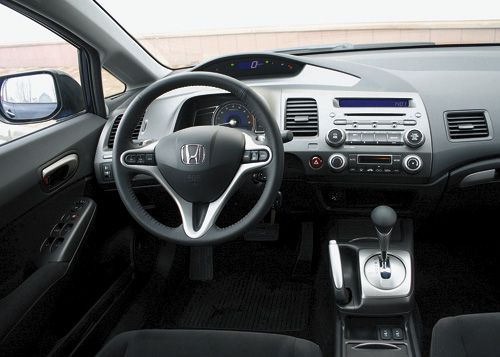
Around the steering wheel is concentrated an area of excellent driver ergonomics. The seating position in the wide seat with moderate lateral support vividly resembles that characteristic of the fifth and sixth-generation Civics: legs are largely extended parallel to the floor, the footrest and floor-mounted gas pedal stand almost vertically. The position of the extremely comfortable small-diameter steering wheel is adjustable both for height and reach. Directly in front of the driver's eyes is a large "saucer" of the tachometer, slightly higher is a digital speedometer: not the most traditional instrument layout, but it reads perfectly. Only the blue backlight raises certain concerns.
Another solution, as unusual as it is successful, is the placement of the handbrake lever. And the fact that the distances from it to the steering wheel and to the gear selector (or the "manual" lever) are so small reminds of a purely racing approach to saving the driver's movements needed for driving. The steering column switches, mirror and window control buttons are made large, embossed, and allow you to rely solely on tactile sensations right away, without distracting attention from the road. Forward visibility is quite good, except that—traditionally for most modern cars—it is spoiled by the wide left front pillar. The final touch to the picture of care for the driver is that even the glove box lock release handle (of a very small box) is oriented toward him.
The space for rear passengers does not shine with special capabilities: you can sit quite decently only behind a person of average height. If the front seats are significantly moved back, there is very little room left for knees.
The luggage compartment has ordinary capacity (approx. 340 l), but is convenient to use due to the low loading height, "clean" internal shape, and ease of folding the rear seat back (in parts).
Passengers may complain that the car is a bit noisy. Indeed, serious sound insulation in the Civic has never been, and is not now. It is hardly a matter of saving money: the interior is finished at the level of the leaders of the golf class. This can be perceived as a tradition. And if you are behind the wheel, you are unlikely to be picky about noise. Even despite the fact that Honda engines have had more refined voices.
You will have no time for "sounds of bad mood": the chassis works so well that it turns even a simple trip around the city into pleasure. The components of this success are the family roots of handling tuning and the caster of the front suspension increased to a value exceptional for front-wheel drive. Also, the successful tuning of the rear suspension, the "honest" power steering, and the "short" steering rack (2.67 turns). Winning combinations and ratios between refined handling, lightning-fast and precise responses to the steering wheel while maintaining an acceptable level of comfort and suspension travel adequate for Russian roads introduce the current Honda Civic into the narrow circle of mass cars with first-class chassis. What will the "hatch" be like?
Russian buyers will find out only in the summer. But the Honda Civic sedan can be bought today. Prices for the car with an automatic start from $21,200.
Technical specifications of Honda Civic
Body – sedan
Curb weight, kg – 1220
Gross weight, kg – 1620
Dimensions, mm:
- length – 4490
- width – 1750
- height – 1435
Wheelbase, mm – 2700
Trunk volume, l – 340
Maximum speed, km/h – 190
Acceleration time to 100 km/h, s – 9.5
Reference fuel consumption, l/100km – 7
Engine:
- type – petrol, inline, 4-cylinder, 16-valve, SOHC i-VTEC
- displacement, cm3 – 1798
- power, hp at rpm – 140/6300
- torque, Nm at rpm – 174/4300
Transmission – automatic, 5-speed
Suspension (front/rear) – McPherson/double-wishbone
Brakes (front/rear) – disc, ventilated/disc
Price, $ – from 21,200.
Advantages and disadvantages
+ Quality, handling, ergonomics.
– Sound insulation.
© 5 Koleso