
Great Wall SUV G 5. The Chinese have invented a new body type
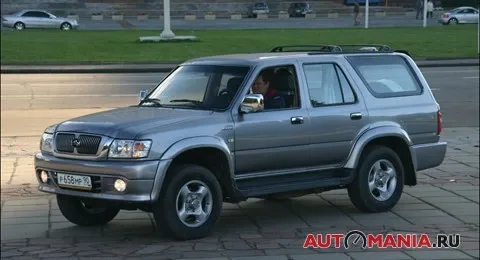
For the test, we got a jeep with a tricky name — Great Wall SUV G 5, and with the prefix Safe. After a couple of days of testing — both on snow and spring mud — I still couldn't understand what SUV has to do with it. After all, Sport Utility Vehicle is commonly understood as a crossover with pretensions to sportiness. But the G5 doesn't reach either sport or "crossover." It's a classic frame SUV, and the donor for it was the Toyota 4Runner. That the Safe is not afraid of off-road is evident from the differential locks right in the cabin (like on the old "Niva") and additional manual locks of the center differential on the front wheels (like on the "UAZ" or the first Nissan Patrol). More precisely, there is a rigidly engaged front axle with freewheel hubs. Off-road, the Chinese car behaved excellently and even didn't back down in front of snowdrifts and deep mud ruts. A colleague persuaded me to drive where his old "Niva" got stuck. We managed, although the G5 weighs 1760 kg — clearly more than the VAZ 2121.
When I picked up the car from the "Irito" dealership, I couldn't understand why with a 2.3-liter engine the power is only 105 horsepower — the same as the Hyundai Getz with a 1.6-liter engine and a mass of about a ton. The seller said mysteriously: "You'll drive it — you'll understand." The old licensed "Mitsubishi" unit is tuned like a diesel: in the city it's sluggish, but off-road it pulls excellently. One authoritative publication even wrote that the G5's engine is from the Mitsubishi L200, but they were mistaken — the L200 has always had only a diesel.
The start from Danilovsky Market was a bit disappointing. I couldn't get comfortable behind the wheel — the seat didn't want to adjust, and the steering wheel constantly pressed into my knees. There are no adjustments at all — twist as you like. Then, with difficulty pressing the clutch, I moved off. The gears are short, engage clearly, but there's a "gap" between second and third. On third, it doesn't pull out of a turn, on second — it roars. The transmission, as it turned out later, is Korean, but it's clearly not designed for such a weak engine and the jeep's weight. That's why in press releases and papers from the glovebox there's no word about the G5's acceleration time to 100 km/h. The car can go 140-150 km/h (we managed to accelerate), but there's zero pleasure — engine roar, vibrations, and noise from the side mirrors-"ears."
As befits a Chinese car, there's a bit of everything here: something from the Mitsubishi Pajero Sport, something from the old Ford Explorer. The steering column switches are clearly ripped off from "Mitsu," the window lifter — from Nissan. The body, as I already said, is "Toyota."
The interior is typical for Chinese cars: light velour in coffee with milk color (they promise to replace it with dark soon), hard plastic, and no airbags — not even a hint of them. Heated seats and mirrors are also absent. But during operation, we found a lot of interesting things in the jeep. For example, we spent a long time figuring out how to open the rear door to load a huge TV for the dacha.
The process turned out to be not simple. First, you need to manually fold down the bracket with the spare wheel. Then, from the cabin with the ignition on, lower the rear door glass (this is a popular feature of American jeeps) or do it with the key by turning it in the lock. Then, with your hand, lower the latch and pull the door toward you, which is usually dirty. Doing this without getting your hands and clothes dirty is almost impossible. And what if the electric window button fails? However, the Chinese shouldn't be blamed — the same algorithm was on the Toyota 4Runner. In short, we still loaded the TV. With difficulty and under the constant howling of the "siren" when the rear tailgate is open.
The heater also didn't please. In the cabin, it's either hot or cold. Moreover, after each ignition off, it somehow turned itself on to full. You drive and constantly turn the regulator — either to the blue or red zone.
But the funniest thing about the car is something else. It turns out I drove for two evenings with the high beams on. Oncoming drivers sometimes flashed, but I thought there were traffic cops ahead. And only before returning the car to the dealership did I understand what was going on. On low beams — it's dark, and turning on the high beams is signaled not by a blue indicator, but by a green one, like normal cars have for low beams.
And finally — the brochure from the dealership, where we returned the G5 with a damaged rear mud flap (it cracked in the frost). I quote verbatim: body type — all-road vehicle. And I thought there were coupes, sedans, station wagons, and others. Now, apparently, a new one has appeared.
Technical specifications:
| Dimensions (mm) | 4560x1780x1820 |
| Wheelbase (mm) | 2615 |
| Ground clearance (mm) | 220 |
| Mass (curb/full, kg) | 1760 / 2085 |
| Acceleration time 0-100 km/h (s) | n/a (more than 20) |
| Average fuel consumption (l/100 km) | 10-11 |
| Engine displacement (cm³) | 2237 |
| Maximum power (hp) | 105 |
| Max. torque (Nm/rpm) | 190 / 2400 |
| Maximum speed (km/h) | 140 |
| Fuel tank capacity (l) | 74 |
| Gasoline | A-92 |
| Tires | 235/75 R 16 |
| Price (rub) | from 390000 |
Dmitry Shavyrin
We express our gratitude to the "Irito" dealership for providing the car for the test.
Source – AUTOMANIA.RU