
I drive a "Volga"
The last of the Mohicans - GAZ models of the 31st series under the "Volga" brand - are living out their final years on the assembly line. By 2010, the management of "GAZ Group" promises to discontinue them. It's a pity, of course, but the legendary car for Soviet motorists has failed to become competitive over the past 20 years. But the replacement is already ready. Serial production of the Volga Siber began on July 25 this year, and the new model will arrive at dealerships in early October. True, the new Volga has no genetic connection with the models of the founder of the domestic auto industry.
The brand is dead, long live the brand
The birth of the Siber was primarily the work not of engineers and designers from Nizhny Novgorod, but of brand managers and marketers. It was they who decided that the JR41 platform (Chrysler Sebring and Dodge Stratus), taken off the assembly line in North America in 2006 after five years of existence, could "take off" in Russia. And it was they who convinced the management of "GAZ" to purchase a license for this car, as well as equipment from the closing plant producing the outdated Chrysler Sebring in Sterling Heights.
Well-forgotten old
 |
The "Siber" has already been quite exposed to photo and TV cameras in recent months. Take, for example, Vladimir Putin's ride in the "Siber" during his July visit to the plant in Nizhny Novgorod, or the automaker's own stand at MMAS. Therefore, there was no intrigue left in the design of the new model before the journalists' test drive. In fact, there never was any from the very beginning - new bumpers, headlights, and taillights did not significantly change the Sebring's appearance. In principle, one could even question the expediency of such a "facelift" altogether - after all, it probably cost a pretty penny to the British from the studio UltraMotive.
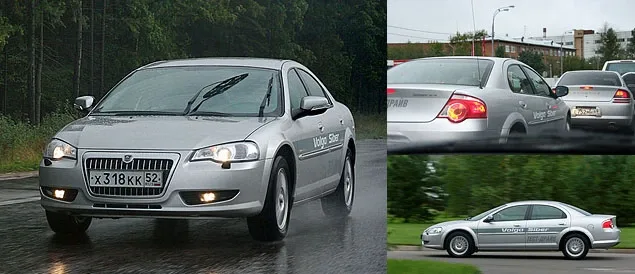 |
But the license plate mount, which divides the wide, "gaping" almost to the lower edge of the bumper radiator grille into upper and lower parts, gives the Siber a resemblance to Audi from a distance (the "Americans" don't have such a "design" element because local traffic rules allow operating a car with even one license plate - the rear one). At least, under the drizzling autumn rain, not only I but also a colleague standing nearby mistook it. However, as soon as the car came a bit closer, the recognizable body lines with the somewhat archaic "cab forward" layout immediately corrected the misunderstanding.
Why archaic? Because Chrysler began producing cars using this design principle back in 1993. And initially, the unusual-looking cars had already become familiar over 15 years. On the other hand, thanks to the front pillars resting on the hood almost above the wheel arches, the interior seems much more spacious than it actually is, and the sloping roofline of the four-door sedan resembles a coupe silhouette. By the way, it is precisely because of this aggressive body shape that many think the Siber has a low ceiling, but that's not the case. With a height of 1409 millimeters and a ground clearance of 140 millimeters, it practically does not differ in this parameter, for example, from the Mazda6 sedan.
A mixture of American and Nizhny Novgorod
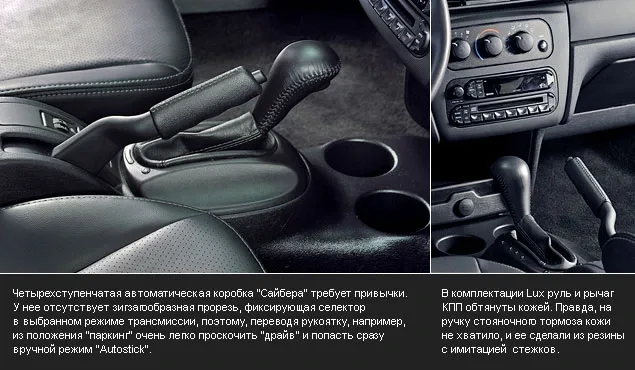
The interior of the Siber evokes mixed feelings. For example, to turn down the music, you have to find the radio console on the dashboard with your hand - in the place where the Sebring's steering wheel had audio system and trip computer controls, the Siber has neat plastic plugs. By the way, there is no trip computer either. As explained by "GAZ Group", the suppliers of components for the Sebring have already stopped producing these units. Now they will have to find a new manufacturer, preferably in Russia (after all, localization needs to be increased from 30 to 50 percent in the next two years).
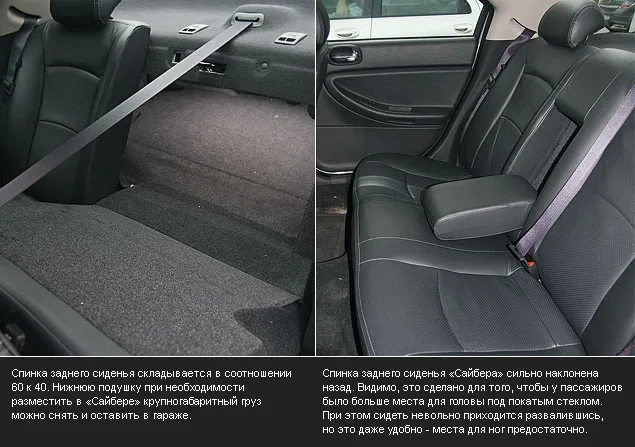
On the other hand, you can't fault the ergonomics thought out in America ten years ago - the seats already made in Russia are comfortable for the driver, the front passenger, and those sitting in the back.
 |
Moreover, in the cabin (and not only there - under the hood, all inscriptions and stickers are also in English), much reminds of the "Sebring". The stylish Chrysler speedometer dial is marked not only in kilometers per hour but also in miles. Above the "steering wheel" with the large "GAZ" emblem - a "foreign car" sticker on the sun visor with English warnings about the danger posed by an activated airbag to a child in a child seat. An interesting fact - the "Siber", unlike real "Americans", does not force the driver and front passenger to use the seat belt with an annoying sound signal. I can't say how it was on the Sebring - I don't remember, but overall it's done in our way - "GAZ-AutoVAZ style".
 |
But the suspension, refined by Nizhny Novgorod engineers, evokes only positive emotions. There is no trace of the American wallowing and looseness of the "Sebring". New shock absorbers and springs now absorb large potholes and bridge joints in a businesslike German manner, and the anti-roll bars with increased cross-section provide small body rolls in corners. The enthusiasm (and I think it was this feeling that drove the Russian engineers in fine-tuning the "Siber") led the developers so far that during a test drive on a Moscow-St. Petersburg highway section near Moscow, the car, to our surprise, drove equally reliably at 120 kilometers per hour and at 180.
Ammunition
The format of a test drive report requires that the reader learns about possible trim levels of the presented car as early as possible, but in the case of the Volga Siber, this is not critical. The fact is that for now, the new sedan can only be purchased with a 2.4-liter 143-horsepower engine and a four-speed automatic in two versions, which actually differ only in the presence of leather interior and price. In the Comfort trim on stamped wheels with plastic hubcaps and fabric interior, the "Siber" costs 590 thousand rubles; in the Lux trim: on 16-inch alloy wheels, with headlight washers and fog lights - 640 thousand rubles. The budget version for 540 thousand rubles with a 2-liter 141-horsepower engine and five-speed manual will have to wait at least six more months.
 |
"GAZ" claims that other versions of the Volga Siber will appear later. According to management plans, this car should stay on the assembly line for eight years, undergoing two restylings. During this time, a diesel engine may well appear in the engine lineup, and the 2.4-liter engine will definitely get a manual transmission. And, honestly, it wouldn't hurt. The "American" with an automatic is gluttonous by definition, and our "Siber" managed to burn almost a full (61-liter) tank of 92-octane gasoline over 300 kilometers of test drive.
This car accelerates to 100 km/h in 13.4 seconds, but at the same time, by feel, the car accelerates well. At least for overtaking on narrow roads, the engine was quite sufficient, plus the gearbox helped - although the engine only picks up from 3.5 thousand rpm, then, during sharp acceleration, the "automatic" honestly revs the engine to six thousand rpm on each gear. It is quite possible that a "charged" version of the Siber will appear very soon. At least, the launch into series production of a turbocharged 2.4-liter engine with 170 horsepower is in the company's immediate plans.
Epilogue
For now, the new model has a considerable margin of buoyancy, provided by orders from state, law enforcement, and other patriotically-minded structures. In addition, the product of "badge engineering" from Nizhny Novgorod competes in price with the products of the Korean auto industry, having a serious advantage over classmates from Western Europe and Japan.
The attractiveness (from a buyer's point of view) of this car is also enhanced by cheap maintenance: the first service is 2.5 thousand rubles, the service interval is 10 thousand kilometers. It is quite possible that this marketing move will work. At least, judging by the Napoleonic plans for the production of just one model, "GAZ Group" strongly counts on this. In 2009, the Nizhny Novgorod residents plan to produce 45 thousand Volga Siber, in 2010 - 65 thousand, and in total, the assembly line capacity allows assembling up to 100 thousand cars per year. For comparison, the leader of the domestic foreign car market, GM concern, sold 259 thousand cars in Russia in 2007. So it is quite possible that very soon, Russian roads will be crowded with "Sibers".