
«Volga» GAZ-31105-501. From afar, for a long time...
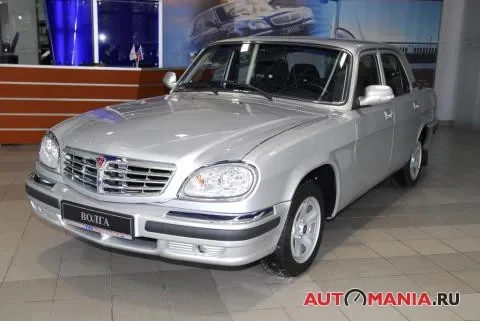
Once upon a time, the car named after the great Russian river was the dream of most of our compatriots: even a ride in a Volga taxi was considered a special chic. And only district committee secretaries and People's Artists could drive Volgas every day. Perhaps only Caucasians could afford to buy this prestigious car: they spared no expense on purchasing Volgas, sometimes paying double the store price. The spacious interior, roomy trunk, and smooth ride (hence its nickname — "barge") seemed like unheard-of luxury back then. Now times have changed, and anyone can buy the legend of the Gorky Automobile Plant. Unfortunately, the Volga itself did not change radically for too long, the market was flooded with competitors from both the West and the East, so its fans noticeably dwindled. And finally, a year ago, the Nizhny Novgorod residents presented the long-awaited version of the updated Volga - GAZ-31105-501. The restyling turned out to be quite successful, which immediately affected sales volumes.
So what pleased Russians about the new version of the Volga? The body itself has hardly changed, frankly indicating how long ago the brainchild of the Gorky Automobile Plant appeared. The updated headlights and radiator grille somewhat rejuvenate the car's appearance, but do not make it a new model in the full sense of the word. Comparing the appearance of the GAZ-31105-501 with the previous version of the car is like solving a puzzle from the "find ten differences" series. Probably, there are about that many. Thus, the modernized geometry of the rear lights visually lightened the rear of the car, which previously looked too bulky, and the "freshened" radiator grille with transverse ribs gave the Volga even more solidity.
But the new design of the Volga's wheel rims is not easy to notice — it is too inexpressive. So there is not much to rejoice about regarding the car's appearance, although perhaps healthy conservatism will someday prevail over the excessive, and sometimes unbridled, imagination of some car designers. Good news was that from now on the Volga is produced in several new body shades. Moreover, the painting itself is now done on the most modern equipment, as a result, the car's paintwork becomes much more resistant to external influences typical of our harsh climatic conditions. But what really changed radically is the interior decoration. Moreover, the interior became not just richer due to the use of modern materials: the main thing is that the ergonomics of the driver's seat noticeably improved. It is immediately clear that specialists from the reputable German companies EDAG and Hormann Rawema, who develop design projects for such renowned automakers as, for example, Mercedes-Benz and Audi, worked on the new interior. It is clear that such experienced masters of their craft primarily worked on the most important component of any car's interior — its ergonomics. Probably, it was not easy for them: after all, they could not change the driver's seating position, since the basic principles of body layout remained unchanged, corresponding to engineering principles from Soviet times. However, the German designers tried to maximize the ordering of the controls and add necessary adjustments to both the driver's seat and the steering column. A power frame was introduced into the design of the new instrument panel, and it became possible to adjust the steering column in two directions — by length and tilt angle. In total, about 400 changes were made! Let us name only a few of the most noticeable and important ones: a new steering wheel equipped with control buttons for the standard Blaupunkt radio (a good choice for our manufacturer); a multi-position "joystick" on the driver's door for adjusting the exterior mirrors and a control panel for the power windows of all four doors.
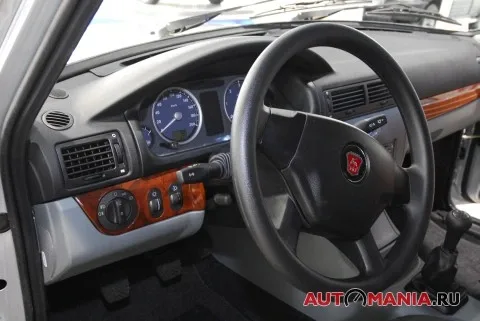
One-piece upholstery of the rear pillars and an interior lighting system consisting of three fluorescent lamps, which rear passengers will surely appreciate. By the way, the rear sofa is still comfortable — passengers are not cramped, there is enough space both above the head and for the legs. New sealed deflectors of the ventilation and heating system significantly improved the air exchange process in the cabin. In addition, the informativeness of the instrument cluster noticeably increased, including due to the pleasant gray-blue backlight. A successful addition was the retractable cup holders, which found their place on the center console. The dashboard as a whole now looks much more attractive. The integrity of the front panel design made it possible to eliminate unnecessary joints of its elements, thus not only making the interior more elegant, but also reducing the level of extraneous noise penetrating into the cabin from outside. And the greatest benefit to Volga owners will, of course, be the air conditioner. Moreover, unlike the unit installed in service centers on cars with the ZMZ engine, the air conditioner on cars equipped with the "Chrysler" engine costs half as much, since the latter is initially equipped with everything needed for installing the device.
And now we come to the main thing - the Volga finally got an imported engine! Until now, cars were serially equipped with a 16-valve injection unit produced by the Zavolzhye Motor Plant. It cannot be said that this engine was not powerful enough: after all, 145 "horses", which is exactly its power, is a good driving force for a "barge". A little later, a 2.4-liter "Chrysler" engine, structurally closest to the "native" ZMZ-406, was chosen for installation in the updated Volga. Of course, against the background of the 406th, the Chrysler engine looks preferable. With almost similar power, it produces more torque, and therefore it is easier for it to move the heavy car from a standstill and pull it during acceleration already from low revs. Although Russian engineers had to work hard on the mating parts: fit the clutch basket, redo the gearbox input shaft and exhaust system, and also modernize about fifteen more car systems.
The innovations also affected the Volga's suspension: for the first time in many decades of the model's existence, the suspension base became ball joints (of the "Zhiguli" type), not kingpins. This did not noticeably affect the car's ride quality, but now there is finally no need to carry out the tedious procedure of greasing the kingpins monthly. The only thing that slightly corrects the car's behavior is the anti-roll bar, now installed on the rear axle. Although when driving, the Volga is still not super stable, but shifts for the better are evident. After all, the leaf springs, on which the body is still suspended, do not have the best effect on the handling of any car.
But the widely advertised power steering, included in the standard equipment, rather disappointed. Of course, it became easier to turn the steering wheel on the spot, but when moving, the car clearly "yaws" on the road, and only after the speedometer needle passes 50 km/h does the power steering come into play, helping to keep the car on the set course.
Among the long-standing and still uncorrected design flaws of the Volga in the new car, we note the unclear operation of the gear shift linkage. Although after modernization it began to work somewhat more collectedly. Apparently, the plant's engineers still have to work on this unit, and until then, buyers will have to pay extra to have the manual transmission brought to perfection in qualified technical centers that specialize specifically in Volgas. As for the brakes, they now function significantly more efficiently than similar devices on cars equipped with domestic power units - apparently, the factory workers began to use imported components. The Volga's trunk, as always, pleases with its capacity. Of course, the fact that the spare wheel is located in it is not very pleasant, but there is probably nothing to be done about it. Unless you hang the "spare" under the body, as many do, but this is not very practical, especially on a country road. So you will have to come to terms with the fact that the "spare" will take away part of the useful area of the trunk - fortunately, it is huge. Of course, in the design and styling of the GAZ-31105-501, some flaws can be found. However, almost all of them are more than compensated by the affordable cost of the car and the subsequent quite proportionate costs of its repair. And the main advantages of the Volga remain the spacious interior and huge trunk. It is quite possible that the presence of these two qualities in the famous domestic car allows potential car owners to make a choice in its favor.
TECHNICAL SPECIFICATIONS
| Length (mm) | 4921 |
| Width (mm) | 1812 |
| Height (mm) | 1422 |
| Wheelbase (mm) | 2800 |
| Weight (kg) | 1400 |
| Ground clearance (mm) | 152 |
| Trunk volume (l) | 695 |
| Engine displacement (cm3) | 2429 |
| Max. power (hp) | 138 at 5200 rpm |
| Max. torque (Nm) | 224 at 4000 rpm |
| Max. speed (km/h) | 178 |
| Acceleration 0-100 km/h (s) | 12.8 |
| Average fuel consumption (l) | 13.7 |
| Price from | 283,000 RUB |
Source – AUTOMANIA.RU