
Ford S-Max. All about Max. Ford has created the fastest minivan in Europe
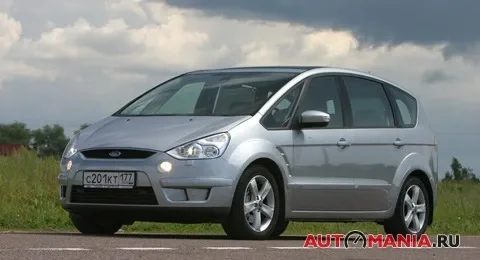
According to the idea of those who created this minivan, it is the S-Max that should fill the empty niche between Mondeo and Galaxy. Today, however, a completely new Galaxy has appeared, made on the same platform as the S-Max, but unlike the latter, it is larger, taller, more solid and more family-oriented.
The future driver of the S-Max is a person not only burdened with a family, but also, in the absence of household members in the cabin, loves to express himself behind the wheel, get aesthetic pleasure from driving and even show off. After all, when coming to the dealership to buy this car, he simply cannot help but notice the engine power of 2.5 liters turbo with 220 hp, 6-speed sports manual transmission and acceleration time to 100 km/h in 7.9 seconds (there is also an option to choose a diesel). And, if you believe the advertising, it is almost the fastest minivan in the world today, and only the Opel Zafira OPS with a turbocharged 2.2-liter engine with 240 hp can compete with it. That one accelerates to 100 km/h in 0.1 seconds less, but this difference is insignificant, and in terms of options, these two cars simply make no sense to compare.
Taking the car for a test, I didn't think long about where to start. No, not flooring the gas, but precisely with opening the hood. I saw the same engine that I had encountered before, riding in the Ford Focus ST, though with 6 horsepower less. Despite the fact that the cover says Ford Duratec, in fact it is the well-known "Volvo" T5 engine (i.e., five-cylinder, turbo), installed on the Volvo S80 and the XC90 SUV. True, there it produces, taking into account the settings, only 210 hp — here a bit more.
If it is capable of quite briskly pulling the XC90 weighing 1200 kg, then why shouldn't it pull a minivan weighing 1600 kg with a payload of 700 kg. Yes, easily.
Family values – on the back burner
And the S-Max easily proved this on the capital's streets. Indeed, I have never had to deal with such a brisk car of such impressive dimensions. And "family values" temporarily faded into the background — I just wanted to have fun, which I previously did on the Focus ST. You can't even imagine — the minivan drives on the highway like a real sports sedan. I, of course, did not reach the maximum of 230 km/h, but the van holds 180-190 km/h so confidently that you are amazed. It confidently hugs corners without any hints of body roll, and the tires on 17-inch wheels don't even squeal (as an option, you can order low-profile tires on 18-inch wheels, like on the Focus ST). Many elements (besides the engine) are clearly taken by Ford from the arsenal of the Swedish brand Volvo it controls. Take at least the adaptive headlights, from which any driver will get true pleasure when driving at night. Steering right — you see everything that is around the corner, steering left — the same effect. In short, there are plenty of pleasures when driving the car.
The design of the S-Max is somewhat futuristic. High-mounted fog lights and pseudo-gills on the spoiler and on the sides of the right and left fenders. The former perfectly illuminate the road, and the latter are nothing more than a design element. A colleague even suggested poking holes in them with an awl to better cool the brakes and reduce splashes thrown from the roadway in the rain.
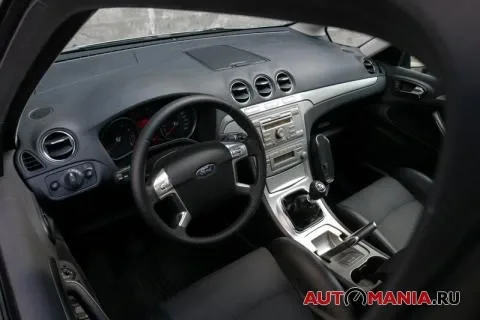
Unlike colleagues who tested the car abroad, the Russian version of the S-Max does not have a navigation screen or display with virtual keys on the center console. All this is replaced by a narrow space for the receiver display and slightly below — separate climate control. The rest of the options seem to remain. The main thing is the parking brake, like in the Renault Grand Scenic (it resembles a throttle lever on expensive yachts) and the main feature of the S-Max — it's not only heated front seats, but also cooled ones in case of too hot weather. The "-" key — it's cold under the seat, the "+" key — it's very warm.
We have already briefly mentioned the almost complete absence of body roll, and the credit for this goes to the suspension and chassis, which are based on the new generation Mondeo sedan, which appeared in spring 2007. If the previous Mondeo was considered almost a benchmark in its class precisely for its driving qualities, then the new one has become even better. And the S-Max has already managed to prove this. By the way, the S-Max, like the Mondeo, is produced in Belgium.
In the near future, as an option, buyers will have access to an active suspension system that monitors the quality of the road surface and, based on the processed data, adjusts the stiffness of the shock absorbers. The driver can choose one of three settings — Sport, Normal, or Comfort. But if the system notices that you are driving recklessly and often entering corners at an impermissible speed, then the Sport mode will be selected automatically. Almost the same system is used on the Cadillac SRX SUV and the newest Audi Allroad (though there are not three settings, but five).
A little about plagiarism
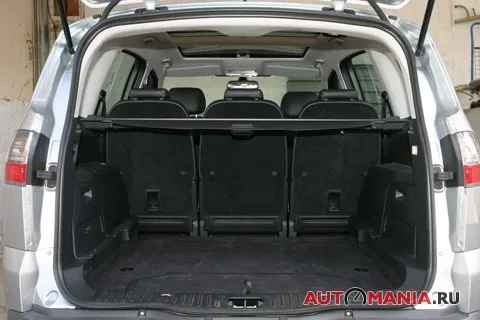
Since we mentioned Audi, I cannot resist expressing a number of claims to the creators of the S-Max. Ford has always been distinguished by "features" inherent only to this company, which have never been used by other automakers. Take, for example, the forced windshield heating mandatory for all models, based on the principle of the traditional rear window heating used worldwide. But never before has Ford been caught borrowing design elements or on-board computer controls. But the S-Max (and especially the Galaxy) clearly shows an element of "imitation." Pay attention to the photos of the car from behind. Don't the rear lights remind you of something? Exactly — this is obvious plagiarism from the Audi A3, and in places from the Allroad. But what struck me most was the on-board computer display — red letters on a vertical screen with a black background — where have we all seen this? Naturally, on Audi. As, by the way, is the red backlighting on the center console. By the way, the computer language in Russia is now only in Russian, and you don't have to bother learning English. If a door is open, you need to add fluid to the windshield washer reservoir, or find out how much further you can drive on the remaining fuel, the on-board assistant will tell you this in your native language. Volvo and Audi — these companies have already mastered this principle of communicating with the customer a couple of years ago. But Ford can be awarded a separate certificate of honor for the HMI (Human Machine Interface) system, which allows you to control all on-board electronics and the computer from the steering wheel using buttons familiar from mobile phones. This is much more convenient and safer than the "iDrive" system on BMW or the joystick on Audi, and allows you to scroll through menus without being distracted from the road.
Be careful in the sun
Before summing up the test, during which about 400 km were covered in 2 days and about ten passengers were transported, we note, unfortunately, one more not very pleasant moment. In sunny weather, driving it is quite problematic. The air ducts, inserts on top of the center console, and the small glovebox (which is hard to reach with your hand and it's generally unclear what to put there) glare terribly in the huge windshield. At the end of the trip, I thought, if a stone hits it, how much will it cost? And what if another one hits the panoramic roof with two pseudo-sunroofs (they don't open, but are only masked by shades)? True, this option can be avoided by not paying an extra $750, but it won't make it easier for you, given the size of the windshield.
So what do we have in the end? The competitors are not particularly solid — these are the Renault Grand Scenic, the already mentioned Opel Zafira, and, with a big stretch, the Corolla Verso. But in terms of driving characteristics, they can all rest for now.
Dmitry Shavyrin
Technical specifications:
| Dimensions (mm) | 4768x1884x1658 |
| Wheelbase (mm) | 2850 |
| Trunk volume (cu.m.) | 2851771 |
| Curb weight (kg) | 1838 |
| Gross weight (kg) | 2420 |
| Payload (kg) | 582 |
| Turning diameter (m) | 11.9 |
| Engine displacement (cu.cm.) | 2522 |
| Power (hp) | 220 |
| Max. Torque (Nm@rpm) | 324/2100 |
| Average fuel consumption (l/100 km) | 9.4 – 13.3 |
| Max. speed (km/h) | 230 |
| Acceleration (0-100 km/h) | 7.9 |
| Price (RUB) | from 1,027,700 to 1,127,700 (Sport version) |
We thank the Ford company representative office in Russia and personally Ekaterina Kulinenko for providing the car for the test.
Source – AUTOMANIA.RU