
Lucky ones
Cars, unlike people, are not prone to luck. They become outdated much faster than we do. Every six to eight years, modern cars get a new or at least seriously modernized platform. In addition, in the middle of the life cycle, no model avoids a facelift, which often implies not only cosmetic changes to the exterior and interior, but also a revision of the engine lineup, and sometimes a slight refinement of the chassis.
However, a facelift, like for people, does not always suit cars. Every car enthusiast has their own list of models that, in their opinion, were ruined by the facelift. Some took the change of generations of the Ford Focus hard, and some probably still miss the old "Fiesta"...
without "surgical" interventions.
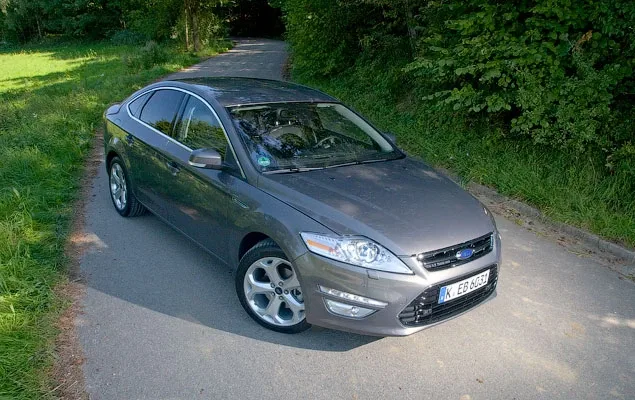
And yet, in skillful hands, a facelift can work real miracles. Moreover, to return freshness to a car, a couple of details are enough – a new hood stamping, an LED strip at the front fog lights, more expensive plastic in the interior - and a model familiar for several years seems to be reborn.
English combinator
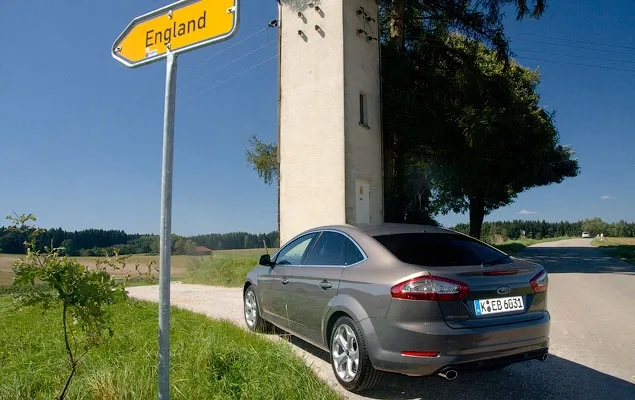
This is exactly what the current Ford Mondeo facelift turned out to be. It seems that Martin Smith, the chief designer of the European "Ford", when creating kinetic design at the beginning of the "noughties", calculated all the moves in advance and thought out how the updated versions of his creations would look. In any case, all three models with which the kinetic era of "Ford" began - S-Max, Galaxy, and now Mondeo - after rejuvenation remained true to themselves and at the same time look modern again.
Most likely, Martin Smith's secret is that the design concept, first shown in 2005 on the Iosis prototype, has not become outdated yet, and refreshing it did not require much effort. And this version looks more plausible: for example, the main detail that really distinguishes the new "Mondeo" from the previous one is two LED daytime running light strips in the front bumper. And even they are included in the basic equipment only of the top trim levels Titanium and Ghia, while for the Trend version they will have to be ordered separately for an extra charge.
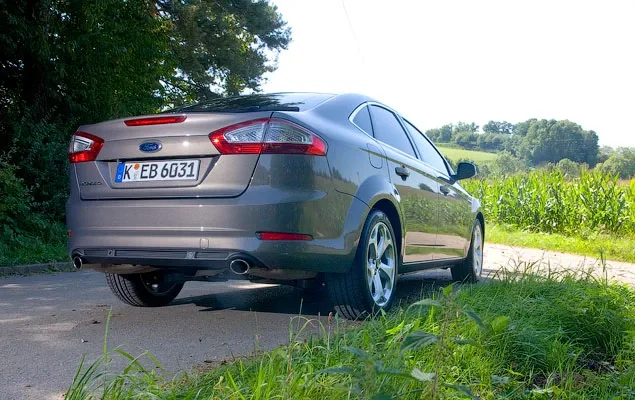
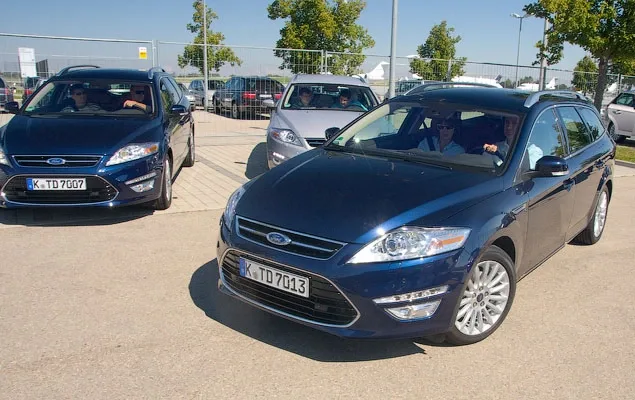
Otherwise, the differences between the updated version and the pre-facelift one are so small that they are perceived more intuitively than analytically. You seem to feel that the car has become different, but to understand what exactly has changed without a press release is possible only in one case – if you put two "Mondeos" side by side. The turn signals moved from the front fenders to the housings of the exterior mirrors, the lower trapezoidal radiator grille has become larger, the upper one – a bit narrower, the hood has acquired a more pronounced relief.
The interior of the "Mondeo" was also touched carefully by the designers. The seats seem to be the same – moderately firm, with excellent lateral support and a profile verified by orthopedists. The front panel made of soft plastic still effectively "rises" around the instrument cluster hood and central ventilation deflectors.
The instruments have changed, but not radically – Ford people changed the font and slightly increased the numbers on the speedometer and tachometer, and the analog fuel gauge became digital and moved to the onboard computer screen. True, during these manipulations, the engine temperature gauge disappeared from the instrument panel.
Then you have to look into the press release: yes, the center console is trimmed with new plastic, the shape of the glasses holder above the windshield has changed, the design of the door handles has been updated, LED interior lighting has appeared, and the new Russified navigation boasts a large 7-inch screen.

The result is this: compared to the predecessor, the updated "Mondeo" looks inside exactly the same as outside – stricter and more expensive. This means that Martin Smith's subordinates worked perfectly. It is precisely such cars that the European market needs – mass-produced and affordable, but looking no worse than premium models. And buyers will not stand behind the price – more than half of the Ford Mondeo of the previous generation were sold in Europe precisely in the top Titanium trim.
This is the philosophy of consumption. As you know, most of the planet's population has long been trying to climb the social ladder with the help of purchases. But this aspiration can be realized in different ways. For example, in the European car market, buyers, in order to raise their consumer status, are ready to splurge on top versions of mass-produced cars if they look, are equipped, and drive almost like premium ones.
Therefore, all the test "Mondeos" waiting for journalists at Munich airport were packed to the brim. We, in particular, got a hatchback in the Titanium trim with adaptive suspension that can switch between three modes ("Comfort", "Normal", and "Sport"), with navigation, an optional "advanced" Sony audio system, seats with heating, ventilation, and memory, a rear-view camera, and a full set of auxiliary electronic systems that a few years ago in such quantities were found only on executive limousines.
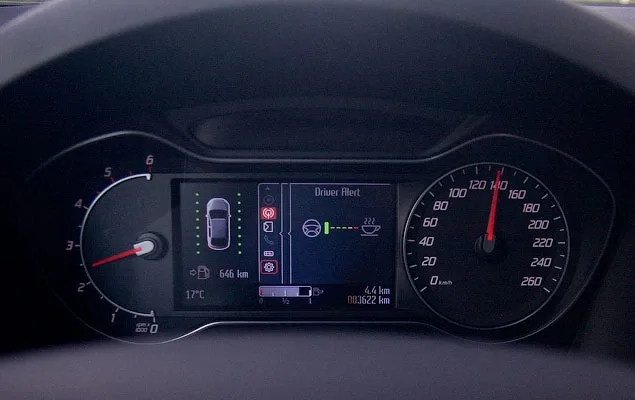
In addition, our market will not get the driver fatigue monitoring system, which analyzes the stability of the trajectory, receiving data from the camera of the lane departure warning system and from the sensors of the stability control system that monitor the car's yaw (on the display – on the right).
But Russian "Mondeos" will be equipped with a blind spot monitoring system and adaptive high beam headlights.
In addition, the basic equipment of new cars already includes active radiator shutters, which accelerate engine warm-up and reduce energy losses in cold weather. The shutters have 15 positions, differing from each other by six degrees. Fully closed shutters can reduce the car's aerodynamic drag by six percent.
But the engineers did not touch the chassis settings of the "pre-facelift" family. Having achieved reference handling, they limited themselves to a slight adjustment of the settings of the adaptive shock absorber control unit, taking into account the weight of the new power units that appeared in the "Mondeo" lineup.
And although on the winding country roads of Germany you can't really "race" – there are cameras everywhere – it was not difficult to understand that the updated test hatchback handles just as well as its predecessor. The "Mondeo" pleases with neutral understeer, natural steering effort, and minimal body roll. As a result, a couple of sequences on a winding track are enough to forget about the 1.6-ton mass of the car and fully concentrate on manipulations with the steering wheel, which is reliably isolated from vibrations.
Wake the beast
There are also no complaints about the dynamics of the updated Mondeo. At least with those engines that we tried in Germany. In Munich, two petrol two-liter turbo engines with 200 and 240 horsepower from the new EcoBoost line debuted, as well as an updated Duratorq TDCi diesel with a volume of 2.2 liters, now producing 220 horsepower. Only petrol new items will go to Russia, but we managed to drive only the 240-horsepower hatchback, and then, out of professional interest, we also tested the diesel station wagon.
One of the main features of the "Ecoboosts" is that they can only be ordered with the new six-speed robotic gearbox Powershift. Apparently, it was decided to abandon the manual, because buyers of expensive and powerful versions of the Mondeo do not favor it. The car with the 240-horsepower engine accelerates to "hundred" in 7.5 seconds according to the passport – exactly the same as the fastest pre-facelift "Mondeo" with a 220-horsepower turbo engine of 2.5 liters and a manual transmission required.
Perhaps with a manual gearbox, the car with the new flagship turbo engine could demonstrate even more impressive dynamics, however, based on personal feelings, the power reserve is quite enough for the spacious family sedan Mondeo. The robotic transmission confidently copes with the impressive torque of the unit, which is 340 Newton-meters in the range of 1900–3500 rpm: shifts occur quickly and smoothly, and in sport mode during intense acceleration, the gearbox immediately downshifts, allowing the engine to rev almost to the cutoff.
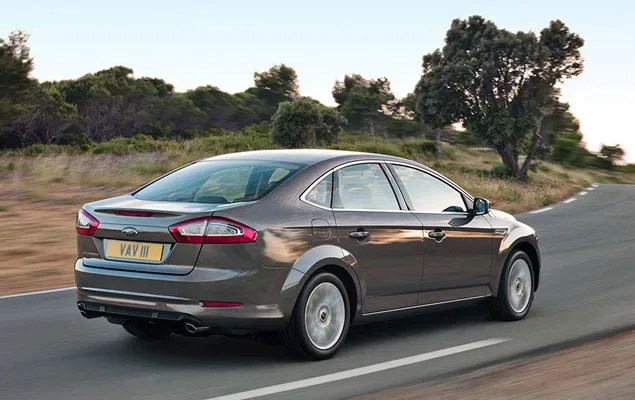
Thanks to exemplary sound insulation, the Mondeo gains speed almost silently. To feel the "rocket" acceleration of the 240-horsepower car, you have to glance at the speedometer and listen to your own sensations – the surge noticeably presses the driver and passengers into their seats. Ford representatives claim that after the facelift, the noise level in the cabin decreased by one and a half decibels. However, the previous version of the Mondeo was already very quiet, so the difference between the diesel and petrol versions could only be heard at low revs, when the characteristic diesel rumble is clearly audible.
The two-hundred-horsepower turbodiesel installed under the hood of the next test car – a Ford Mondeo wagon with a manual transmission – works just as quietly. Especially if you don't provoke it into aggressive driving. But the colossal torque of this engine (450 Newton-meters at 1750–3000 rpm) literally pushes the driver to press the gas pedal harder.
The wagon accelerates quickly: the factory-claimed 8.3 seconds to 100 km/h seems plausible. The short-throw manual gearbox lever also works precisely. However, constantly shifting it quickly gets tiresome – you can truly enjoy aggressive driving in this car only with a great desire. It's much more logical to drive calmly, economically consuming diesel fuel. After all, diesel cars are primarily bought for fuel savings.
Especially since the facelifted Ford Mondeo has acquired a whole set of technologies whose main task is to reduce fuel consumption. First, all Mondeo versions now feature a "smart" battery charging system: during braking or simple deceleration, the starter switches to generator mode, recharging the battery. In addition, another "green" system called Eco Mode was recorded in the "brains" of our wagon, which works on the principle of a virtual carrot and stick.
If you dig into the menu, you can display an image of a flower on the onboard computer screen, whose petals turn green depending on how economical the driver is in terms of fuel consumption. Ratings are given in such "disciplines" as "timely upshifting," "smooth driving" (frequent accelerations and braking increase consumption), and even "the number of short trips on an unheated engine."
Our approach
In Russia, they save differently. The main trump card of the Ford Mondeo on the Russian market is the plant near Vsevolozhsk, where sedans are produced. It is this that allows Ford to maintain attractive prices for its flagship model. Moreover, after the facelift, the base Mondeo sedan on the Russian market has risen in price by only 10 thousand rubles – to 689 thousand rubles. The more expensive sedans have also increased slightly: for example, the Titanium version now costs from 909 thousand rubles, whereas before the facelift this bar was at 887 thousand rubles.
In addition, the appearance of new EcoBoost engines does not mean that the naturally aspirated units of 2.0 and 2.3 liters with 140 and 160 horsepower, respectively, which are popular among buyers, will disappear from the range. But a car with a two-liter diesel engine producing 140 horsepower, which we really liked during a recent long-term test of the pre-facelift Mondeo, will now be harder to buy – this engine is only available for the updated Titanium, whereas previously it could be ordered for the inexpensive Trend trim.
But this loss is unlikely to upset Russian motorists, who are in no hurry to buy diesel cars due to the cold climate, unstable diesel fuel quality, and the relative high cost of such cars. Especially since the Mondeo range has plenty of petrol engines for every taste.
Technical characteristics of the updated Ford Mondeo
| 2.0 EcoBoost 240 PS | 2.2 TCDi 200 PS | |
| Length, mm | 4850 | 4837 |
| Width, mm | 1886 | 1886 |
| Height, mm | 1500 | 1512 |
| Wheelbase, mm | 2850 | 2850 |
| Weight, kg (without driver) | 1569 | 1615 |
| Engine displacement, cm3 | 1999 | 2179 |
| Power, hp/rpm | 240/6000 | 200/3500 |
| Torque, Nm/rpm | 340/1900-3500 | 450/1750 - 3000 |
| Maximum speed, km/h | 246 | 225 |
| Acceleration from 0 to 100 km/h, s | 7.5 | 8.3 |