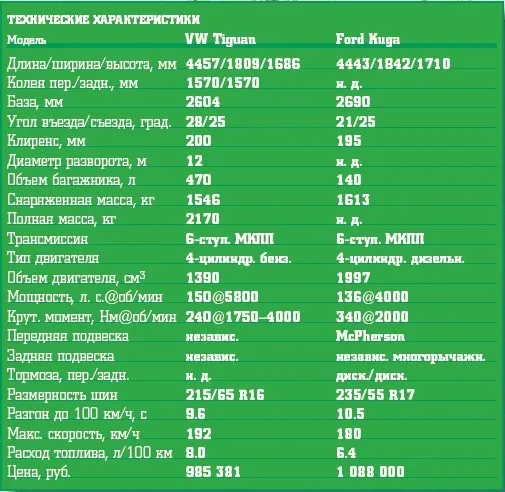
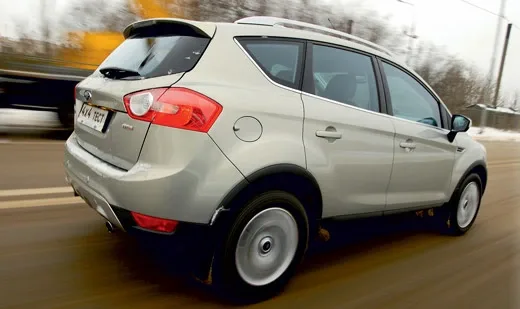
Is it worth putting a diesel Ford Kuga and a petrol VW Tiguan 1.4 TSi side by side? Not just worth it, but absolutely necessary: when the diesel doesn't yield to the petrol engine in dynamics, and the latter, in turn, doesn't want to concede in fuel efficiency, you can't help but start thinking. Especially since both cars, besides names seemingly straight out of Kipling's tales, share another similar trait – both are equipped with a six-speed manual transmission.
COUNTRY-CITY-COUNTRY
If my life were tied to living outside the city, I would definitely choose the manual – with it, the driving process brings much more pleasure. Although I fully realize that modern automatics can shift no worse than a human – but still. However, with a manual gearbox, fuel savings are obvious: you can save a liter or even two per hundred kilometers.
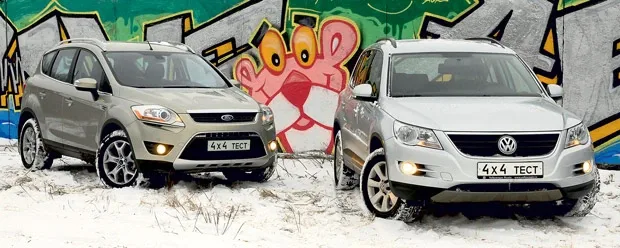
To hold a casting for the role of a daily vehicle on the route "country-city-country," we plotted a path from the office to a picturesque village. First from Krylatskoye along the Novorizhskoye highway – that's 33 kilometers, then to Zvenigorod (about 12 kilometers), and from there to the final point another approximately 32 kilometers. In total, the entire route in both directions was 155 kilometers, which took 2 hours 30 minutes (before entering the capital, we had to crawl three kilometers for half an hour). On the highway, as agreed, we didn't accelerate faster than 130 km/h. That speed seems optimal to me for daily trips on the "New Riga." On narrow roads, naturally, the limit was 100 km/h.
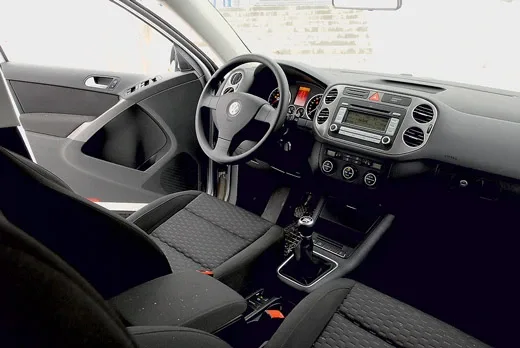
Simply put, we just recreated a typical everyday situation in which crossovers with a six-speed manual could show themselves in all their glory. Although much has already been written about both models overall, it's worth noting a few important details. First, from an ergonomics standpoint, the VW Tiguan is nearly flawless. But in the Ford Kuga, a tall driver might lack a couple of centimeters of seat longitudinal adjustment for complete happiness. Moreover, behind the seat pushed all the way back, even a ten-year-old child would be cramped – you might as well climb onto the sofa with your legs. But in the Tiguan, there's plenty of space in the second row, and additionally, the rear seats can be moved longitudinally. In short, if you have a family of four and you're above average height, you can stop reading – the Kuga definitely won't suit you.
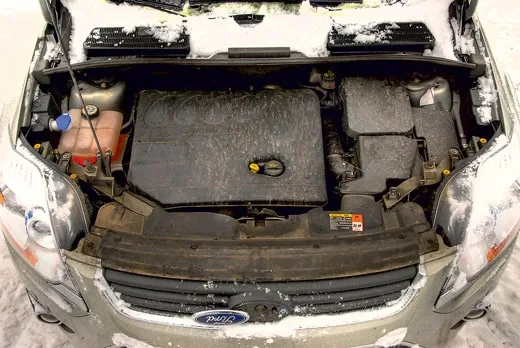
To open the Kuga's hood, you need to slide the emblem and insert the key into the slot. The key is only needed for this – the engine starts with a button
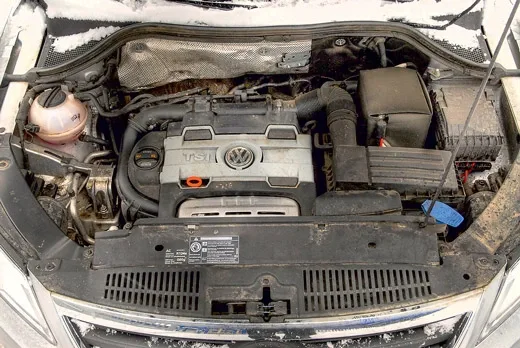
Somewhere there are hidden two turbos that equip this amazing 1.4-liter but 150-horsepower engine
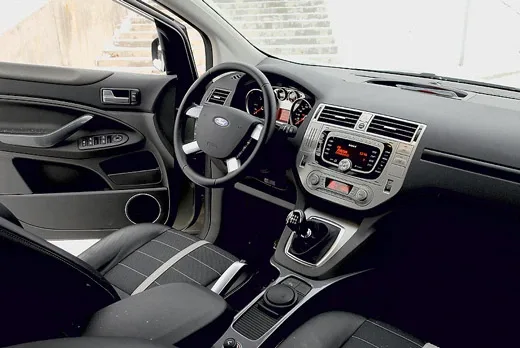
There are other, less significant features. For example, the Ford starts with a button: stylish, modern. The key, when folded, resembles a neat key fob. However, the Kuga's hood opens with the key. And every time you need to top up washer fluid, you'll have to reassemble the key like a puzzle.
When it comes to interior trim, the Tiguan and Kuga go nose to nose: Ford successfully demonstrates traditional German quality. No, seriously – it seems even the texture of the soft plastic on the dashboard is the same as in the VW. Excellent! However, VW wins in the number of various pockets and compartments. When you spend several hours a day in the car, that matters – although it can't be a decisive argument when buying.
HERE'S WHAT THE SIXTH IS FOR
Both of our "beasts" drive quite admirably. My partner, who had never dealt with a six-speed manual before, wondered before the test why so many gears were needed. He even tried driving the Tiguan in fifth gear, keeping the engine at 3000 rpm – he thought that for a 1.4 engine at 130 km/h that was normal. But then he overcame himself and engaged sixth, immediately discovering that you can move just as effectively at 2000 rpm without losing dynamic reserve. With the Ford Kuga, the situation is similar – on the top gear at 130 km/h, the tachometer needle shows 1600–1800 rpm, and there's still the ability to accelerate at any moment.
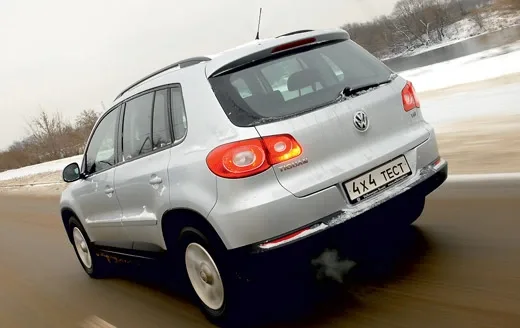
When we turned onto a concrete road, where we had to overtake trucks constantly for comfortable movement, both crossovers had plenty of dynamic reserve. And both handled excellently. But differently. The thing is, in the Tiguan, all reactions are slightly softened, a bit smoothed. Its creators seem to inwardly adhere to Mercedes-Benz ideology. The Tiguan's steering wheel and pedals respond very precisely, without straining the driver at all. It lets you feel both wheel slip and their turning angle, and body roll is practically absent. But there's no sharpness, no tension at the wheel – you drive playfully and arrive at your destination rested. And over bad roads, the VW seems to fly like a magic carpet – ride smoothness is superb.
In the Ford Kuga, slightly different rules apply. Everything is a bit stiffer, a bit sharper – both the steering, suspension, and response to pressing the gas pedal. In fact, the balance between comfort and handling is excellent here too, but it's noticeably shifted toward driving pleasure. The Kuga drives deliciously, there's a zest, a pinch of pepper in this crossover. But it also provokes you to press harder, try to take a corner faster, execute a maneuver more sharply. So enjoyment on the road is guaranteed. True, it might fade a bit if you have to iron out broken asphalt every day.
By the way, regarding the complete opposite of driving pleasure – standing in a traffic jam at the city entrance – here we liked the Kuga a bit more: it always has good torque, you can start almost without pressing the gas – after all, it's a diesel. But its rival won't move from the very bottom without additional revving. Moreover, at the start, an inexperienced driver on a hill might stall the Tiguan the first two or three times. At the same time, off-road, the German crossover generally behaves more correctly: it has an unusually adequate traction control system. But the Kuga quickly tires in difficult situations – its coupling, which acts as a center differential, overheats. Up to, you know, smoke from under the floor.
And yet, the most interesting part awaited us at the gas station, where we started and returned. We measured fuel consumption using the standard scheme: the tank is filled to full, upon arrival – again to full. It turned out that in suburban mode, the fuel consumption of our subjects was the same – 8.5 liters per hundred kilometers. However, diesel fuel is about a ruble cheaper than Ai-95, and with a daily mileage of 150 kilometers, the savings over 20 working days would be about 260 rubles. On the other hand, at our gas station, the situation was reversed: they asked a ruble more for Euro diesel than for 95-octane...
LET'S FORGET ABOUT MONEY
So what should a suburban resident choose? This is a case where we can forget about money. If the roads are good, the zest in your blood hasn't faded, and the family is small – Ford Kuga. If comfort matters on the road, the asphalt is broken, you're tall, and space in the back seat is necessary – VW Tiguan. If you'll spend a lot of time in traffic jams – again Kuga. But if you plan to occasionally leave the asphalt and even get stuck – Tiguan again.