
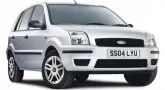
During the discussion of Ford's new station wagon (see No. 9, 2002), one of my colleagues said in frustration: "It should have been called not Fusion, but Contradition." Five months later, we had the opportunity to verify the accuracy of this prophecy...
In music, the British and Americans use the word fusion to describe a mix of rock and jazz. This style has many fans, especially overseas. Europeans are more reserved about this musical eclecticism, but they don't reject it either.
Any comparison is flawed, but if we try to draw parallels in appearance, the picture is this: some of the Fusion's body elements are very reminiscent of parts of the Ford Maverick SUV (let's not mention the donor — the Fiesta), but in front of us is just a two-box "hatchback-wagon" that doesn't even dream of off-road. It seems that the designers at Ford's European division, having had their fill of SUV projects, decided to apply the same style to passenger cars, adapting the dimensions and technologies to the needs of the average buyer. The result is a nice-looking car with a rather unusual appearance for its time. A point in favor of the Ford Europa design studio.
But the ancients said: "You meet people by their clothes..." Keeping this in mind, let's look inside.
The interior, in terms of colors and shapes, looks quite attractive. The driver's seat is positioned low — roughly at the level of a standing person's knees — and has "developed lateral support."
It's just that it would be better if it were smaller. If you don't sit perfectly straight the first time, problems begin: in the middle of the cushion there is a bolster that narrows toward the backrest, and when sitting "crooked," it causes a lot of discomfort. The bolster itself hides the seat heating element, which turns on automatically depending on the outside temperature. No button or lever to turn off this forced heating could be found.
Subjectively, this function is only a torment. When the cabin is warm, especially in insulated pants, you start to suffer. It's like "the steam breaks your bones."
After looking around, fidgeting, adjusting the seat and mirrors, you can get going. The engine starts easily, even after a frosty windy night. The handbrake is in place. The pedals are a bit small, but comfortable and have "correct" travel. The gear lever, apparently, is convenient for people of average height or those who sit closer to the steering wheel; for long-legged people who move the seat back, reaching it is a bit far.
The steering wheel feels pleasant in the hands and doesn't cover the instrument panel, the design of which, however, seemed to us not fully thought out: when sitting "reclined, with arms outstretched," the lower edge of the rim overlaps the bottom of the dashboard and hides part of the indicators.
The steering column switches are convenient, but smokers will definitely be upset by the ashtray — it is located and designed as if made for the passenger, not the driver. The cigarette lighter, on the contrary, is the opposite: for the passenger to reach it, they will have to bend and go around the gear lever with their hand, invading the driver's territory.
We start moving. We stall. We start again... It turns out that the 1.6-liter Duratec with 100 horsepower (the same one as in the Focus) requires revving up at launch. If you press the gas lightly and release the clutch abruptly, there is a risk of stalling.
The gearbox in the Fusion is urban, even too urban. The engine revs willingly, but you don't want to push the needle to the red line unnecessarily. If the first two gears were a bit longer, there would be no complaints — the little car has enough power and torque. There are no questions about the gear lever's operation. But with the upright seating position that the design provokes, it would be better to either bring the lever closer to the driver or tilt it.
Overall, the Fusion, which really is a kind of new alloy, leaves a mixed impression. The design — both exterior and interior — is quite attractive, but the materials look cheap. The cabin layout is rather successful, the equipment seems sufficient, but for some reason the "standard" version doesn't include power accessories.
After interacting with the car, there is a feeling of understatement: everything is there, everything works, almost everything is convenient, but there is a lack of integrity and completeness. Maybe the "alloy" hasn't fully "fused"? However, we don't claim to be objective: we are too accustomed to other traditions and other ideals.
Technical specifications of Ford Fusion 1.6 Elegance 5D
- Body – station wagon
- Number of seats, persons – 5
- Curb weight, kg – 1199
- Dimensions (length/width/height), mm – 4020/1721/1534
- Wheelbase, mm – 2485
- Maximum speed, km/h – 178
- Acceleration time to 100 km/h, s – 10.9
- Control fuel consumption, l/100 km:
- urban cycle – 9.0
- extra-urban – 5.3
- combined – 6.6
- Engine:
- type – petrol, DOHC
- displacement, cm3 – 1596
- power, hp at rpm – 100/6000
- torque, N·m at rpm – 146/4000
- fuel system – injection
- Transmission – manual, 5-speed
- Tire size – 195/60R15
- Wheel suspension:
- front – McPherson
- rear – dependent
- Brakes:
- front – disc
- rear – drum
- Price (in Europe, excluding taxes), $ – 14612