
Ford Focus. Sleight of hand…
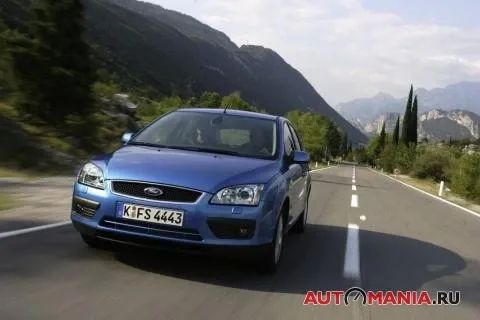
The second generation Ford Focus hardly needs an introduction. This affordable compact hatchback has long and firmly established itself on our roads, confidently holding the lead in its class for several years in a row, and it is unlikely that a worthy rival capable of displacing it will emerge in the foreseeable future. However, everything flows, everything changes, and, as usual, gets more expensive. Inflation has not spared this pseudo-domestic bestseller either, although, giving credit to the "Ford folks," it is worth admitting: they managed to keep the price of the most popular foreign car in Russia within quite reasonable limits for such a segment.
So, today the Ford Focus II is available in six base versions. The most affordable of them — Ambiente — costs $12,990. It is unlikely that anyone will be tempted by the not-too-practical three-door with an 80-horsepower 1.4-liter engine and a single airbag. There is no ABS, no air conditioning, not even floor mats, although this trim is still listed in dealer price lists. Of course, all of the above can be installed for an extra charge, but, in my opinion, it is much wiser to immediately choose the more feature-rich and popular among our drivers Comfort version. It is about $1,000 more expensive, and it still lacks ABS, and there is also only one airbag, but it does have air conditioning. The main thing is that the buyer gets the opportunity to choose a more powerful engine and equip the car with an extended list of options. By the way, it is in this trim that the 1.8-liter 115-horsepower turbodiesel is available — the only one in the lineup.
If that seems too little, Ford has more presentable "Focuses." For example, Trend for $16,070 or Ghia for $17,380. With the exception of a couple of items that the "Ford folks" fundamentally leave only as options, here there is everything a modern driver needs. For those who do not like to bother with choices, a fixed version Special Edition (SE) is provided. You will have to pay a lot for it — $21,260, but then the base will already include all electronic systems, a full set of airbags, dual-zone "climate," cruise control, a radio with a CD player, and a maximum electric package, including a self-dimming mirror. The only thing left for the buyer to choose is the engine. But here too, the "Ford folks" have simplified everything to the limit: there are only two engines, both with a volume of 1.6 liters, and the difference is only in output — 100 or 115 horses. Simply a paradise for the lazy.
About a year and a half ago, a "hot" version for thrill-seekers appeared in the family — the Focus ST. This is the most expensive option, but, oddly enough, not the most feature-rich. Unlike the SE buyer, its owner will have to choose between an audio system and "xenon." Although, by and large, options are not the main thing here. The main thing is under the hood. And there, the ST has a 2.5-liter turbo engine with 225 horsepower, which has been known for several years from Volvo models and recently migrated to the products of the American concern. This car, it must be said, drives quite briskly, and in terms of driving qualities (like its purely "civilian" brother) it can claim to be almost the best in its class. But the ST is a specific car and therefore not mass-market, so let's return to the ordinary standard Focus, which, in fact, glorified in our country not only its family but also the "surname" itself.
Unlike its predecessor, which once received the title of Car of the Year, the Focus II did not become something supernatural for Europeans. And this is understandable. Its appearance, of course, was seriously reworked: the body became larger, designers added "sloping" to the profile and "muscularity" to the wheel arches, striving to give sportiness and aggression. However, all this poorly hides the obvious generational continuity. In principle, there is nothing shameful in this, except that competitors, with the exception of perhaps the "eternally relevant" VW Golf V, have stepped far ahead during this time — take at least the Honda Civic, the new Toyota Auris, or the same Citroën C4. Against their background, the once-revolutionary Focus looks rather ordinary.
The same picture is in the interior. The deliberately rough finish, matching the athletic appearance, is maintained in the familiar Hi-Tech style: pleasant-to-touch coarse-grained plastic of the front panel and door cards, a center console decorated with modern materials, two-tone fabric upholstery of the seats, organically complementing the overall picture. For the first generation, which appeared at the turn of the millennium, all this was just right — not luxurious, but not original either. Today, round and oval air duct deflectors, like in the Focus II, are found in every second competitor, so the Ford interior can no longer be called outstanding. Although, we note, this does not affect ergonomics in any way. The pros include a comfortable seating position both front and rear, and a decent set of adjustments. The cons include not ideal rear visibility and a rather modest amount of headroom, which is why tall passengers begin to suffer from claustrophobia after a couple of hours. The driver, by the way, can save themselves by adjusting the height of their seat, while the rest will have to endure.
The luggage compartment, in principle, deserves praise — moderately spacious, quite functional. But pessimists should not look under the false floor. The fact is that Russian specifications require a full-size spare wheel, and the stamping in the floor is initially designed for the "space-saver" common in Europe. As a result, a decent chunk of useful space is eaten up by a polyurethane pad that adjusts the niche for a full-size wheel.
The lineup of "Focus" engines today is rightfully considered one of the widest in the class. Of course, not all engines are available in every trim, but the very fact of such a choice clearly plays into the hands of both the manufacturer and buyers. As already mentioned, the base unit is a 1.4-liter 80-horsepower engine, familiar to our compatriots from the Ford Fiesta. The next step is the currently most popular 100-horsepower 1.6-liter engine, which, unlike the younger one, can work with both a "manual" and an "automatic." By the way, for a long time the automatic transmission was installed only on these versions, while the rest came exclusively with a manual. But about six months ago, Ford revised its transmission policy and added an automated version of the once-top 2-liter engine to the price lists. At the same time, the range itself has grown: a 1.8-liter 125-horsepower unit can be considered relatively new, though it is only available with a manual gearbox.
Now let's talk about driving qualities. Let's take the most demanded and mass-produced option: the Focus II with a 100-horsepower engine and a manual transmission. The habits of such a hatchback are quite typical — a brisk start, smooth acceleration, decent dynamics. The gearbox shifts easily and clearly. In the city, you immediately feel the advantages of the "stretched" third gear, but you should not get carried away: at the bottom, the engine lacks power, and at the top, it lacks torque. In addition, after 3000 rpm, you notice insufficient sound insulation of the engine compartment, and the wheel arches would also benefit from an additional layer of sound-absorbing material.
The suspension works decently. Moderately stiff, it swallows small irregularities without a trace, and handles large ones collectedly and clearly, noticeably but not too much shaking the passengers. At the same time, the Focus holds the road more than confidently and does not please with serious body rolls in corners. Against the background of such average performance, one cannot fail to note the adequacy of the steering and brakes. Here, the car's creators worked to a five-plus — this is, of course, a subjective assessment, but a driver who prefers an active style will surely like it. The car instantly and accurately reacts even to a slight turn of the steering wheel, clearly tracing the given trajectory. The quite adequate brake pedal does not spoil the impression either, although during sharp braking it will be difficult to avoid nose dives at first.
Technical specifications:
| Dimensions: | Ford Focus |
| Length (mm) | 4340 |
| Width (mm) | 1840 |
| Height (mm) | 1490 |
| Wheelbase (mm) |
The car's appearance undoubtedly attracts the eye. The designers managed to create an image that stands out in the flow and is memorable. But is there really something more behind the striking exterior than just a marketing ploy? To answer this question, I went on a test drive, taking with me not only the keys but also a notepad and pen to record impressions.
The interior greets with pleasant minimalism. The seats are comfortable, with good lateral support, which is important for active driving. The instrument panel is informative, all indicators are easy to read. Inside, it is quite spacious, and finishing materials were not spared. The trunk pleases with its volume — 385 liters, and with the rear seats folded down, it grows to an impressive 1245 liters.
Under the hood of my test version was a gasoline engine with a volume of 1.6 liters, producing 100 horsepower at 6000 rpm and 150 Nm of torque at 4000 rpm. For the city, this is quite enough, although on the highway during overtaking, you have to use the gear shift lever more often. The stated acceleration to 100 km/h is 11.9 seconds, and the maximum speed is limited to 180 km/h. The average fuel consumption, according to the manufacturer, stays around 7.5 liters per 100 km, which is quite acceptable for such a unit.
On the move, the car demonstrates a good balance. The suspension is energy-intensive, but on large bumps there is an excessive stiffness that may seem excessive on broken roads. The steering is precise, with enough effort to feel the car. In corners, it stands confidently, with minimal body roll. At the same time, the car does not feel wallowy, which adds to the driving excitement.
In the end, I got a lot of impressions. This car is not just a beautiful "body kit", but a fairly balanced urban dweller with character. It knows how to please the driver, although it is not without some compromises. The price for the tested version ranges from $12,990 to $22,010 — for this money, the buyer gets a stylish, dynamic and practical car that will not get lost in the gray everyday life of a metropolis.