
Ford Fiesta
Adult baby
Engine - 1.6 L
Max power -
120 hp/6000 rpm
Max torque - 152 Nm/4050 rpm
Max speed (km/h) - 193
Acceleration 0-100 km/h - 9.9
Fuel consumption:
city - 7.9
highway - 4.7
combined - 5.9
5-speed manual
Curb weight - 970 kg
Length - 3950 mm
Width - 1720 mm
Height - 1480 mm
Tires 195/50R15
Price $21,263 (170,100 UAH), minimum - $13,953 (111,619 UAH)
Equipment:
Keyless Entry system with Ford Power engine start/stop system, ABS, climate control, 5 airbags, heated windshield, light sensor, rain sensor, rear parking sensor, power package, power-folding exterior mirrors, special Hot Magenta body paint, Soho Dotts Cloth interior
Service interval:
20,000 km
Cost of scheduled maintenance - $187 (1,493 UAH) + additional expenses depending on the vehicle's condition
Competitors:
Opel Corsa
Fiat Grande Punto
Peugeot 207
Mazda 2
Nissan Micra
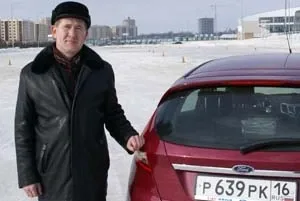
Marat Makhmutov, "Kazan School of Higher Driving Skills"
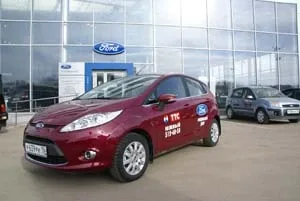
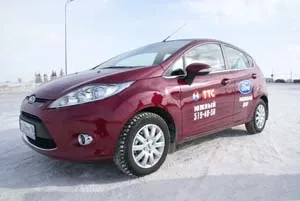
Time flies unnoticed: it seems we only recently celebrated the New Year, and spring is already knocking on the doors, peeking with sunbeams into the windows of houses and cars. Moreover, this year it clearly decided not to wait for the calendar date and came into its own already in mid-February. So it's no surprise that on one of those warm February days, an equally warm and sunny newcomer appeared on the threshold of our office — a fresh "Fiesta" in a rich burgundy color, with daring shapes that are hard to take your eyes off. Many have heard about the "kinetic" design that Ford now applies to its new models. On city streets, the third-generation "Focus", the fresh "Mondeo" sedan, and the "Kuga" crossover are no longer rare — they all bear the imprint of the American corporation's new design philosophy. Now this company has been joined by a little B+ class car with a fiery Spanish name — it has taken its rightful place in the manufacturer's updated lineup. From the first glance, it was clear: the car is devilishly good-looking! Elongated headlights that unceremoniously extend onto the hood and fenders, a swift beltline that visually stretches the body, and in profile and from the rear, it somewhat resembles a flattened "Kuga".
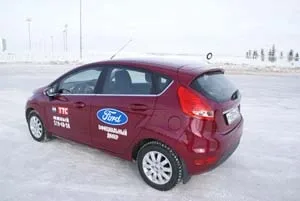
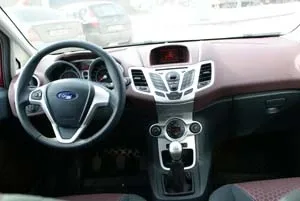
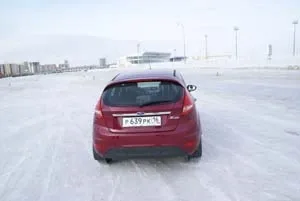
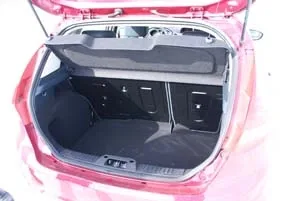
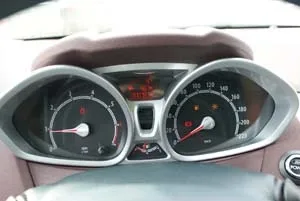
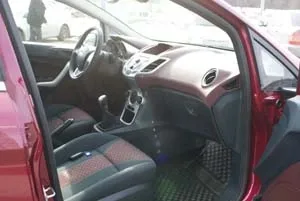
In general, for the appearance, you can safely give a five. Noticing the heated windshield, 16-inch alloy wheels, and rear parking sensors, I move on to the interior. The test car is in the "Titanium" version, that is, in the richest trim. The front panel is two-tone — burgundy with dark gray, the plastic is high-quality, everything is neatly fitted. The fabric upholstery of the doors and seats in matching tones looks elegant and pleases the eye. The elongated instrument pods — tachometer on the left, speedometer on the right, and between them the onboard computer display and fuel gauge — are perfectly readable. The leather steering wheel with thickened grip areas and music control buttons fits comfortably in the palms, and the front seats with mechanical adjustments allow you to quickly settle in comfortably. The driver's seat, of course, has more adjustments. In the back, two adults can sit quite comfortably, unless the front seats are occupied by people noticeably above average height. For the compact class, the laws of the genre are observed one hundred percent. The rear bench folds in parts, but when transporting hard and angular items, you should think about protecting the painted metal of the backrests — it is not covered by anything and easily gets scratched.
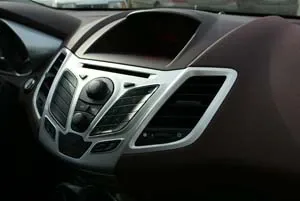
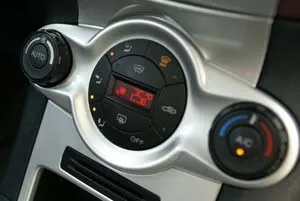
Of particular interest to young girls — and they, apparently, will become the main buyers of this beauty — will be the central console. It is made in the form of two little wings, as if opened towards the air flow, and is dotted with many buttons styled after old "Nokia" phones. Just below is the climate control unit with a display and a small niche for small items. There is a 12-volt socket, AUX connectors for a player, and USB for a flash drive. In my opinion, the kinetic design has logically flowed from the exterior into the interior as well.
Now about the main thing — how the new "Fiesta" drives. Under the hood, it has a four-cylinder gasoline engine Duratec Ti-CVT with a volume of 1.6 liters, producing 120 horsepower. This is the top engine for this model. In our case, it works in pair with a five-speed manual. Probably, for a city car aimed primarily at women, an automatic transmission would be more logical, but for now, we have to settle for what we have — the "stick". ABS is in place, but ESP is not — it is promised only in the "Ghia" version. However, this is even for the better, because we decided to start with a handling test on an ice rink — the car is shod with winter studded tires. On ice, the "Fiesta" behaved as a front-wheel-drive car should, no surprises. The electric power steering was very pleasing: it allows you to finely feel where the car is heading when the front axle understeers, and to correct the trajectory in time. We couldn't do without a bit of hooliganism — we did a "police turnaround" and a spin in reverse. All this was done with enthusiasm and boyish fervor, because the car is youthful, and therefore it doesn't have to be boring. It's hard to understand the engine's traction capabilities at low speeds, so for a full assessment, we head to a suburban highway.
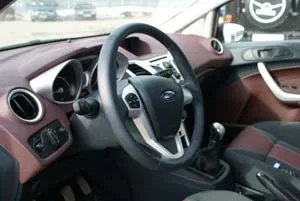
The path to the highway lay through city streets with far from ideal asphalt. And here it turned out that the chassis settings in terms of comfort are optimally selected: there are no irritating rocking motions, no unpleasant jolts, no impacts on the steering wheel from potholes and joints. In short, the suspension pleased everyone without exception. Having reached the starting point, we decided to first check the dynamics, and then — the behavior at high speed. We set off, but honestly, we expected more from 120 horsepower. No, there is enough traction, but for the acceleration to match the pedal press, the engine has to be revved above 4000 rpm — that's when it shows its true fighting character. And during calm driving in a higher gear at 2000–3000 rpm, a sharp press on the gas causes only dissatisfied grumbling and rather sluggish acceleration. Perhaps the fact that there were three of us in the car, and all of us are far from miniature people, played a role, and the little one isn't designed for that! But the handling on a winding road is beyond all praise! Despite the rear torsion beam instead of a multi-link, the car traces the trajectory without a hint of understeer, clinging to the surface until the last moment. I was sitting in the back when Vadim flew into a rather sharp turn at a decent speed — it seemed we would inevitably be carried outward. But no, the "Fiesta" only slightly "rearranged" and calmly continued on. On the way back along the same road, I was already driving. A precise and informative steering wheel, excellent elastokinematics of the suspension, allowing corners to be taken at the limit of the wheels' grip, precise gearbox operation, decent sound insulation. Excellent, simply excellent! With such emotions, we returned to the city — and after all, the city is the main habitat for cars of this class, like the new "Fiesta". Agile, comfortable, spacious, luxuriously finished inside, with pleasant standard music, and simply beautiful — it is quite capable of becoming a favorite for many.
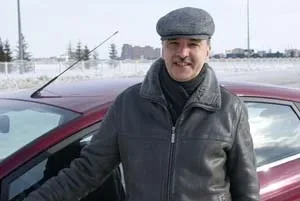
Vadim Sadykov, "Autoclub-Kazan"
Still haven't had a chance to ride the new Ford Fiesta 1.6? Then let's try to guess its character from pictures and specifications. What do we have?
1. "Sporty" lines of the car, swift design.
2. A 1.6-liter engine is a rarity for the B-class. It produces 120 hp and is the most powerful naturally aspirated engine in the segment, plus it is equipped with a dual variable valve timing system.
3. A compact B-class hatchback weighs only 1050 kg.
What sensations do you expect from such a combination? Naturally, explosive dynamics, confident pickup at any rpm, and gluttony. But in practice, it turned out quite differently. The main surprise is modest appetite: the official 7.9 L per hundred in the city, and our mixed cycle showed only 7.0 L. Ease of control is present, but acceleration even from 3000 rpm is difficult and accompanied by an unpleasant acoustic background.
To better understand the car's character, let's compare it with the Opel Corsa 1.2 (1150 kg, 80 hp) and the Mazda2 1.5 (950 kg, 102 hp). Interestingly, the Mazda2, even with a 4-speed automatic, feels noticeably more responsive than the more powerful Fiesta. The Japanese car's pull is felt from the very bottom, as if it's urging you to press the pedal harder. In the Fiesta, the herd of 120 horses dozes until mid-range revs. Yes, after 4000 rpm it shoots off no worse than the Mazda2, but was it worth building a whole new variable valve timing system just to get the character of the old 2.0 from the Focus, albeit with less power? However, if you compare the Corsa and Fiesta, their low-end behavior is almost identical: both hold speed confidently, respond sensitively to light throttle input, but react to a sharp kick-down the same way — with a pause, a displeased engine roar, and subjectively sluggish acceleration. The torque seems decent (152 Nm at 4050 rpm), but the Japanese know how to extract much more from a 1.6 with dual VVT. Take the Toyota Corolla — 124 hp, and the new Avensis — 132 hp at 6000 rpm and 160 Nm at 4000 rpm. So why have such a large engine for the B-class here at all? The answer is visible on the onboard computer display, and it's relevant in today's realities: fuel economy.
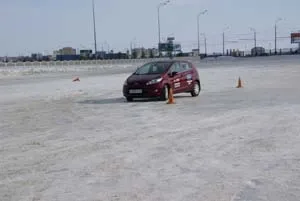
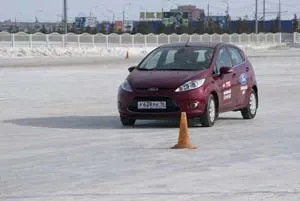
Perhaps the Fiesta's main trump card is the chassis tuning. It absorbs bumps almost perfectly and holds the road excellently in corners. The car is incredibly driver-friendly, forgiving and correcting mistakes — perhaps the best choice for a beginner. True, there's a nuance here too. Our car had 175/65R14 tires (this size is marked as "not supplied" in the catalog). But the standard 195/50R15 will be noticeably stiffer on bumps, although they'll improve acceleration dynamics due to the smaller overall wheel diameter.
Comparing prices with competitors is almost pointless right now. Prices change almost weekly, and discounts and special offers are updated even more often. You can only tell if it's expensive or cheap on a specific day — tomorrow everything will be different. So let's focus on objective things: material quality, design — this is another argument allowing the Fiesta to claim the title of the most popular B-class car.
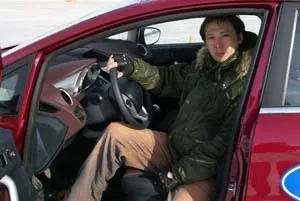
Alfred Mardanov, "Autoclub-Kazan"
A little Kuga! That's the thought that came to mind at first glance, and as it turned out, not just to me. Ford managed to almost fully realize kinetic design even in a compact car, although the task seemed impossible. The sleek radiator grille, headlights overhanging the wide fenders, lowered and pushed-back mirrors, small triangular windows front and rear — all this creates the unique image of the new Fiesta. Under Ford's new program, this car will be sold simultaneously on all continents. Previously, that seemed like fantasy. Americans, for instance, don't favor cars that can't seat kids, wife, mother-in-law with twenty suitcases, a parrot, and a dog, while Europeans, on the contrary, adore small cars — the smaller, the better. But times change, and so does economic perception, and perhaps Ford is right in their endeavor. Moreover, they promise easy suspension adaptation to any road quality. Europe with its autobahns and serpentines, Russia with its troubles, America with highways, or Chinese roads — each surface type can have its own tuning. And this isn't just words — we tested it ourselves. The tuning is simply ideal. This theme ran like a red thread through all our conversations during the test, as did the car's extraordinary friendliness. You get in and drive as if it's an old friend you've known for a hundred years and know what to expect from. You wouldn't expect such comfortable and confident driving from such a car. Progress can't be stopped by any financial crises.
I was especially pleased with its mature behavior on the highway. The car holds its course confidently, and crosswinds can't knock it off its trajectory. I'd also note the sound insulation — surprisingly high for this class. Only past 110 km/h does aerodynamic noise from the mirrors start to appear, and rear passengers are bothered by a whistle near the triangular window. At high revs, a cheerful engine rumble penetrates the cabin, but it doesn't spoil the acoustics; rather, it adds that very "kinetics" the designers intended. As good as it is on the highway, its element is the city. Big, modern, with a frantic pace. Dense traffic flows along avenues, dissolving into courtyards and parking lots. Here, the rule is simple: don't lag behind. And this little one follows it completely. Thanks to the engine tuning and stretched gears, it doesn't require frequent shifts: at low speed in traffic on a higher gear, it responds easily to light throttle input. Revs rarely drop to a modest 1000–1500 rpm; they're always a bit higher, and the car is constantly ready to surge. But if you floor it — better to downshift. Though that's also a pleasure. The short-throw, almost sporty gearbox works flawlessly — crisp, informative, firm shifts that tempt you to play with the lever. This was especially evident on the ice rink during our experiments, which Marat mentioned. The car behaved maturely: precise reactions, smooth and predictable slides. A regular front-wheel-drive car. I also noted braking on bare ice. The clear, informative brakes, along with ABS, work excellently. The system activates exactly when you expect it, without unnecessary nervousness. What can I say — a great car, and it's nice that it can speak Russian. A small thing, but pleasant.
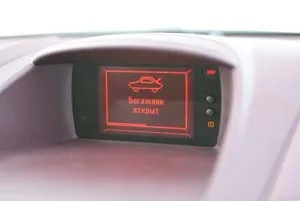
Engine start is by button, and when pressed (if the chip key is nearby or inside), a Russian message appears on the central display like "press the clutch pedal to start moving." The car often engages in dialogue and prompts: sometimes "driver's door open," sometimes "trunk open." In my opinion, the rear passenger space is slightly reduced in favor of the trunk. The rear row seems shifted forward, perhaps for ease of entry and exit. I'd prefer more room in the back at the expense of trunk volume. To be fair: the price of our example is 630,000 rubles (data from February 2009), and it will likely reach 700,000. Perhaps over time people will get used to such figures, but right now it seems expensive. What can you say? A mature car demands a mature price. And this is payment not just for the car, but for impeccable style, technical equipment, and perfection. Judging by the number of these cars on our streets, people are willing to pay it.