
Happy Holidays!
When I flew home after getting acquainted with the new generation of the Ford Fiesta hatchback, a short note of three words appeared in my notebook: "no", "yes", and "yes".
That's how I answered three questions that had been troubling me before the trip to Italy. First: did the new model retain that very driver-oriented character for which this compact hatchback was loved by many? No! Second: did the car become better? Yes! And third: would I take it into my own garage? Yes!
The Main Question
Don't believe talk that the new "Fiesta" has gotten heavier and lost its former sharpness. Those who say so most likely have never sat behind the wheel of the new-generation hatchback and draw conclusions solely from pictures on the internet. And those who did take a ride have apparently already forgotten what the sensations from the old model were like.
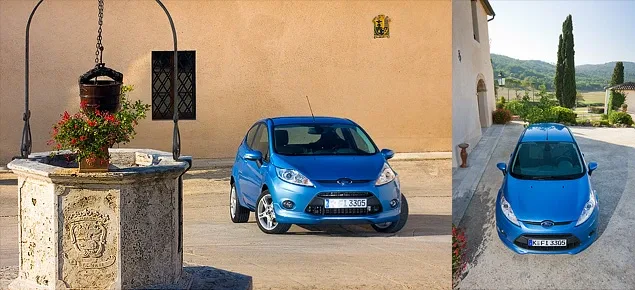 |
So, the new Ford Fiesta drives beautifully! First, it has become 40 kilograms lighter than its predecessor and three centimeters lower, so accusations of "spreading out" are definitely unfair. Second, the new model is based on the same "driver-oriented" platform as the previous model, but with some improvements.
The wheelbase has grown by three millimeters, the front and rear tracks have become wider by 9–29 millimeters depending on the version. The rear beam has become almost a third thicker, and the body, thanks to the extensive use of high-strength steels, has become 10 percent stiffer. The front stabilizer has also grown — 22 millimeters versus 19 on the old car. The springs and shock absorbers have been completely recalibrated, and new silent blocks have appeared in the suspension.
By the way, the Mazda2, which came out a year earlier, is built on the same "cart". And this car, by the way, was not reproached by anyone for a lack of sportiness.
True, as Dieter Schwartz, the global development manager for the Ford Fiesta family, claims, the suspension settings of the two models still differ. The "Mazda" has softer springs but stiffer shock absorbers, while the "Fiesta" has the opposite. According to Schwartz, this is where that barely perceptible difference in the behavior of these hatchbacks comes from. To some, the "two" seems like a real sportswoman that notices every crack in the asphalt, but the "Fiesta" does not. But the Ford engineers had a different goal. "We had to increase comfort, but at the same time not lose the sporty character," explains Dieter. Did they succeed?
More yes than no. Yes — because the new "Fiesta" really feels more comfortable. It is quieter and better at swallowing small bumps. And, which is especially pleasant, it has a surprisingly honest steering wheel that perfectly filters out unnecessary information from the road.
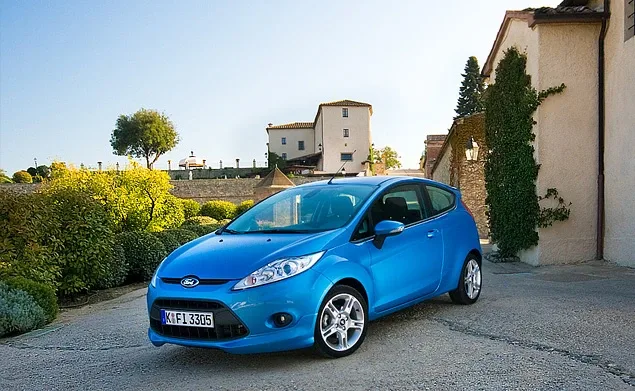 |
In any case, the tongue would not turn to call the Ford Fiesta a "slush". Quite the opposite! Even to me, a die-hard fan of "hot" hatchbacks, the five-door version in Titanium trim on a broken road seemed quite bumpy. And the three-door Fiesta Sport, by feel, is even stiffer. There is nothing surprising about this — the sport version gets springs shortened by 10 millimeters, different shock absorbers, and a stiffer rear beam.
"Thanks to the new design of the rubber-metal bushing of the rear beam, we can tune the suspension to the requirements of a specific market. For Europe, we made the car stiffer, and for Asia we will change the spring and shock absorber settings and install a different bushing that better dampens bumps," says Schwartz. And the beam itself will be different for different markets: somewhere thicker and stiffer, somewhere thinner and softer.
A similar situation is with the steering. The old "Fiesta" had hydraulic power steering, while the new one received a modern electro-hydraulic system EPAS. "We chose this scheme not by chance — it reduces fuel consumption and CO2 emissions, since it works only when the driver needs assistance. In addition, it better dampens bumps and can compensate for vehicle drift due to road slope or ruts, creating the necessary force on the steering wheel in the opposite direction imperceptibly for the driver," says Dieter Schwartz, as if reading a press release. That's where this fantastic "purity" of the Ford Fiesta's steering comes from!
At first, the "electric" steering wheel seems slightly unnatural and slightly sluggish, even despite the reduced steering ratio from 15:1 to 14.25:1. But you get used to its character very quickly and then begin to get real pleasure from how it is tuned! A slight lack of feedback is felt only at small steering angles and at low speed, but as soon as you add gas — the steering wheel fills with weight and becomes extremely precise. It's not for nothing that Ford people drove more than 50 thousand kilometers in search of optimal settings for the control electronics. And that's not counting the 3.5 million test kilometers of general testing.
Moreover, the electric power steering calibrations are selected individually for each modification: the Fiesta Sport's steering wheel was initially made "heavier", and on diesel versions the EPAS even more effectively fights drift during acceleration.
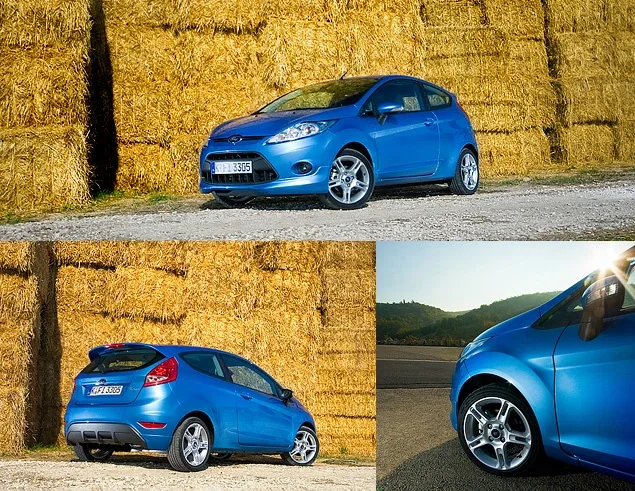 |
In total, six engines are available for the new "Fiesta": four petrol ones with a volume of 1.25 liters (60 or 82 horsepower), 1.4 liters (96 horsepower), and 1.6 liters (120 horsepower), as well as two turbodiesels — 1.4- and 1.6-liter with a power of 68 and 90 horsepower, respectively. In Russia, all units will be sold except the low-power petrol engine and the 1.4-liter diesel.
I managed to drive only the most powerful Fiesta Sport with a new petrol engine equipped with a variable valve timing system. Almost the same engine is installed on the Russian Ford Focus, but on the "Fiesta" this unit has a phase shifter on both camshafts. The result is plus five horsepower and the same maximum torque (154 Nm).
The engine, by the way, is excellent! Even though it does not turn the "Fiesta" into a racing car, 120 horsepower is noticeably better than the 100 of the old model. Moreover, the new engine pulls well at low revs, and after 3–3.5 thousand revolutions it briskly and with a menacing roar flies to the very limiter. Add to this the precise gearshift mechanism, a clear steering wheel, a dense suspension, and excellent brakes (even despite the fact that there are still "drums" at the rear) — and you get an excellent car for winding roads and mountain serpentines. Even in a calm mode, you get a lot of pleasure from the "Fiesta", and with increasing speed it turns into a whole ocean.
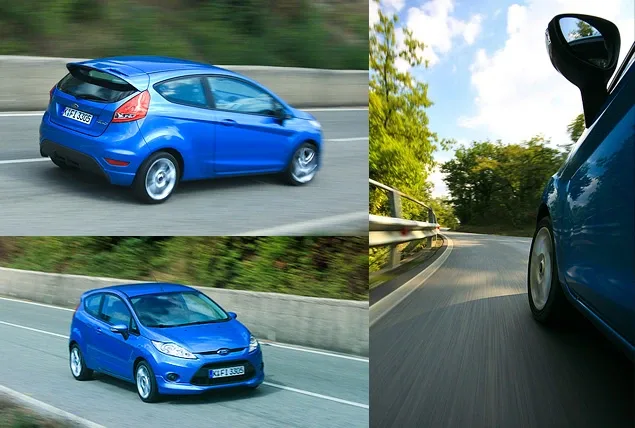 |
You drive faster and faster, and the tires continue to dig into the rough Italian asphalt with a bulldog grip. The stability reserve in corners is not just large — it is huge! So huge that most drivers in real life are unlikely to approach the limit of tire grip. But even if you make a mistake, nothing terrible will happen — with a strong excess of speed in a corner, the "Fiesta" will show a quite predictable understeer under the muffled rattle of the stability control system. And no tendency to a slight drift in response to a sharp throttle release, for which we so loved the old "Fiesta ST" after a trip to the racetrack in Myachkovo.
"But that's boring!" — Fiesta fans will exclaim. I would not say so: even though there is a little less driving excitement in the character of the Ford Fiesta, there is much more comfort. And this, you will agree, is much more important in a global sense. Especially for a car destined to be the first "worldwide" Ford model.
Moreover, the new "Fiesta" will definitely have a "charged" ST version — with proper suspension, brakes, and a corresponding appearance. "We have almost finished the exterior of the new Fiesta ST," Ford designer Chris Bird accidentally let slip. — "But I cannot yet name the exact debut date, because our engineers cannot pick a suitable engine. All I know is that it will look very cool."
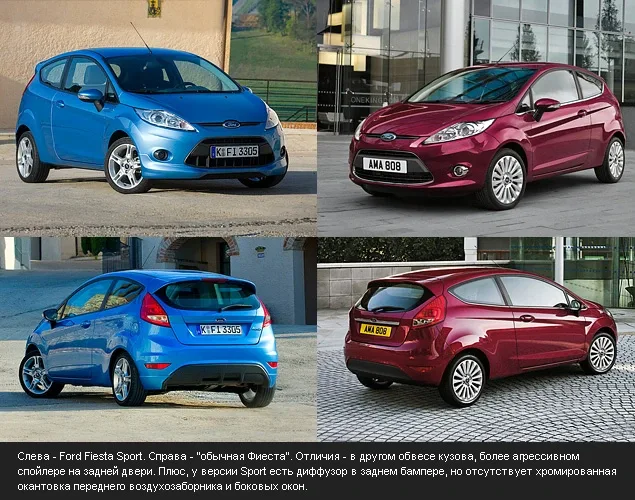 |
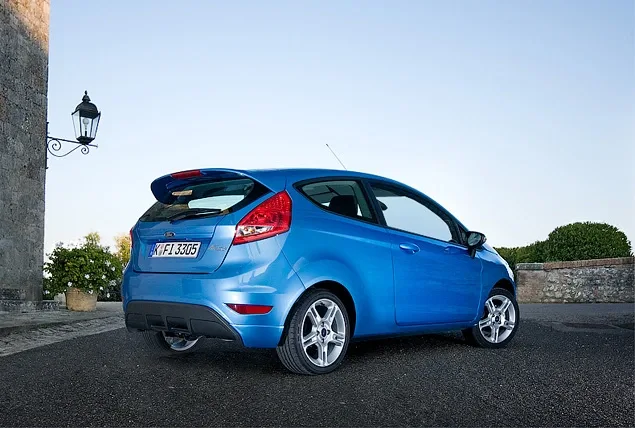
Cooler than the regular "Fiesta"? But it already looks wonderful! Spectacular elongated headlights, complex body plastic with distinct stiffening ribs on the side panels and boldly outlined wheel arches — you can walk around the new hatchback for hours, discovering new design details that start to "play" only at a certain angle of view. And if earlier the "Fiesta" was called a "frog" for its wide muzzle and square headlights placed at the corners of the body, now it is a real beauty.
Question Number Two
The new design is perhaps the main trump card of the new "Fiesta", which should attract the attention of buyers, especially young ones. As Bird says, the initial bet was placed precisely on young people who easily perceive the "kinetic" design philosophy.
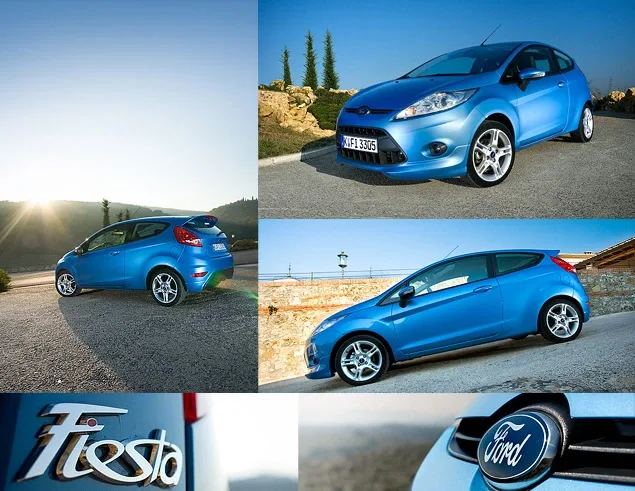 |
Now Ford's "kinetics" has moved into the car's interior as well. The developers assure that no other brand has yet managed to achieve such a unity of external form and internal content.
And indeed, inside the new car looks even bolder than outside. The central console with controls for the stereo and onboard computer seems to "flow" under the pressure of the wind, deep instrument wells, sharp edges on the steering wheel hub, and elongated lines on the door cards — all of this perfectly emphasizes the "kinetic" mood embedded in the exterior.
The new architecture for controlling onboard electronics is surprising at first. We're talking about that very console that Ford's own people compare to a mobile phone. The resemblance is real: the buttons on the left handle first-level menu items, and a small joystick that can be tilted in four directions and pressed works like a central navigation key, as on most modern phones. At the bottom there are two more context buttons whose functions change depending on the selected item. Even the plastic of the buttons resembles a phone's — slightly rough and tactilely pleasant.
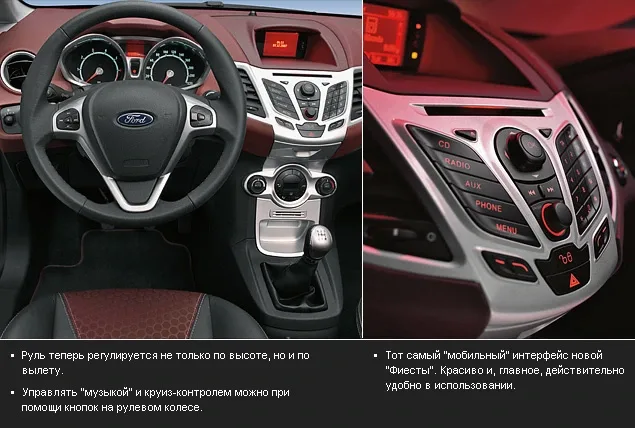 |
The multimedia part of the "Fiesta" also pleased: quality acoustics with rich sound, mp3 support, the ability to connect players via line-in or USB. Most functions can be controlled by voice. The only ergonomic drawback is the excessive tilt of the control unit, which means shorter drivers will have to reach for the far buttons. For me, at 189 centimeters, this wasn't an issue.
Buyers will be offered a choice of 11 color combinations and interior trim options. In each of them, except the Ghia version, the front panel will feature contrasting colored inserts — for example, blue with gray or burgundy with gray. There will be 15 body colors, seven of which are completely new. Among them is that very Hot Magenta that debuted on the Verve concept and was so loved by the public.
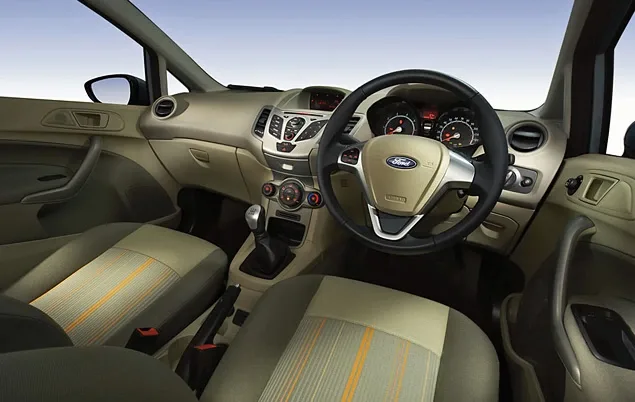 |
By the way, the new model has already reached Russian dealers — the first batches were expected in early October, at the same time as the European sales launch. And by the end of the month, the first cars in "customer" trims were supposed to arrive.
The price question
Compared to its predecessor, the new model has noticeably become more expensive. Previously, the base Fiesta 1.3 Ambiente (70 hp) cost 325 thousand rubles, but now the most affordable "three-door" will cost 388 thousand. True, the engine has become more powerful — 82 hp, and the base already includes a steering column adjustable in two directions and electric mirror adjustment. For the five-door body, you'll have to pay an extra 10 thousand rubles.
In the Trend trim with the 1.4 engine, the price will be 413 thousand rubles. If you choose the "five-door" with a classic hydromechanical "automatic" with four gears rather than a "robot", the amount will rise to 453 thousand.
 |
Now the "Fiesta" will have two top trims at once — Ghia and Titanium. They are almost identical in equipment but have different interior finishes: classic and high-tech. Such "three-doors" with a 1.4 engine, leather interior, rain and light sensors, 15-inch wheels, projector headlights, and climate control will cost 442 thousand rubles, and with the 1.6 engine — 462 thousand. The "automatic" is offered only with the smaller engine.
The Fiesta Sport is available exclusively with the 1.6-liter gasoline unit (120 hp). Sports fabric seats, leather steering wheel, body kit, lowered suspension, 16-inch wheels, and air conditioning — all this is already in the base. The price of the "Sport" starts at 498 thousand rubles. For an extra charge, you can add climate control (12 thousand) and side sills (about eight thousand). For comparison, the previous Fiesta S cost from 430 thousand.
The most expensive version will be the diesel "Fiesta" 1.6 (90 hp), which will be offered only in the rich Titanium trim. The "three-door" with diesel will cost 497 thousand, the "five-door" — 507 thousand rubles.
If you remember, at the beginning I answered "yes" to the question of whether I would buy this car for myself. I'll repeat: I would, and with great pleasure. And specifically the Fiesta Sport — white, with the 120-horsepower engine, big wheels, and sports seats!
Mmm… The only problem is that I already have a white "Fiesta".
Technical specifications of the Ford Fiesta Sport 1.6
| Length, mm | 3950 |
| Width, mm | 1722 |
| Height, mm | 1481 |
| Wheelbase, mm | 2489 |
| Curb weight, kg | 1109 |
| Engine displacement, cm3 | 1596 |
| Power, hp/rpm | 120/6000 |
| Torque, Nm/rpm | 152/4050 |
| Acceleration time from 0 to 100 km/h, s | 9.9 |
| Top speed, km/h | 193 |
| Fuel consumption in combined cycle, l/100 km | 5.9 |