
The Ford Fiesta is genuinely new. Not a single detail reminds of the old generation — the Verve concept was brought to production without compromise. The first encounter with kinetic design in the compact class gave us a truly solid, stylish, and well-built-looking car. Or is it still a trinket, and a distinctly feminine one at that? Ladies behind the wheel look far more natural than stern, smoke-soaked men with AI-95 blood type...
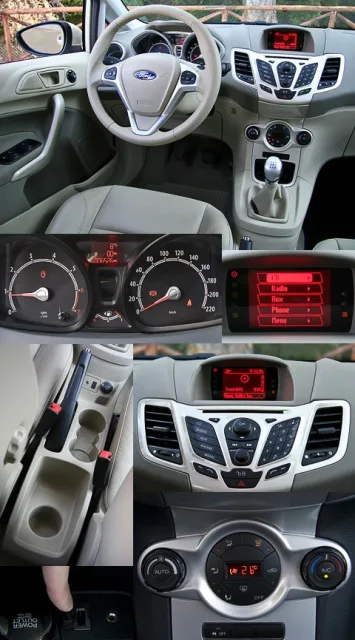
The center console, styled like a mobile phone keypad, is the very essence of the concept of an "accessory." The car's connection to household items is a sign of the times. But the intrusiveness of Ford's idea is unsettling. As is the disjointedness of the other fragment-ideas that make up the interior. The "binoculars" instrument cluster turned toward the driver. Round climate control blocks densely covered with buttons. Steering column stalks resembling packages of expensive cosmetics (I wouldn't have guessed myself; I'm quoting the press release). The steering wheel rim, cut with ridges and recesses. To handle this creativity without hesitation, you need to get the hang of it, to get used to it. And who, exactly, needs this? Who are all these people?
- Style! Now it seems that the creators of the previous Fiesta didn't think about design and interior refinement at all.
- The mobile phone raises the most questions. The connection between the buttons and joystick and the menu branches is not transparent enough. In addition, you have to reach for the joystick, lacking a mega-thumb on your right hand. However, figuring out the interface intuitively is much easier than with the first version of i-Drive, even with instructions. Fortunately, the menu (like the onboard computer) in the Fiesta is Russianized. An important condition: don't try to master it while driving.
- The Fiesta is equipped with a keyless access and start system (like the Focus and Kuga). Before pressing the Ford Power button, on versions with a manual transmission, you need to depress the clutch while holding the car with the brake pedal or handbrake.
- In keeping with the times, the Fiesta offers the user a USB port. Thank you. But steering wheel reach adjustment (which wasn't there before) or heated windshield look much more relevant.
The answer comes from Christopher Bird. It was he, Martin Smith's predecessor, who set the new direction for European Ford design. He also participated in the work on the new Fiesta. Bird holds a theatrical pause: "Of course, we targeted the fairer sex. And the mobile phone idea is an all-in idea, our i-drive, a lure for the most advanced and active young women eager for something new. Targeting them, we hope others will follow. And they'll start talking about the Fiesta."
You can talk not only about design. The stylish interior is well-assembled, with soft plastic in the trim. There are no serious complaints about the seating of four average-height people, nor about the number and location of small-item compartments or the trunk. The fashionable gadget is practical! And, by class standards, richly equipped. Although the lion's share of the richness, alas, is in the options list.
"More than a fashionable gadget!" Bird continues. "Yes, cars mimic the environment of the target audience: apartment, mobile phone, computer, even clothes... Yes, we chose the familiar and customary interface of a cell phone to make the car easier to perceive. But the Ford Fiesta is not a Nissan Mixim. The Japanese concept flirts with those who have traded real-world movement for virtual life. But the Fiesta still genuinely delights and drives interestingly! Did you notice the steering wheel 'for the correct grip'? Owners of our car are full of drive!"
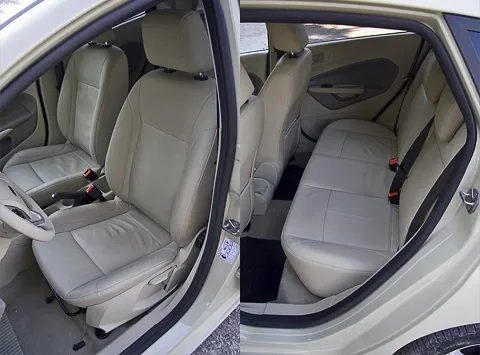
The standard front seats are comfortable. Instead, you can get leather ones (Ghia version), just pay. But the adjustments are mechanical in any case. Three people seated in the back will be squeezed from the sides by the Fiesta, and tall ones will also have pressure on their heads. But two average-height people fit in the back without problems.
At the presentation, the drive is embodied in three-door and five-door 1.6 models with a five-speed manual. The petrol cars are 120-horsepower, the diesel ones have 90 "horses." At first, it seems that the petrol version is a bit bland on the road. Under the impression of the exterior, you expect a celebration, an explosion of emotions, and memories of the temperament of the platform-sharing Mazda 2 are still fresh. If you abstract yourself... The Fiesta drives very smoothly, livening up a bit at high revs, forgiving deliberate mistakes in gear selection. Only when climbing a serpentine road do you lament that engine builders nowadays languish under the fifth of the environmentalists. And on the highway — that there's nowhere to shift above fifth.
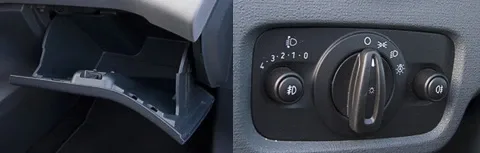
- Having decided, no doubt, that the armrest box would prevent the owner from placing her handbag between the seats, the creators limited themselves to a spacious glove compartment.
- The creators claim that the Fiesta was made not only for women: the buttons and control handles, they say, were specially enlarged to fit a man's hand. The exterior lighting switch, it seems, was forgotten.
Overall, it's a celebration of obedience. A woman doesn't need explosive substances. On the contrary, it's good that the car doesn't provoke. But in the quiet cabin, the engine hum constantly drones. And that's bad. They should turn down the volume... They can! The Fiesta with the 1.6 diesel (90 hp) and additional sound insulation is noticeably quieter than the petrol one. And more spirited, even though it's half a centner heavier. Sure, you have to tug at the convenient and precise gear lever more often, but after each downshift and the tachometer needle hitting the cherished zone "from 1500," the car eagerly rushes into battle, although by 4000 rpm the engine, unlike the stubborn petrol one, goes limp.
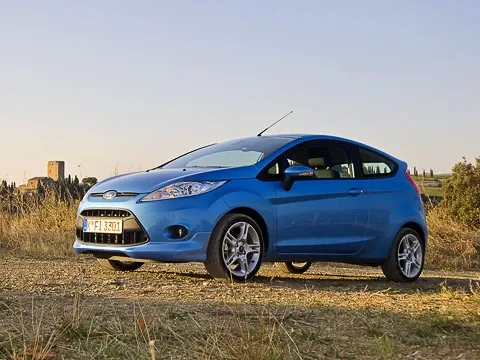
The brakes are good. And I liked the suspension. Moderately firm, comfortable, and it doesn't bother with road imperfections. The smoothness of the ride and loyalty don't come at the expense of handling: in corners, both the petrol and diesel five-doors are equally good. Correct, predictable. Gradually increasing understeer is easy to correct. The steering effort is no longer as natural as before, but this synthetic feel is not offensive for sensing the car. By the way, on the move, it no longer seems that there's an excess of creativity in the interior. Even the notorious mobile phone fades into the background.
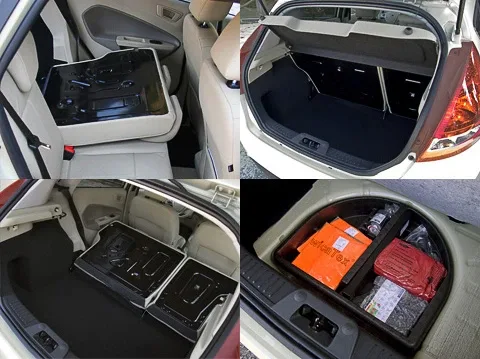
The rear seat backrest folds in parts, but the cushion, though removable, is one-piece. Under the floor of the trunk in cars for the Russian market, there's not a repair kit but a space-saver spare wheel.
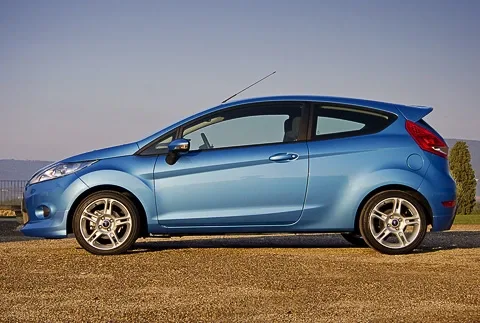
Bird didn't overpraise! And here's the key moment. If we recall the Mazda again, driving the Fiesta is a more expensive-feeling pleasure. As for the three-door in the Sport version, the word "pleasure" is not shameful to write with a capital letter. It also has a 120-horsepower petrol "four," but different power steering settings and increased stiffness of the rear suspension, front springs, and all shock absorbers. The body, accordingly, is also stiffer than the five-door's. And only on this version is ABS already standard, and the optional ESP system can be turned off.
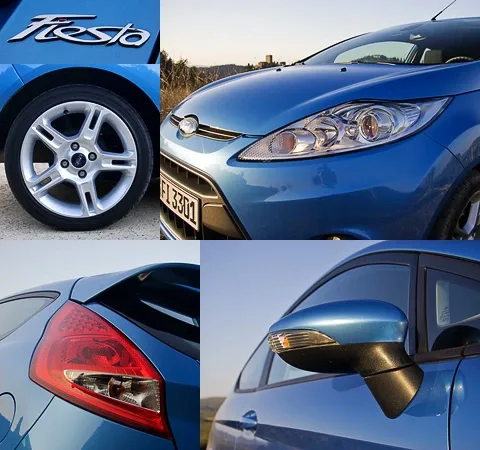
Girls, shoo! The sport seats accept men as their own. Plotting trajectories on the sport Fiesta is more interesting, and it holds them noticeably more firmly. The feeling of the car has also strengthened. But the quality of the roads seems to have suddenly deteriorated a bit — cracks, potholes... And the female journalists on regular Fiests somehow all fell behind at once.
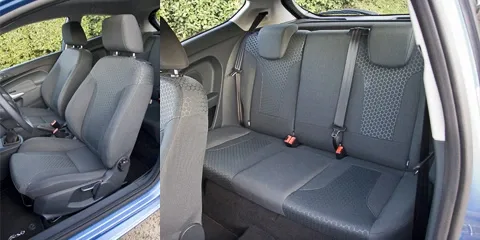
The seats of the Sport version perfectly hold the bodies of those in front. Access to the rear seats of the three-door is a challenge for non-sporty passengers.
Among the female colleagues invited to the presentation was my acquaintance Anya. Her first impression will be a strong argument for or against the new Fiesta car. Also because Anya owns a Fiesta of the previous, fifth generation. "It drives well. The interior is more expensive, more interesting. It's become easier to spread out small items and place a bag. And the trunk is deeper. Oh yes! No more needing to unlock the fuel filler flap with the key!"
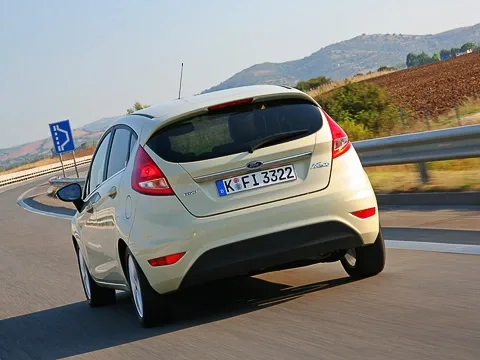
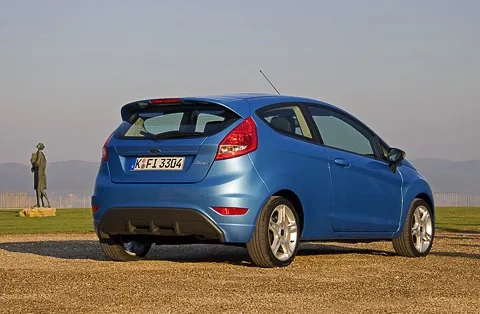
There are no serious complaints about forward and side visibility, although the wiper cleaning zone could be wider. But the rear window is vanishingly small. All hope rests on the decent exterior mirrors.
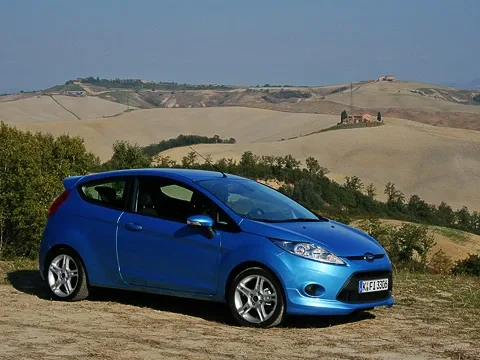
And for many Fiesta buyers, such an assessment is quite enough. More expensive, more interesting, and ultimately good — these are, in fact, the benchmarks the creators had. And Anya didn't even mention the console's peculiarity. Neither yes nor no. She only noted, in a feminine way, that the Fiesta's beauty greatly depends on the body color. Bodies in our way.
Technical specifications
| Specifications | Ford Fiesta 1.6 Ti-VCT | Ford Fiesta 1.6 TDCi |
|---|---|---|
| Body | ||
| Number of doors/seats | 3/5 (5/5)* | 3/5 (5/5) |
| Length, mm | 3950 | 3950 |
| Width, mm | 1722 | 1722 |
| Height, mm | 1481 | 1481 |
| Wheelbase, mm | 2489 | 2489 |
| Track front/rear, mm | 1473/1493 (1460/1480) | 1473/1493 (1460/1480) |
| Curb weight, kg | 970–1119 | 1022–1164 |
| Gross weight, kg | 1500 | 1550–1555 |
| Trunk volume, l | 295 | 295 |
| Engine | ||
| Type | petrol | turbodiesel |
| Location | front, transverse | front, transverse |
| Number and arrangement of cylinders | 4 in-line | 4 in-line |
| Number of valves | 16 | 16 |
| Displacement, cm3 | 1596 | 1560 |
| Max power, hp/rpm | 120/6000 | 90/4000 |
| Max torque, N•m/rpm | 152/4050 | 204/1750 |
| Transmission | ||
| Gearbox | manual, five-speed | manual, five-speed |
| Drive | front | front |
| Chassis | ||
| Front suspension | independent, coil spring, McPherson | independent, coil spring, McPherson |
| Rear suspension | semi-independent, coil spring | semi-independent, coil spring |
| Front brakes | disc, ventilated | disc, ventilated |
| Rear brakes | drum | drum |
| Ground clearance, mm | 160 | 160 |
| Performance | ||
| Maximum speed, km/h | 193 | 175 |
| Acceleration 0–100 km/h, s | 9.9 | 11.9 |
| Fuel consumption, l/100 km | ||
| — urban cycle | 7.9 | 5.2 |
| — extra-urban cycle | 4.7 | 3.6 |
| — combined cycle | 5.9 | 4.2 |
| Emission standard | Euro-4 | Euro-4 |
| Fuel tank capacity, l | 45 | 45 |
| Fuel | AI—95–98 | diesel |
| *In parentheses data for five-door hatchback | ||
Technology
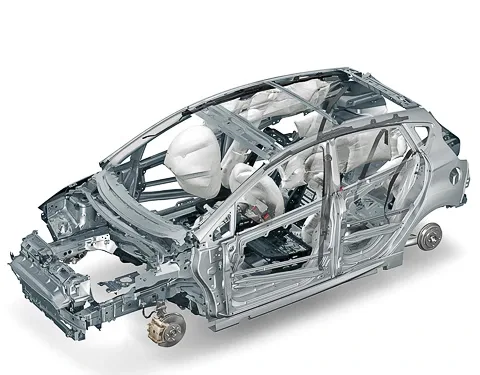
The dimensions of the new Fiesta have hardly changed compared to the previous generation car. However, the body has become 10% stiffer, and the unladen weight has decreased by about 40 kg. This time, sound insulation has been noticeably improved, especially for diesel modifications. The driver's seat has been lowered by 30 mm, and adjustment ranges have been expanded: the seat moves 286 mm horizontally and 55 mm vertically. The front door pockets are the most spacious in this class. The trunk is also the largest in the model's history: from 295 to 979 liters.
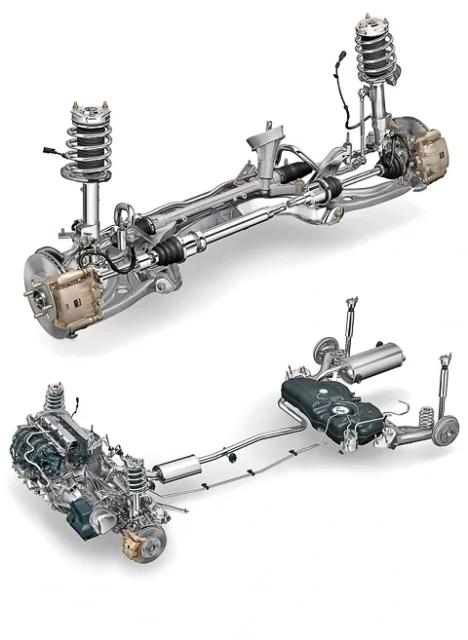
Suspension settings — McPherson struts at the front, torsion beam at the rear — are selected depending on the market, varying silent blocks, springs, and shock absorbers. For Asia, where comfort is paramount, softer versions are prepared. Europe, which has always prioritized handling, will receive a rear axle with increased roll stiffness. Cars with European settings are supplied to Russia.
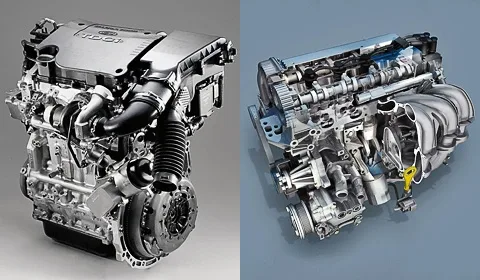
Among the Fiesta's petrol engines, there is now its own flagship — the 1.6 Duratec Ti-VCT engine with 120 hp. It is more economical than the previous 100-hp engine of the same displacement: it consumes on average 5.9 liters per 100 km. Peak torque is 152 N•m at 4050 rpm. The engine has two independent variable valve timing systems on intake and exhaust. The block and cylinder head are aluminum. The petrol engine range also includes three more 16-valve Duratec engines: a 60-hp 1.25-liter (average consumption 5.4 l), its 82-hp modification (5.7 l), and a 96-hp 1.4-liter (with manual transmission — 5.7 l). The Duratorq TDCi diesels have also been refined for efficiency: the 1.4 consumes 5.3 l in the city and 3.5 l on the highway; the 1.6-liter consumes 5.2 and 3.6 l, respectively.
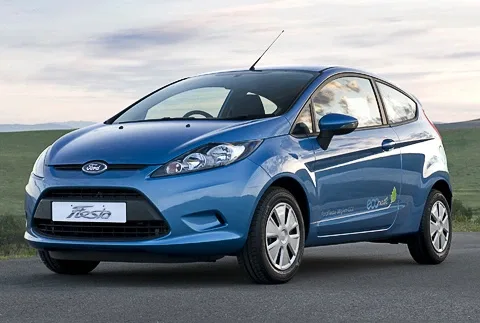
The Fiesta ECOnetic version, created specifically for environmentalists, is sold exclusively in Europe. Under the hood is a recalibrated 90-hp 1.6 Duratorq TDCi diesel. Differences from regular cars: final drive ratio 3.055:1, reduced ground clearance (suspension borrowed from Sport), low-rolling-resistance tires 175/65 R14, and aerodynamic wheel covers. The result is an average consumption of only 3.7 liters per 100 km and CO2 emissions of 99 g/km, which is 10% less than a standard diesel Fiesta.
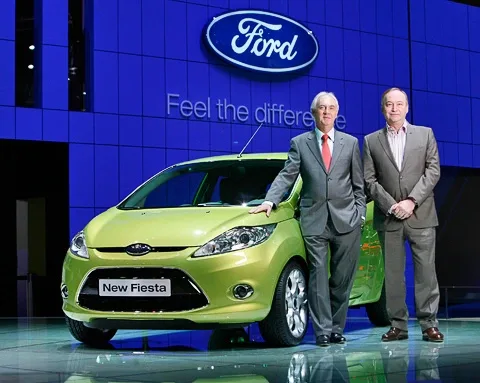
The public debut of the new Fiesta generation took place at the Geneva Motor Show in 2008. The car is currently assembled at plants in Cologne (Germany) and Nanjing (China). Unlike its predecessor, this Fiesta was originally designed as a global model: by 2010, hatchbacks and cars on the same platform — sedan, crossover, and minivan — are planned to be sold in Asia, South Africa, Australia, and North America.
Trim Features
Ambiente. Base trim: bumpers in body color, steering wheel adjustable for tilt and reach, electric adjustment of side mirrors — standard.Engines: petrol 1.25-liter Duratec with 60 and 80 hp, as well as a 68-hp 1.4 Duratorq TDCi diesel. Russian options: three- or five-door hatchback with 1.2 engine (82 hp) and manual transmission.
Trend. It is predicted that this version will become the best-selling — it will account for 63% of European sales. Differences: mirrors in body color with heating and electric drive, front electric windows, central locking with remote control.
Engines: petrol 1.25 and 1.4 Duratec, diesels 1.4 and 1.6 Duratorq TDCi. For Russia: three- or five-door hatchback with 1.4 (96 hp) and manual or automatic transmission.
Sport. It can be recognized by 16-inch five-spoke alloy wheels, front fog lights, body kit, leather steering wheel, and sport seats. Already standard: onboard computer, side airbags, air conditioning, and ABS. The suspension is lowered by 10 mm. This version reaches 100 km/h in 9.9 seconds, with a top speed of 193 km/h.
Engines: petrol 1.6 (120 hp) Duratec Ti-VCT or diesel 1.6 TDCi (90 hp). In Russia, Sport is available only in a three-door body with a 1.6 engine (96 hp) and manual transmission.
Ghia and Titanium. Top trims. Common: chrome on the front grille frame and side windows, fog lights, leather steering wheel, air conditioning. Ghia additionally has leather interior, 15-inch alloy wheels, rain and light sensors, dual-zone climate control.
Engines: petrol Duratec 1.25, 1.4, and 1.6 l, diesels Duratorq TDCi 1.4 or 1.6 l. Titanium options for Russia: three- or five-door with 1.4 (96 hp) and manual or automatic, 1.6 (120 hp) with manual or turbodiesel 1.6 (90 hp) with manual. Ghia has the same set but without diesel.
History
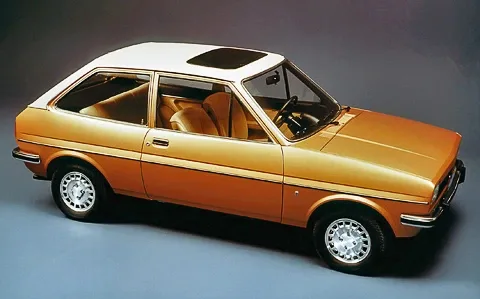
The first Ford Fiesta hatchback debuted in 1976, although development of the car for the era of the oil crisis started three years earlier. A billion dollars was spent on the project — a fabulous sum for those times. The investment paid off: by early 1979, plants in Spain, Germany, and Great Britain had assembled more than a million cars. Buyers were attracted by compact dimensions, a choice of four petrol engines (from 40 to 84 hp for the “hot” XR2 version), a spacious trunk, and a reasonable price. Production ended in 1983.
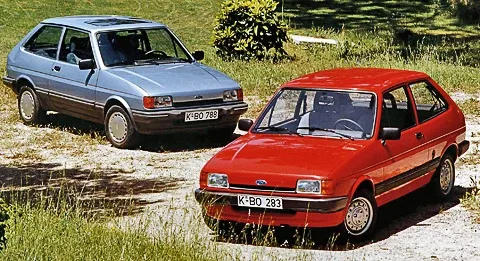
The second generation Fiesta, produced from 1983 to 1989, can be called new with a stretch. A 54-hp diesel was added to the previous but modernized petrol engines, the XR2 sport version received a 1.6 engine with 96 hp (8.7 seconds to 100 km/h), and the four-speed manual gave way to a five-speed. Also, for the first time, a belt-driven CVT was installed in a pair with petrol engines.
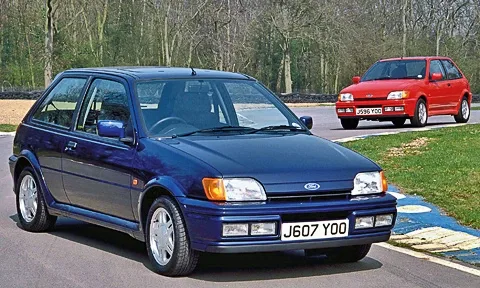
From 1989 to 1995, the "festive" third-generation Ford was assembled on European assembly lines. It was then that five-door hatchbacks appeared in the lineup, Zetec engines settled under the hood, and older engines got fuel injection. This generation of Fiesta was the first to receive a turbocharged petrol engine — 1.6 liters and 133 horsepower. The interior became more spacious and better finished, and the options list included ABS and front airbags. By the way, in 1992 the model set a personal sales record — 650 thousand units per year.
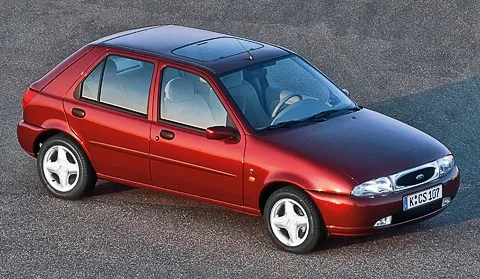
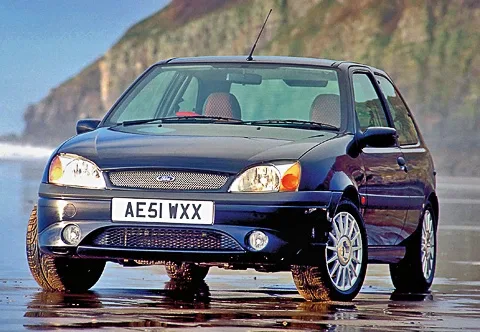
The fourth generation of Fiesta was produced from 1995 to 2001. The exterior and interior design did not justify the playful name — it's hard to imagine a more dull and visually boring car. However, the petrol engine lineup consisted only of Zetec units with power from 75 to 100 hp, and the equipment became richer. True, the car's character calmed down — the fastest version needed 9.9 seconds to reach 100 km/h. In 1999, the model underwent a full restyling, which is visible in the bottom photo.
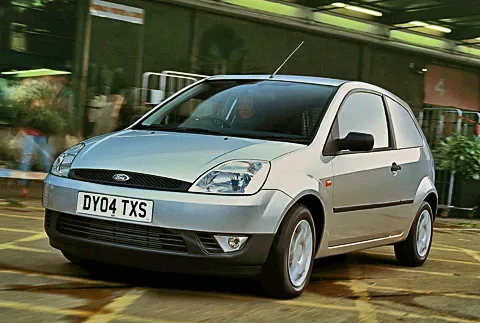
The fifth and final generation appeared in 2001. The car grew in all dimensions, received Duratec petrol engines and modern Duratorq turbodiesels with common rail. The main feature of the Fiesta remained unchanged — the sportily tuned suspension made you forgive the plain exterior and simple interior. Over seven years of production, 415 thousand such cars were sold worldwide. And in total, over 32 years, more than 12 million Fiestas have been sold!
Behind the scenes 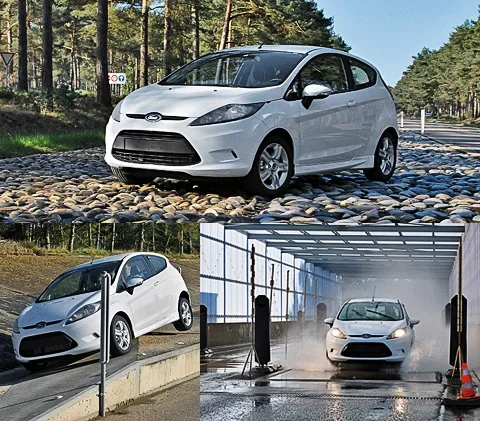
For Ford, the success of the image model on the Russian market is a matter of principle. This is evidenced by the fact that forty Russian journalists were invited to the Italian presentation — a whole plane! True, this happened back in autumn...