
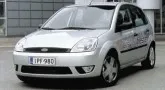
I suspect that you, like us, have already managed to examine all the photos. So, looking at this car, the first thing that comes to mind is the Ford Focus. There is a strong impression that we are looking at its reduced copy. But if you look a little longer, you realize: despite all the external similarity, the car has its own distinctive and memorable appearance.
The interior, of course, cannot be called luxurious, but it is made neatly and, as it seemed to us, with soul. At least, it does not clash with the exterior at all. Even the steering wheel (which, by the way, adjusts for tilt and is very similar to the one installed on the Mondeo) looks appropriate here. The seating position in the Fiesta resembles a "bus-like" one, but calling it uncomfortable is hard. True, only the seat cushion has height adjustment, not the backrest. We have encountered this on other cars, and it did not cause delight. In the Fiesta, however, no particular discomfort is felt — so it can be considered the norm.
Wide door openings provide quite tolerable access for rear passengers — here the advantages of the minivan layout come into play. The seats are high, and there is plenty of legroom, because the car has grown not only in length and width, but also in height. Even if the front seat is pushed all the way back, it does not interfere. The only thing worth doing before settling on the rear bench is to raise the headrest. In the lowered position, it protrudes strongly forward and prevents you from leaning back, creating pressure on the shoulder blades. It raises easily — you don't even need to press the locks, just a simple hand movement, and it is already at the desired height. It seems this is designed specifically for passive safety. Four airbags are also responsible for that — two in front and two on the sides (already in the base version), as well as special body deformation zones.
The initial trim also includes an audio system with a CD player and tuner. Calling it the familiar word "radio" is difficult: the device is built into the center console and visually divided into three sections, resembling a home music center. The system sounds good, although it lacks a bit of high frequencies. Such a trifle as an ashtray could have been skipped, but it is too funny. It is made in the form of a cup with a lid that can be placed in the cup holder or, if not needed, simply put away in the door, where there is a special recess for it.
The trunk release button from the cabin is located almost in the same place as in the Focus — to the left of the instrument panel. From the outside, the trunk opens only with the key or from the key fob — there are no buttons on the door, this is purely Ford's style. The trunk itself, naturally, did not surprise with anything extraordinary. But the fact that the seat back folds only as a whole was a bit puzzling. As was the fact that on the reverse side it is just painted metal without upholstery.
Surprisingly, there is not a single handle above the doors in the cabin. Maybe this is a hint that during movement you won't need to grab anything in fear?
During calm and measured driving, there is indeed nothing to hold onto in the Fiesta. Except perhaps for the driver — the steering wheel, which, as it turned out, has good reactive effort, which is somewhat unusual for this class. Eighty horsepower from the 1.4-liter engine is quite enough for the city. At least, the car does not fall out of the traffic flow. At peak revs it is a bit noisy, but when shifting to the next gear it calms down. The gears (there are five) engage very easily. However, do not think that even on fifth gear you will be able to accelerate the car. As soon as you engage it, the Fiesta seems to fall into hibernation. Even "pedal to the metal" does not help. Perhaps with a more powerful engine the car would be more agile, but with this one — expecting outstanding dynamics from it is useless.
Do not count on high ride smoothness either. The German-style stiff suspension makes itself known even on small bumps, and there is nothing to say about our potholes. The compensation for this is excellent handling. Maneuvering in the Fiesta is a pleasure: an obliging power steering, responsive brakes, and exceptional visibility. A large glass area, narrow pillars, and properly adjusted mirrors are what a car that will spend most of its life in a metropolis needs.
If not for the overly stiff suspension, the Ford Fiesta could be called the ideal city car. However, we drove a car with the European package and in Europe. By autumn, when the Fiesta's sales are expected to start here, Russians will most likely get a somewhat different, more adapted to local conditions car.
Technical specifications of Ford Fiesta 1.4
- Body — 5-door, all-metal
- Number of seats — 5
- Curb weight — 1035 kg
- Gross weight — 1515 kg
- Dimensions (length/width/height) — 3915/1680/1460 mm
- Wheelbase — 2485 mm
- Maximum speed — 168 km/h
- Acceleration to 100 km/h — 13.2 s
- Control fuel consumption (combined cycle) — 6.4 l/100 km
- Engine — petrol, inline, 4-cylinder; displacement 1388 cm³; power 80 hp at 5700 rpm; torque 124 N·m at 3500 rpm; fuel system — multi-point injection
- Transmission — 5-speed, manual
- Tire size — 175/65R14
- Suspension: front — independent, rear — semi-independent
- Brakes — with ABS; front disc, rear drum
- Steering — power-assisted