
You want to touch every handle. Crank up the bass on the stereo. Figure out where the ceiling is softer and where it's more pleasing to the eye. Two bottles of whiskey don't fit in one glove box, in another the screen glares. I'd probably spend the whole summer on short test drives, listening to engines and figuring out how the seats fold... But it's funny: when you drive a car every day, you quickly get used to it and stop noticing the little things. But in a short side-by-side comparison, the differences are immediately apparent.
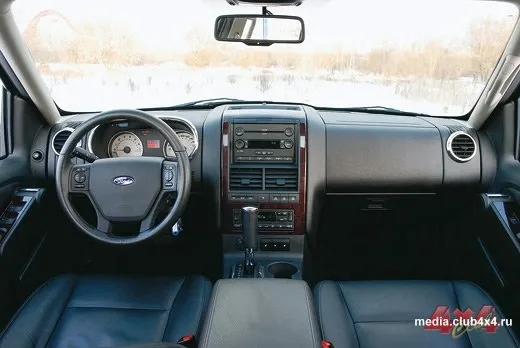
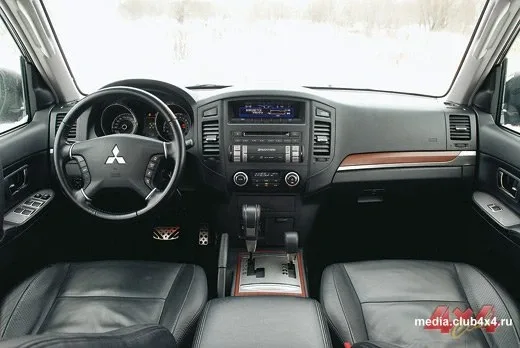
Within ten minutes behind the wheel of the Ford Explorer and Mitsubishi Pajero, you understand what we keep saying. You can't judge a car by its past. So what if the old Explorer was mediocre both on pavement and off-road, and the Pajero was the opposite?
TYPICAL, ANALOGOUS
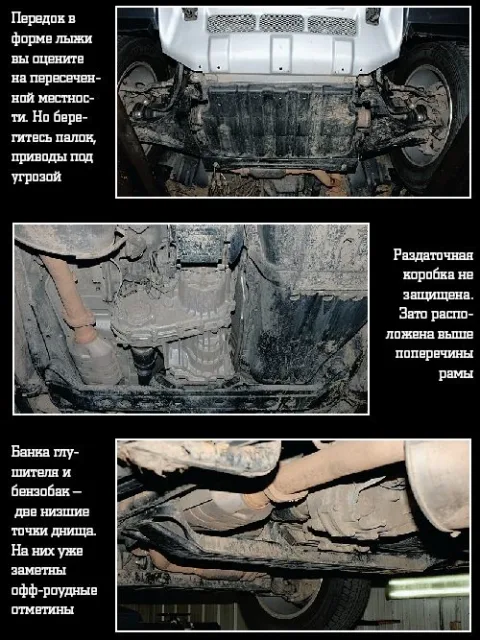
Both cars are classic SUVs from the turn of the century. Both have fully independent suspension, but they can still be confidently considered versatile off-roaders. The Pajero, for example, according to the manufacturer, can tow a 3.3-ton trailer, ford a half-meter deep stream, and tackle a 40-degree incline. The Explorer has similar characteristics, but it also handles great, even though it has a ladder frame, while the Japanese car has a unibody.

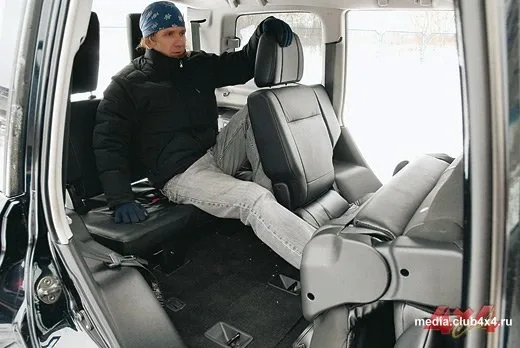
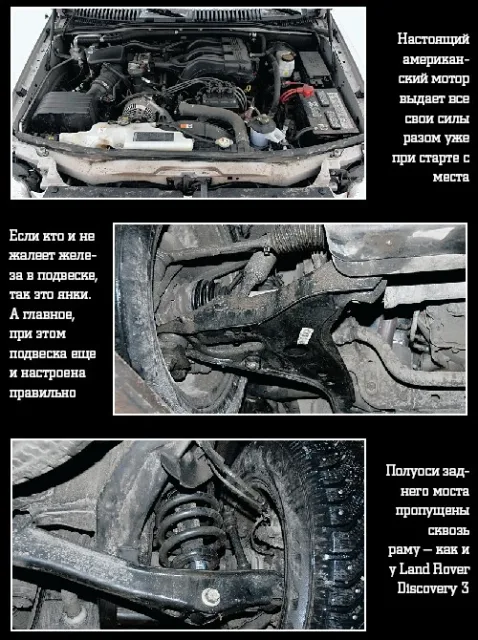
Both have advanced transmissions with low range, but the Pajero can drive in rear-wheel drive or permanent all-wheel drive (its center differential locks). The Explorer's front axle engages automatically when the rear wheels start to slip. And it happens smoothly, despite the lack of a center differential.
The Pajero also boasts good geometry and a locking rear differential. But that's for off-roading, and you still have to get there. Preferably quickly, so as not to waste time. So first, let's find out how each behaves on pavement.
DRIFT IN KRYLATSKY
We pull up to the start, wait for the signal, and floor it. I was in the American car and initially thought we took off early — the Mitsu stayed put. We repeated. The Pajero hopelessly spun its wheels, jerking as the traction control braked the slipping wheels, and then it could only watch the Explorer drive away. What's the secret? Low-end torque and smart electronics.
But when you need to stop the Ford Explorer, it's not as good. No, the brakes work fine, but you have to press the pedal with such force! By the time you get used to it, you'll go gray... Otherwise, its on-road behavior is quite respectable — at least for an SUV. Yes, it may nose-dive under hard braking, but overall the suspension is tuned in a European style. In fact, it's essentially the same as the coil-sprung Discovery. And the steering is much more communicative than you'd expect.
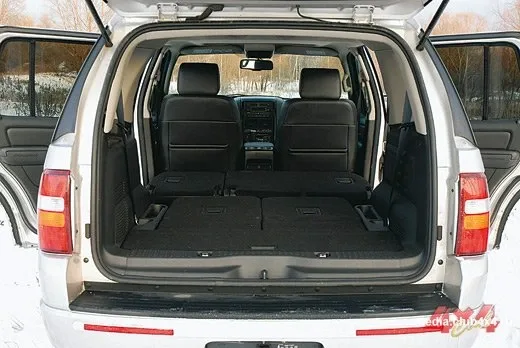
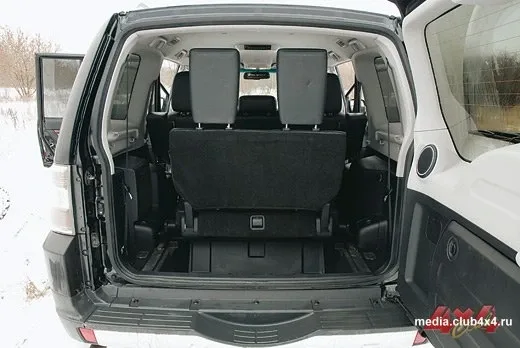
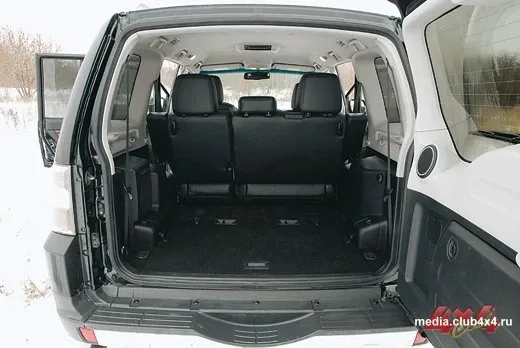
The Mitsubishi Pajero IV behaves much more relaxed on pavement. Everything here is clearly tuned for comfort. Up to a slight vertical rocking... Driving the Ford is as much easier as driving on studded tires on ice is better than on summer tires. But that's on pavement, and it seems we've already arrived?
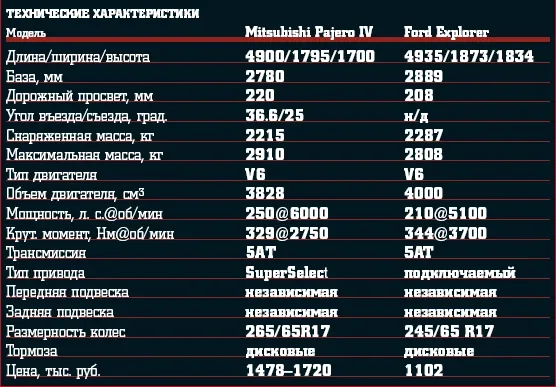
SPECS: MITSUBISHI PAJERO IV
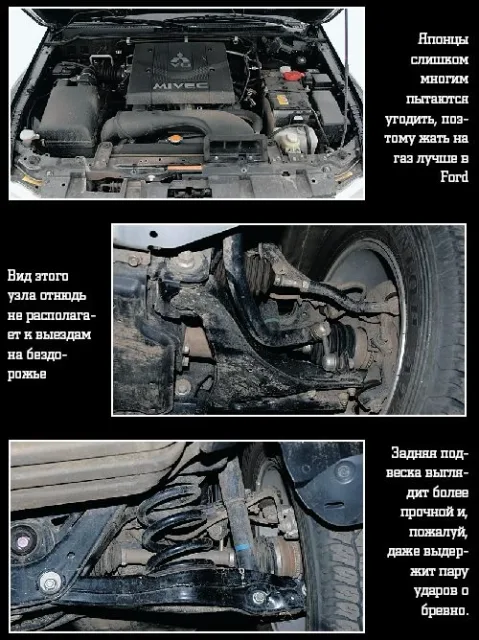
SPECS: FORD EXPLORER
VIRGIN GROUND TAKEN
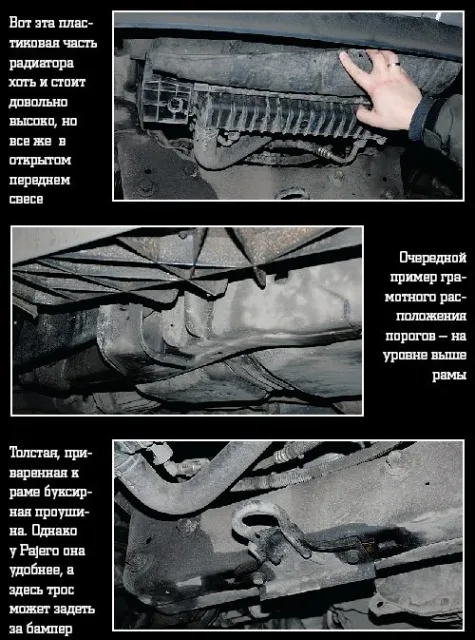
Off-road, we started by trying to climb a slippery hill. Neither the Ford nor the Mitsubishi could do it in a steady pull, at a calm pace. Only the Pajero managed it with a run-up. The Explorer, which lunged forward next, immediately sat on its frame crossmember. Its geometry is worse... Then we found smaller bumps, and there, without room for a run-up, the Ford completely outperformed the Mitsubishi. The engine, with excellent low-end torque, and the traction control system tuned for off-road, allowed the Explorer to tackle obstacles without fuss, even with wheels hanging. Meanwhile, the Pajero hung on another bump, its electronics futilely trying to figure out what the driver wanted.
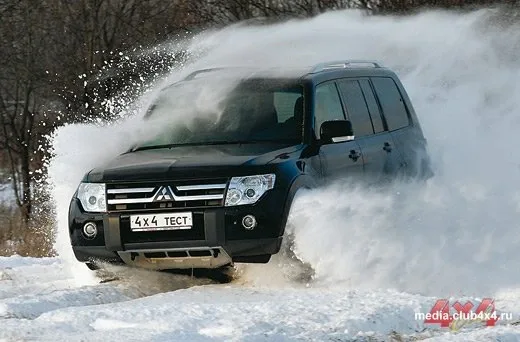
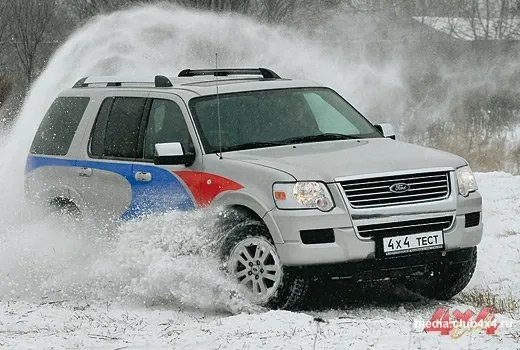
Next, we chose a snowy section with bumps and took turns breaking fresh trail. At low speeds, the Mitsubishi handled better, but as revs rose, the Ford's stiffer suspension gave it an advantage. Overall, in active off-road driving, both hold themselves well.
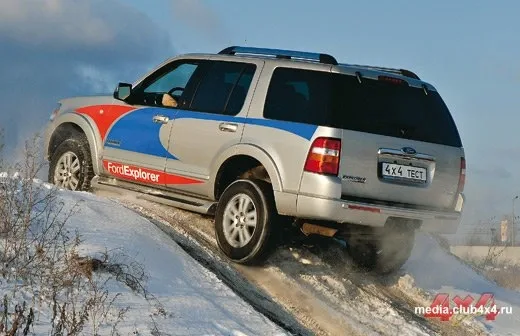

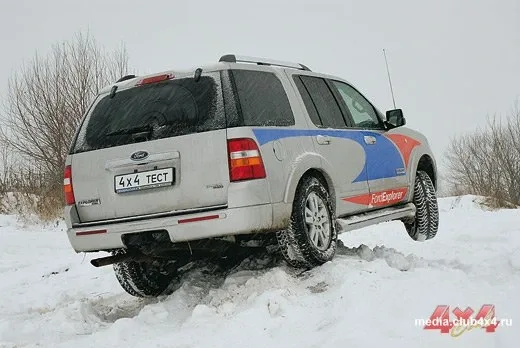
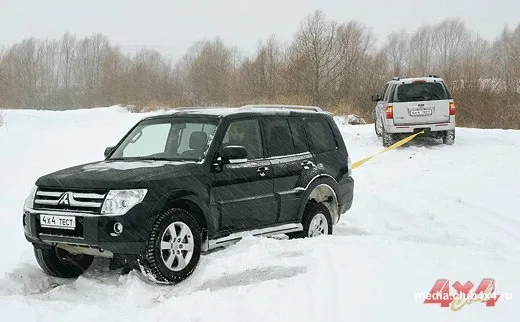
It's just a shame the Mitsubishi rattles with all its plastic panels! From that perspective, the Ford pins it to the mat. It exudes power, comfort, and solidity in every way. Many fall for those hooks. Others are hypnotized by the Pajero name and believe the Japanese car is always better than the American. But as you can see, in reality, it's not so simple.
The Ford Explorer was provided by Avtopassazh, tel. (495) 363 9595
The Mitsubishi Pajero IV was provided by ROLF, tel. (495) 785-19-78
The Mitsubishi Pajero IV was provided by ROLF, tel. (495) 785-19-78