
Ford Explorer. All for comfort and in honor of Eddie Bauer
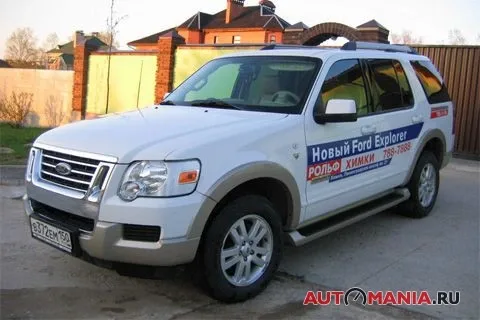
Americans traditionally have special requirements for cars. Outside — an abundance of chrome, inside — leather, wood, many cup holders and entertainment monitors. The suspension must be soft, the engine powerful, and the ride itself as comfortable as possible. The updated Ford Explorer meets all these requirements, becoming the flagship in the class of large SUVs after the discontinuation of the Expedition and Excursion.
The new Explorer is not a model from scratch. The manufacturer only slightly refreshed the exterior: added chrome (especially noticeable on the radiator grille), completely replaced the optics, changed the shape of the mirrors (which did not do any good — more on that later), and slightly increased the dimensions. Overall — a light facelift that left the main thing unchanged: the Explorer was and remains a 100% American SUV.
Good night, passengers
The interior has transformed more significantly. Soft, even overly soft, wide seats easily adapt to any driver. He has 10 power adjustments with memory for this, but passengers will have to settle for manual settings. The rear bench can also be adjusted for recline, so it is quite possible to take a nap there on a long journey.
The situation with the steering wheel is more interesting. It adjusts only vertically, but this is not a big problem — everything is compensated by the seat settings. On the wheel itself — many buttons: control of music, climate, and, of course, cruise control (where would an American be without it!). The automatic transmission selector, traditionally located on the steering column, has been moved to the floor, which makes the space to the right of the wheel feel empty.
But the activation of turn signals, lights, and wipers is crowded onto one left steering column stalk. You will have to get used to it for a long time. You want to blink the turn signal — you accidentally turn on the windshield wipers. It starts raining — and instead of the wipers, the high beams activate.
Help turn off the interior light
They overcomplicated things in another place too. When I left the dealership and drove into a dimly lit underground parking lot, I needed to look into my notebook. I pressed the dome light button, and a couple of minutes later tried to turn it off with the same button. No such luck. Neither on the second nor the third attempt could I turn off the light. The prospect of driving for three days with the bulb on was not pleasing: during the day it does not interfere, but at night — both on the highway and in the parking lot — it would be annoying and attract the attention of the traffic police.
The manual (only in English!) was silent. I had to return to the dealership. The mechanics had already started looking for a malfunction when a random owner of the same Ford suggested a solution. It turned out nothing was broken. You just need to turn the instrument brightness adjustment wheel all the way to the left, wait for a click, then turn it to the right again — and the light goes out. And to turn on the dome light, you need a separate button under the ceiling! Who came up with this and why — it is unclear. Once you learn it, you will not forget it, but a normal person cannot guess such logic.
Who came up with the "wrong" shaped mirrors
I want to see that "cowboy" from Louisville, Kentucky (the birthplace of the Explorer), who designed the side mirrors. Maybe it is the same person who came up with the dome light? The mirrors themselves are large, "Jeep-like." But in the lower part, they have strange side bevels that create blind spots, especially interfering when changing lanes to the right.
Triton — that sounds powerful
Americans have never cared much about the quality of interior trim. For them, the main thing is not what is inside, but what is under the hood. And there, the Explorer is in perfect order. The new Triton 4.6-liter V8 engine has become more powerful than the previous one by 57 "horses" and now produces 296 hp with a torque of 407 Nm, available already at 4000 rpm. The almost two-ton colossus accelerates to 100 km/h in 8.8 seconds. True, the electronics limit the top speed to 170 km/h. The manufacturers claim a 10% reduction in fuel consumption: the official figures are now 18.5 l/100 km in the city and 15.0 on the highway (previously 19.6 and 15.7, respectively). Our measurements almost coincided: a minimum of 15.5 liters, a maximum of 18.2 liters.
Typical savings on the interior
Americans do not bother too much with interior trim. It is enough to look inside any "made in USA." The new Explorer is no exception. The center console and door cards are trimmed with hard plastic with "wood" inserts. Upon closer inspection, uneven joints and even burrs are visible. They saved everywhere they could, except on comfort and suspension. The Jeep has neither headlight washers, nor xenon, nor fog lights. The test car did not even have heated seats (offered as an option). There are only four airbags.
The instrument panel is informative. The speedometer is calibrated in both kilometers and miles. The onboard computer also switches between European and American measurement systems. It shows the range on the remaining fuel, average consumption, the amount of fuel used, time behind the wheel, and trip A and B. The odometer works unusually — with an accuracy of 100 meters. The dual-zone climate control also behaves strangely: for cooling in the heat, it offers only 16 or 19 degrees, and then the temperature changes in half-degree increments. The climate can be controlled directly from the steering wheel.
How pleasant it is to travel in the back
But they did not skimp on the comfort of rear passengers. The audio system with a 6-disc CD changer and MP3 player is complemented by a powerful subwoofer. In addition, the family SUV has two LCD screens: one smaller — in the left headrest, another larger — folds out from the ceiling. One passenger can watch a movie, another can play computer games. Naturally, a remote control and headphones are included (so as not to distract the father at the wheel). But there are only two seats in the back: a massive console is located in the center. This design is called "captain's chairs" and was invented by Eddie Bauer (see below).
The large and powerful car accelerates easily and quickly and literally floats over the asphalt like a liner. But only when driving straight. During sharp lane changes, strong rolls appear — this is the price for a too-soft and comfortable suspension. In corners, you have to hold on tight to the steering wheel, otherwise you start sliding off the leather seat due to the lack of lateral support. However, Americans even like this, so Ford engineers do not change the suspension settings, focusing on consumer tastes. In the fifteen years since the Explorer appeared, 5.5 million units have been sold, most of which remained at home. And only in the 16th year of its existence did the model radically change its exterior and interior. Moreover, the price of a mid-size Jeep with a 4.6-liter engine is significantly lower than that of European analogues.
In Russia, the tested Eddie Bauer trim (named after the famous American businessman, a pioneer in sportswear and a proponent of an active lifestyle) costs 1,514,000 rubles (about 68 thousand dollars). At home, it would cost no more than 40 thousand. But in any case, neither a European nor a Japanese car of this class can be found for that money.
Dmitry Shavyrin
We thank the dealership "Rolf Khimki Ford" for providing the car for the test.
Technical specifications
When you first get into this car, you immediately understand: it was created to conquer space. The dimensions inspire respect — almost five meters in length, two meters in width, and a height of nearly 1.85 meters. From such a driver's seat, you look down on the world, and this feeling of permissiveness is worth a lot.
Outside and inside: impressions from the first acquaintance
The design of this car is a separate topic. There is an opinion that this car looks controversial, but I disagree. It has its own charisma: a massive radiator grille, muscular fenders, huge wheels. It does not try to be elegant — it simply demonstrates its power and confidence. Inside — the same philosophy: a high and straight dashboard, comfortable seats with good lateral support, and the feeling that the interior was created with a margin of safety for decades ahead.
The seating position here is high, as befits a real SUV. Visibility is excellent, you feel like the captain of a big ship. The trim materials, of course, are not premium, but they do not cause complaints — everything is solidly assembled, nothing creaks. Rear passengers are especially at ease here: there is so much legroom that you can sit cross-legged, and the third row, although intended more for children, when folded completely frees up a huge trunk.
In motion: the character of a large SUV
Under the hood, we have a gasoline V8 with a volume of 4.6 liters, producing 296 horsepower and 407 Nm of torque. The sound of the engine is a separate kind of pleasure, a deep and rich rumble that does not irritate even on the highway. With such an engine, the car accelerates to 100 km/h in 8.9 seconds, and for a two-ton colossus, this is a very decent indicator. The official top speed is 170 km/h, but the feeling is as if you are going much faster.
The gearbox is a classic automatic, which works quite smoothly, but sometimes makes you think before downshifting. This is especially noticeable when overtaking on the highway: you need to press the pedal in advance to give the transmission time to think. But in low-range mode and with lockers, this SUV is capable of a lot. I went out onto a section with deep ruts and mud — the car passed it without the slightest hint of wheel spin, confidently and calmly.
On asphalt, the car also feels quite good, although it reminds you of its mass. There are body rolls in corners, but they are not frightening — this is rather a feature of the tall body. The steering is not the most informative, but for such a car this is normal. But the suspension pleasantly surprised me: it is not stiff, as I expected, but quite energy-intensive. Small irregularities and joints are swallowed imperceptibly, and on serious potholes the body only shudders slightly. At the same time, I won't say it is too soft — rolls on asphalt make themselves known, but this can be tolerated.
Price and costs
Fuel consumption is a separate topic for discussion. In the combined cycle, the car asks for from 12.4 to 16.8 liters per hundred, and, believe me, making it fit into the lower limit is practically impossible. In urban mode, it easily crosses the mark of 17-18 liters. The tank, fortunately, is capacious — 85 liters, so on one refueling you can drive for quite a long time. You can even fill it with A-92, which slightly softens the financial blow.
The price of the issue — the base version costs 1,268,000 rubles, but the tested example in the maximum configuration goes up to 1,514,000 rubles. For this money, you get not just a car, but a real status SUV with excellent off-road qualities and a character that will not leave you indifferent. Yes, it has its drawbacks, but its charisma and capabilities cover all the disadvantages.