
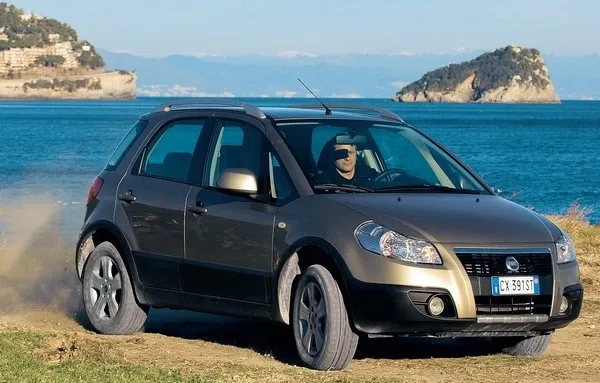
This crossover can hardly be called massive — the length of the Sedici barely exceeds four meters. What distinguishes it from typical off-roaders is a moderately increased ground clearance, protective trim under the bumpers, and plastic cladding on the sides. Remove these details — and we have an ordinary five-door hatchback. It is they that turn the car into an SUV.
MOUNTAIN TEST
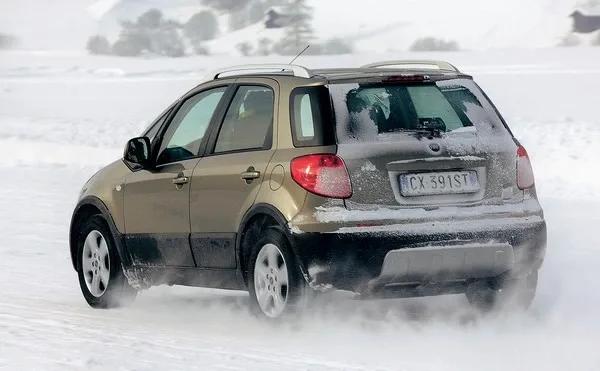
The first test for the newcomer was the Alps, where we decided to evaluate its behavior on snowy roads. On Continental ContiWinterContact winter tires, the Sedici held confidently on both ice and packed snow. All-wheel drive worked flawlessly: as soon as the front wheels start to slip, the rear wheels instantly engage. The electronics controlling the transmission act precisely and without surprises.
A button next to the parking brake lever allows you to abandon the automatic mode in favor of one of two alternatives: you can rigidly lock the distribution of traction to all wheels or, conversely, make the Sedici purely front-wheel drive.
Both during acceleration and braking on snow, the Italian crossover never gave any reason to doubt its handling. Moreover, in a number of exercises, it looked no worse than recognized off-road veterans. Take, for example, a climb of 1300 meters: the Sedici without a stability control system conquered it in 1’52’’860, which was one of the best results in the overall standings. Interestingly, only the BMW 530 xd managed this task faster. In the slalom, the Italian also did not lose face — 16.6 seconds, exactly the same as the Grand Cherokee showed.
SNOW TEST RESULTS
(Continental ContiWinterContact TS 810 tires)
- 0-60 km/h(1) – 9.9/7.2 s
- 0-100 km/h(1) – 20.3/16.7 s
- 80-0 km/h – 68.3 m
- 100-0 km/h – 104.8 m
- Slalom(2): 16.7/16.6 s
- Climb(3): 1’ 52’’ 860
Notes: 1) Front-wheel drive/all-wheel drive. 2) Ten cones at a distance of 30 m from each other. 3) Length – 1300 m, gradient – 10%.
EVERYDAY LIFE
After descending from the mountains, we returned the standard wheels, and the all-wheel-drive FIAT turned into an ordinary car undergoing the standard editorial break-in: the Vairano test track gave way to city bustle, suburban highways to high-speed autobahns. In short, everything as usual. To understand the character of this car, not much time was needed — it revealed its best sides almost immediately.
 |  | ||
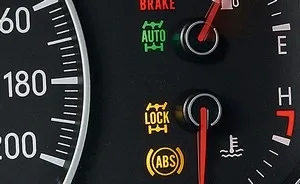 |
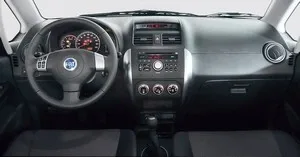
STATUS INDICATION On the instrument panel there are indicator lights that show whether the drive is operating in automatic mode or whether forced distribution of traction to all wheels is engaged. |
PROS AND CONS
The car was created in partnership between FIAT and Suzuki. The 1.6-liter petrol engine is a Japanese development, while the Italians were responsible for the diesels and the exterior. The petrol unit is distinguished by smooth and stable operation, vibrations are almost imperceptible. The only thing that upsets is the noise. This is especially noticeable during active acceleration at high revs, but also on the highway at permitted speed, the engine emits unpleasant squealing notes. The transmission is partly to blame: five gears are clearly not enough. The gearshift lever on the tunnel is slightly short, and the clutch pedal is very light, however, neither causes any trouble. The lack of a sixth gear directly affects fuel consumption. It cannot be said that the Sedici is excessively voracious, but an average of 10 liters per hundred is not pleasing.
A pleasant bonus to the overall impression was the quite responsive and precise steering (naturally, adjusted for the car's class). Overall, the car behaves predictably in any situation. In corners, the Sedici noticeably transfers mass to the outer wheels and rolls, but at the same time responds sensitively to the driver's actions and obediently follows his commands.
ABOUT THE IMAGE
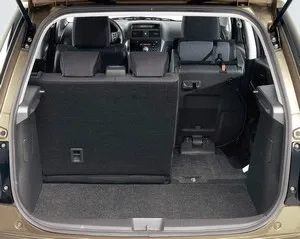
The designers apparently did not bother too much with the interior — the trim is solid, but Japanese pragmatism looks frankly cheap in places. The plastic is hard, and the color combinations are not always successful. The steering column is adjustable only for height, reach is not available. But the driver's seat has a standard height adjustment. The rear bench folds in parts, but it cannot be slid longitudinally. All these shortcomings would not be so significant if the Sedici did not claim the role of a universal car.
The all-wheel-drive version of the FIAT Sedici is priced at $22,951 (183,600 UAH). Add $169 (1,350 UAH) for metallic — and you get the price of its "twin" Suzuki SX4, however, already in front-wheel-drive configuration.
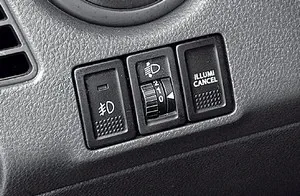 | LIKE Such a function is usually found on Japanese and American cars: a separate key allows you to increase the brightness of the display when the headlights are on. The benefit is obvious — the instruments are read noticeably easier. | |||
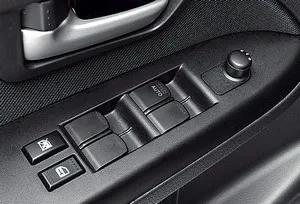 | DISLIKE They clearly saved on the backlighting of the button block. In the dark, only the inscription Auto on the driver's side window switch is distinguishable. |
 |  |  |
MEETING THE "MOOSE"
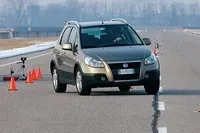
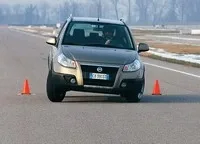
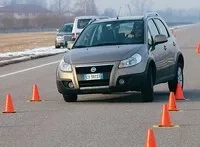
Given the tall body and soft suspension of the Sedici, we were especially curious how it would handle the "moose" test. The test vehicle did not have an electronic stability control system (this option is not available for Russia at all, even for an extra charge), and the result turned out to be curious: at the maximum maneuver speed of 63 km/h, the car gently slides with all four wheels, without lifting off the asphalt for a fraction. The roll is moderate, and the precise steering does not change effort — all this makes the maneuver quite simple for the driver. Another impressive result we got on a constant radius arc, where the maximum lateral acceleration reached 0.97 g!
Technical specifications provided by the manufacturer
FIAT Sedici 1.6 16V 4x4
- Engine: front transverse, 4 cylinders, cylinder bore – 78.0 mm, piston stroke – 83.0 mm, displacement – 1586 cm3, compression ratio – 10.5:1, maximum power – 107 hp at 5600 rpm, maximum torque – 145 Nm at 4000 rpm, specific power – 67.7 hp/l, crankshaft bearing, cylinder block and head made of light alloy, 4 valves per cylinder, 2 camshafts in the cylinder head, chain, variable valve timing, electronic injection
- Transmission: permanent front-wheel drive, automatically engaged rear-wheel drive, multi-disc clutch with electromagnetic control, single-disc clutch with hydraulic drive, 5-speed manual gearbox
- Tires: 205/60 R 16, rims 6J, on the tested car – Bridgestone Turanza ER 300, compact spare wheel
- Body: 5 doors, 5 seats
- Suspension: front – independent, transverse arms with telescopic strut (MacPherson), coil springs, anti-roll bar, rear – semi-independent, trailing arms, coil springs, hydraulic telescopic shock absorbers
- Brakes: front disc, ventilated, rear drum, ABS
- Steering: rack and pinion with electric power steering
Dimensions and weight: wheelbase — 2500 mm, track front and rear — 1495 mm each, length — 4115 mm, width — 1755 mm, height — 1620 mm, ground clearance — 190 mm, approach and departure angles — 20.3° and 31.1° respectively, maximum negotiable gradient — 73%, curb weight — 1250 kg, luggage compartment volume — from 270 to 670 liters, fuel tank — 50 l.
Place of production: plant in Esztergom, Hungary.