
Fiat Panda. The Polish Bear
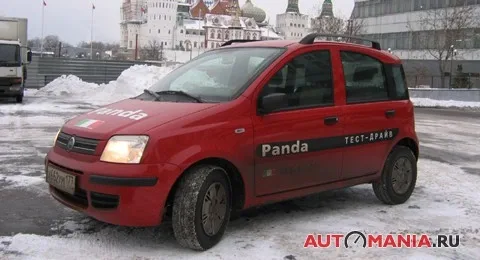
In early 2007, the Italians decided to introduce us to their 2004 winner — the Panda model. This tiny car, which externally resembles a puffy Daewoo Tico and an unfinished Ford Fusion, scored 281 points and became the European "Car of the Year," beating the Mazda 3, VW Golf (241), Opel Meriva (213), Toyota Avensis (219), Nissan Micra (111), and BMW 5 Series (144). And four years later, the laurels of the "Car of the Year" winner went to the FIAT 500, whose ancestor once served as the prototype for the "hunchbacked" Zaporozhets. I don't want to make gloomy forecasts, but given our love for huge SUVs like the Porsche Cayenne, the fate of the "five hundred" is unlikely to be better than that of the Panda. How many Pandas have you seen on Russian roads?
For Russia — only one option
Europeans today have access to a much wider selection of Pandas than we do. Abroad, you can buy a version with a 1.1-liter engine producing 55 hp or a 1.3-liter diesel with 70 hp. Here, only the Polish assembly with a 1.2-liter engine producing 60 horsepower is sold.
For the test, we got the 1.2 Dynamic modification with a robotic transmission, which the Polish Panda calls "Dualogic." Under the hood — only 60 "horses." The sprint to 100 km/h takes 14.0 seconds. For comparison: the Opel Corsa with a more powerful 1.2-liter engine (80 hp) takes 15.4 seconds, and the Toyota Yaris with a 1.3-liter engine (87 hp) — 13.5 seconds. At the same time, the "Japanese" has a serious drawback: its robot constantly overheats and requires periodic cooling. In "A" mode, the Panda is not as phlegmatic as the Corsa, and definitely not as thoughtful as the Yaris. Moreover, it doesn't nose-dive when you sharply press the gas.
Small — means touchy
The Panda is a rare case where the name fully reflects the character and appearance of the car. It is just as slow in acceleration, clumsy, and wobbly in corners as its Chinese namesake in the wild. The bulging "eye" headlights, protruding "ears"-roof rails, and a dense body on 13-inch wheels — the spitting image of a panda from a children's book. Treating the FIAT Panda as a serious car, discussing ground clearance, power, and other technical details is a pointless exercise. It's small — it might get offended. Apparently, because of the love for irony in Europe, the Panda is advertised by Jamaican bobsledders — the same recognized authorities in the automotive industry as our plumbers and janitors in nanotechnologies.
So, let's try to take a ride in a car that 58 leading European auto experts voted for three years ago.
Interior without much warmth
Honestly, the cabin didn't impress at first glance. Hard plastic, psychedelic seat upholstery resembling an undercooked omelet with bumps, didn't inspire confidence. Especially confusing was the price — 385 thousand rubles. Electric mirrors and front power windows with an automatic mode were supposed to justify the considerable sum. But the crank handles in the back, wipers that can't work in tandem with the washer (you first have to spray the glass yourself, and then manually turn on the wipers!), make you doubt the adequacy of the price. All switches move stiffly, and the toggles are simply huge.
It's pleasantly surprising that even in the base, the Panda has an onboard computer — it's conveniently placed on the panel and quite informative. The gearshift lever (forget about the "automatic"!) is mounted on a raised podium of the center console, like in many minivans. This is convenient: you can change the airflow settings without taking your hand off the shift knob. But the seat adjustments in the Panda didn't work out. All three days of the test, I couldn't get comfortable behind the wheel: my back constantly ached, my legs were cramped. The driver clearly has too little space — the left leg rests against the door handle, the right against the center console. In the back, the same problem — passengers are also cramped.
Control with one finger
I didn't find the side mirror adjustment buttons right away — they were hidden for some reason where the handbrake usually is. But an unexpected bonus was the button with a steering wheel icon, which is now on all Fiat models. It activates the "city" mode. The steering wheel already turns with one pinky, and with this function, the car becomes completely "manual" — both when changing lanes and when parking. Visibility, given the inconvenient mirror adjustments, I would rate below a three. The side mirrors are like in a woman's compact — seeing neighboring cars in them is a whole problem.
In motion, the Panda resembles a cross between a clumsy bear cub and a small schooner. The car, like a boat, constantly rocks and drifts to the side. Although there are no complaints about the suspension: it handles potholes on Moscow roads without discomfort. Overall, you can find a common language with the Panda and, becoming a good captain, enjoy leisurely trips. The tall side windows offer a great view of the surroundings, which are often hidden from passengers by low and narrow embrasure windows, like, for example, in the Chrysler 300M.
The "bear" turned out to be gluttonous
Like a real Chinese bear, which feeds exclusively on young bamboo shoots and consumes them in huge quantities, the little Panda requires a lot of fuel. The official data promises 7.1 liters of 95-octane in the combined cycle with a curb weight of only 940 kg. But these are clearly underestimated appetite figures. I couldn't get below 9.8 liters per hundred. The brakes are disc front and drum rear, which is already yesterday's news.
As a result, it remains a mystery to me what exactly 58 of the best European journalists saw in this little one, calling it the "car of the year."
Dmitry Shavyrin
Technical specifications:
| Dimensions (mm) | 3540 x 1580 x 1540 |
| Curb weight (kg) | 835 |
| Wheelbase (mm) | 2300 |
| Engine displacement (cm3) | 1242 |
| Power (hp) | 60 |
| Max. torque (nm/rpm) | 102/2500 |
| Maximum speed (km/h) | 145 |
| Average fuel consumption per 100 km (l) | 7.9 |
| Acceleration 0-100 km/h (s) | 14.0 |
| Tires | 1580 R 13 |
| Turning diameter (m) | 9.1 |
| Price (rub) | 385000 |
| Price of all-wheel-drive version "Climbing" | 510000 |
Source – AUTOMANIA.RU