
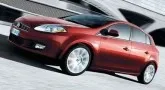
The history of Fiat in modern times can safely be divided into two chapters — before the debut of the Bravo and after it. This model became the starting point for the brand's new corporate style and a completely different approach to car design.
The Italians took only a year and a half to develop the Bravo — from the first prototype to the assembly line! To meet such a tight deadline, the entire technological chain had to be restructured and shortened.
Already at the computer design stage, component suppliers were brought in. Components created in a virtual environment were prepared for production in parallel with the car itself, and the assembly scheme on the line was calculated right there, without leaving the computer. They also saved on crash tests: out of 170 mandatory tests, 100 were conducted using mathematical models.
The designers also had to work at an accelerated pace. From the first sketches to the full-size mock-up, only six weeks passed, although you wouldn't say so from the car's appearance — it looks quite cohesive and well thought out.
2008 Fiat Bravo
© Photo: Fiat
In the front of the hatchback, you can discern the features of the Grande Punto by Giugiaro, but the shapes have become more smoothed out. On the nose — a new emblem with a red backing and a radiator grille resembling a propeller: a nod to the concern's aviation past.
The rear lights echo the very first Bravo model — thus the designers emphasized the continuity of generations. But the rear bumper, which barely protrudes beyond the body, is a particular source of pride for its creators.
Inside, non-standard materials are used: the front panel is covered with soft plastic with a carbon imitation, and the upper part of the door cards, also plastic, is trimmed to look like synthetic fabric.
In terms of cabin space, the Bravo is one of the best in its class: at my height of 186 cm, I can easily sit "behind myself." The trunk is also impressive — 400 liters, and with the seats folded, all 1175, and there's even room for a full-size spare tire.
True, the loading height is a bit high, and there's no exterior handle for opening the trunk. The question is: what to do if the door seal freezes in winter?
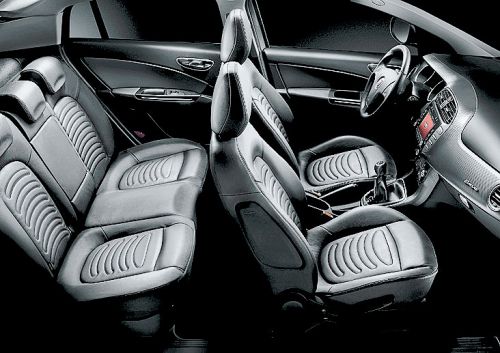
2008 Fiat Bravo
© Photo: Maxim Fedorov, 5 Koleso
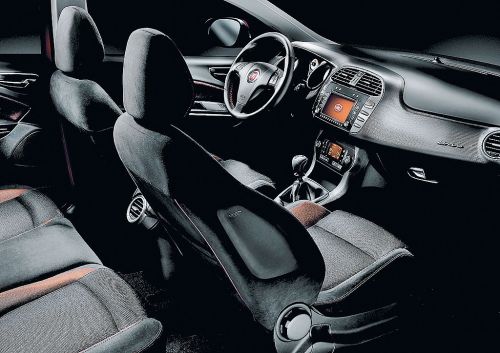
2008 Fiat Bravo
© Photo: Maxim Fedorov, 5 Koleso
For the test, we got cars with 150-horsepower engines: the 1.9 Multijet turbodiesel and the fresh 1.4 T-Jet gasoline turbo unit. In Russia, however, only the gasoline version will be offered — in 150-horsepower form or detuned to 120 horsepower. Both engines pleased with their elasticity and confident low-end torque, although they truly come alive only after 3000 rpm, when the turbo kicks in.
In character, the gasoline 1.4 T-Jet is very similar to the diesel, only its peak torque is more modest and comes at higher revs.
The Bravo's suspension decently absorbs bumps without annoying excessive shaking, and body roll in corners remains moderate. However, I'd like the steering to be more informative...
The electric power steering turns the wheel into the helm of a computer simulator, and not the most successful one. Feedback from the wheels is blurred, but sensitivity is excessive — on the highway you have to constantly correct the steering. The "Sport" mode, available in the Sport trim, doesn't help: the steering becomes heavier, but the "zero" still doesn't appear.
Many of the Bravo's shortcomings could be overlooked if not for the price. In Russia, the newcomer is positioned as a rival to the VW Golf, and it will cost accordingly. And for that kind of money, the buyer has the right to expect not only striking looks but also everything that comes with them.
2008 Fiat Bravo
© Photo: Maxim Fedorov, 5 Koleso
2008 Fiat Bravo
© Photo: Maxim Fedorov, 5 Koleso
Driving
Dynamics are excellent, but a powerful engine paired with a "dead" steering wheel is not the best combination.
Interior
In terms of passenger space and trunk volume, the Bravo is one of the leaders in the C-class.
Comfort
The suspension is moderately stiff and handles bumps well.
Safety
Five stars in Euro NCAP. Already in the base — 4 airbags and ABS.
Price
Specific figures will be announced later, but it's already clear: the Fiat Bravo will not be cheap.
| Dimensions, mm | 4336x1792x1498 mm |
| Engine | 1368 cc, 150 hp/5500 rpm |
| Transmission | manual, 6-speed |
| Dynamics | max 212 km/h; 8.5 s to 100 km/h |
| Competitors | Mazda3, Peugeot 308, Toyota Auris, VW Golf |
Pros and cons
+ Stylish looks, spacious cabin and trunk, powerful engine, high safety level.
- Imprecise steering, high price.
Our opinion
When choosing this car, the emotional factor will be decisive. Buying a Fiat Bravo is more of a marriage of love than of convenience, but the spacious and ergonomic cabin, capacious trunk, and powerful turbo engine will help preserve the joy of ownership even after the first infatuation fades.
© 5 Koleso