
Owning a serious car is boring, but owning a frivolous one is pure pleasure. In the case of the Fiat 500, you don't even need to be an owner to get a boost of positivity: spot this energetic anti-vampire on the street, and you're guaranteed a charge of good mood. And when they handed me the keys to the "Cinquecento," a thought flashed through my mind: "Is this really all mine?"
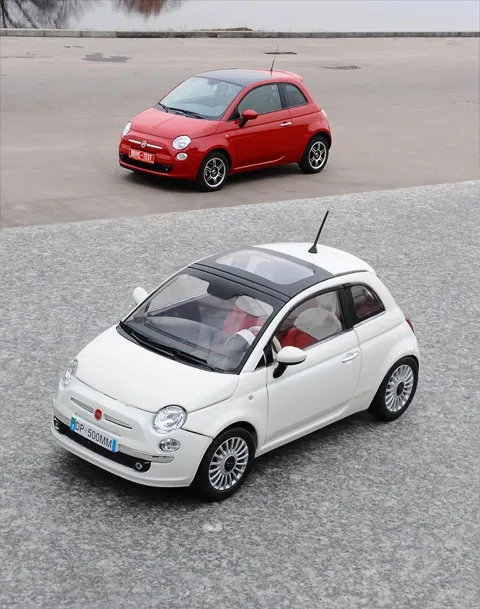
Look: it's not a car—it's a toy! More precisely: a toy and a car.
All "mine" means 3546 mm in length, 1627 in width, and 1488 mm in height. Just over 650 thousand rubles. But can you measure design in some SI units? Especially since every millimeter of the Fiat is like a page from a coloring book. Have you seen how many body colors are offered for the "Cinquecento"? And the endless stickers, badges, wheels, accessories... you could even repaint the ignition key in your favorite shade! But my Fiat is bright red and sits on non-original wheels (winter tires in the standard size 185/55 R16 for the "Cinquecento" are hard to find). Almost no decals.
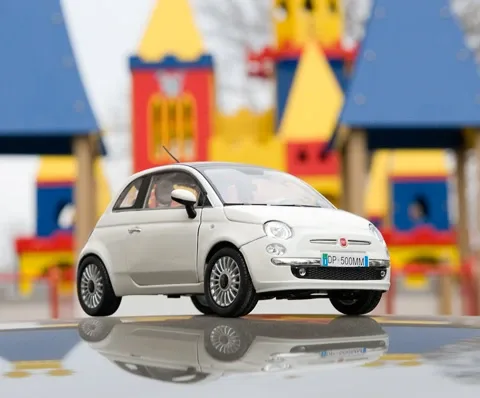
On the road, it invariably causes a sensation: "Oh, what a cutie," "Adorable!", "I want one!"—and these aren't my words, but those of ordinary passersby. Ordinary, you understand? The Fiat 500 attracts even those for whom cars have never been more interesting than Nanai rock musicians' creativity is to me. And they asked me not about the pistons and camshafts of the "Cinquecento," but about its price.
So let me say a few words about the tech myself. My "Cinquecento" has a quite adult 100-horsepower 1.4 engine. It borrowed it, along with the six-speed manual, from the Panda 100HP, as well as almost everything else. And the "Cinquecento" is produced at the same "toy factory" in Poland as the Panda and Ka.
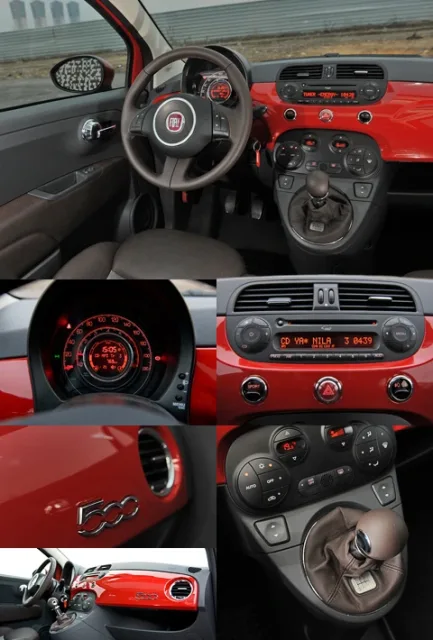
The dashboard in body color is a nod to the metal crossmember in the cabin of the original "Cinquecento." Almost every detail here is designer: from the large chrome door handles to the stylish instruments. But the window and audio system buttons are inconvenient (their placement is dictated by the Panda's layout). Instead of a glovebox, there's an open shelf.
Inside, the mood is the same. The dashboard painted in body color, seats with funny saucer-shaped headrests. But here's the surprising thing: when I get inside, besides the frivolous design, for some reason I expect the car to be thoroughly engineered in every way—such a cohesive and complete image is usually found only in expensive cars, not in modest subcompacts. And I genuinely wonder why they saved on trim in the Fiat. Not everywhere, though. Why is there no dual-zone climate control or auto mode for the passenger window, and why is a plain ceiling lamp slapped on the roof? Although, in theory, that's how it should be.
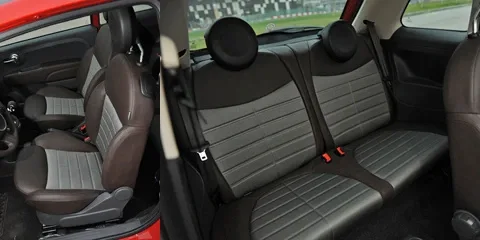
Apart from the excessively hard headrests, there are no complaints about the front seats, but there are plenty about the driving position. In the back, only children will be comfortable.
But what should not exist in this world is such a driving position. If you don't have a doll-like anatomy (and especially dimensions), you'll have to choose between two options: either tuck your legs under you, or barely reach the steering wheel. Here's a puzzle tougher than a Rubik's cube, please! And the steering wheel, as luck would have it, doesn't adjust for reach. No matter how you sit, it's still cramped!
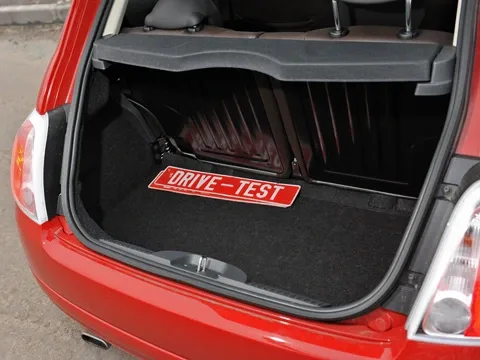
Not every toy will fit in the trunk.
In the back, legroom is surprisingly spacious. Too bad you'll still have to, like a doll, unscrew your head and put it... most likely, on your own lap. Definitely not in the trunk: it's quite small. The rest of the complaints about the cabin are quite childish. Well, yes, you have to get used to the placement of some buttons, so what? But everything else is fine: the instruments are easy to read, the seats themselves are decent, and shifting the gear lever back and forth is pleasant.
The "Cinquecento" has the same length and wheelbase as the Panda, but it's lower, wider, and more fun to drive! On the move, the car resembles a toy. The suspension is like a ball: it handles bumps firmly and softly, but the short-wheelbase lightweight constantly bounces on potholes: "Boing!" But the handling is good. The "Cinquecento" rolls moderately, responds clearly to steering inputs, and at the limit behaves almost neutrally, cheerfully squealing its tires...
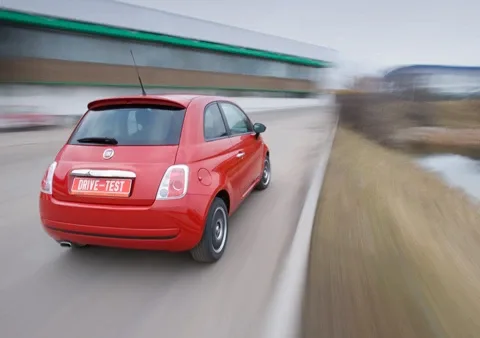
High speeds come easily to the Fiat, but not so much to its passengers.
"Vroom!"—and the little car easily pulls away from seriously growling "tens" at the traffic light: the eyes of those around become like the Fiat's front lights. The playful buzzing engine revs to 7,000 rpm in one breath. First gear is very long (you accelerate to almost 90 km/h), so you don't get tired of shifting. For those who don't like doing it under any circumstances, there's a "robot"—but only with the 70-horsepower 1.2 engine.
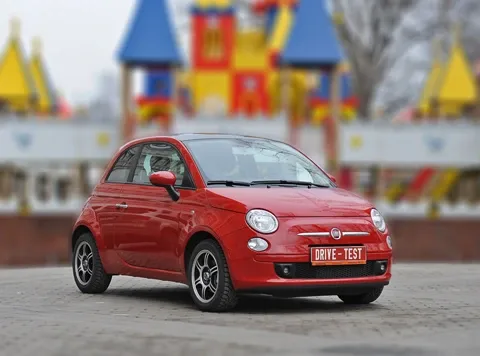
The price of the car in base trim is 555 thousand. That's a lot! But only 500 of these toys will be sold across the country this year. A price for exclusivity?
Sport mode is a good thing. Honestly, it doesn't add sportiness, but the steering becomes heavier, and responses to the gas pedal are quicker. Just what a city sneaker needs. And the normal mode doesn't cut it: overly smooth responses and a light steering wheel. But that's only for traffic jams: there's no comfort anyway. By the way, on base versions of the "Cinquecento," instead of Sport mode, there's "ultra-light" City.
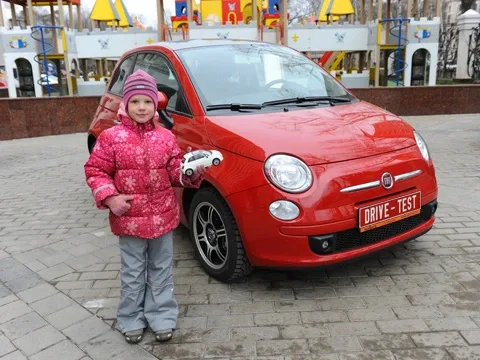
Our leading expert on family cars highly appreciated the compact dimensions of the "Cinquecento."
But at speed, the Fiat 500 starts humming Winnie-the-Pooh-style chants and yells. You can hear both the vocal engine, the studded tires, and the wind whistle. Sound insulation is lousy: it's not for nothing that the Fiat had problems with Russian certification because of it. Although the car holds a straight line decently, doesn't wander much in ruts—the main thing is that there's no side wind.
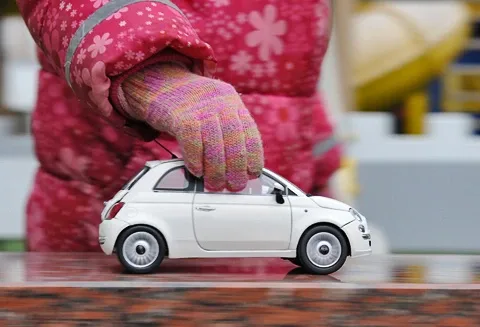
In the expert's hands, the Fiat 500 accelerates very confidently.
The city is the "Cinquecento's" element. Not only because on a long road you'll go deaf from noise, and your back and legs will demand major repairs. It's in the city that the Fiat 500 looks most organic and delights not only the owner but also those around. That's the whole point of a toy!
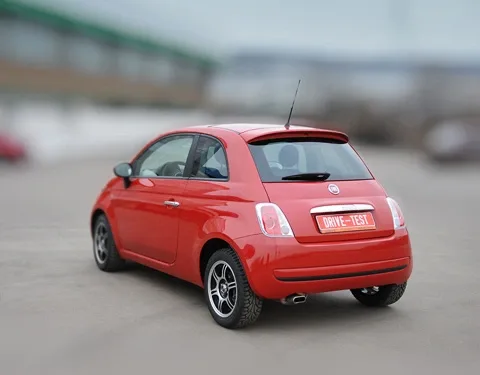
The protruding exhaust pipe is a hallmark of the Sport version.
The Fiat 500 won't give its owner excellent comfort. It's not much better in terms of parking, taxes, or fuel consumption. How can you seriously discuss its practicality? And you can nitpick the Fiat endlessly, but overall—everything is very harmonious and cohesive. And most importantly, the little car gives what others can't—a good mood. The Fiat 500 is delightful because it's the most non-automotive little car. After the Smart. But while many look at the Smart as a self-propelled misunderstanding, the Fiat is perceived the same way by everyone.
Technical specifications
Fiat 500 — a compact three-door hatchback designed for five seats. Dimensions are modest: length 3546 mm, width 1627 mm, height 1488 mm. Wheelbase — 2300 mm, track front and rear — 1414 and 1408 mm respectively. Curb weight — 930 kg. Trunk holds 185 liters.
Under the hood — a gasoline engine with distributed injection, mounted transversely. Four cylinders in line, 16 valves, displacement 1368 cc. Power — 100 hp at 6000 rpm, torque — 131 N•m at 4250 rpm. Gearbox — manual, six-speed. Drive — front.
Suspension front — independent, coil spring, MacPherson type. Rear — semi-independent, coil spring (twist beam). Brakes — disc: ventilated at the front, solid at the rear. Top speed — 182 km/h, 0-100 km/h in 10.5 seconds. Fuel consumption: city — 8.2 l, highway — 5.2 l, combined — 6.3 l per 100 km. Tank — 35 liters, fuel — AI-95. Emission class — Euro-5.
Fiat 500 trim levels
Base equipment
- Front airbags
- Side airbags and inflatable "curtains"
- Driver's knee airbag
- Air conditioning
- Electric power steering
- ABS
- Electronic stability control
- Hill-start assist
- Power windows
- Sport seats
- Audio system with six speakers
- CD player with MP3 support
- Multifunction steering wheel
- Immobilizer
- Power-adjustable and heated rearview mirrors
- Central locking
- On-board computer
- Tilt-adjustable steering column
- Alloy wheels R15
- Leather-wrapped steering wheel
- Glass roof
Additional equipment, RUB
- Climate control — 11,000
- Leather steering wheel with audio controls — 5,000
- Remote central locking — 1,500
- Split rear seat — 3,500
- Leather gear shift knob — 2,500
- Leather interior — 36,000
Base trim price — 590,000 RUB
Price of tested car — 649,500 RUB
Tech
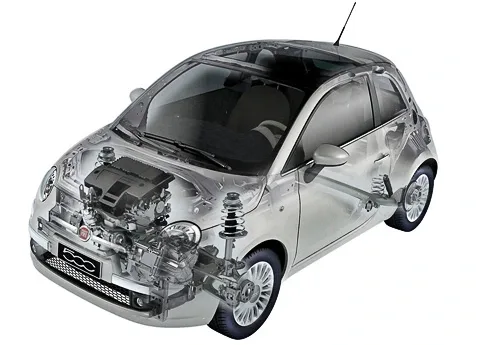
The car is built on the Fiat Panda platform, which also served as the basis for the Ford Ka hatchback. Up front — McPherson struts, at the rear — a torsion beam. In Russia, in addition to the 100-hp engine, a 1.2-liter 8-valve engine with 69 hp is available, and on the European market — also a 1.4-liter 75-hp diesel.
Safety
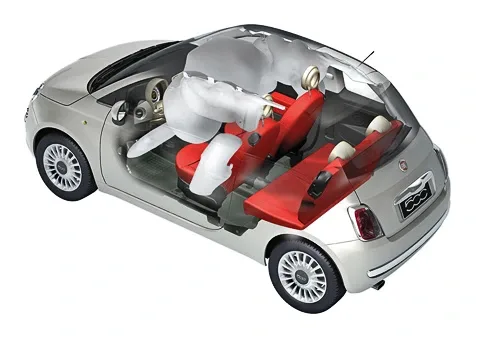
Even in the standard trim, seven airbags are provided, including a knee airbag for the driver. According to Euro NCAP crash test results, the Fiat 500 received the maximum five stars for adult occupant protection — 35 points: 15 for frontal impact, 16 for side impact, and two points each for pole impact and seatbelt reminder system. Child protection is rated more modestly — 28 points and three stars out of five. Pedestrians are also not a priority: 14 points and two stars out of four possible.
Design
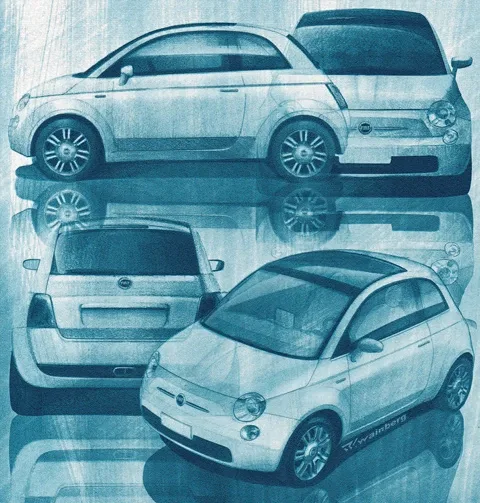
The exterior of the "cinquecento" was worked on at the brand's own design studio in Turin. The project was led by Roberto Giolito, who had previously created the Trepiuno concept — the direct predecessor of the production model. After this success, Giolito was appointed chief designer of Fiat.
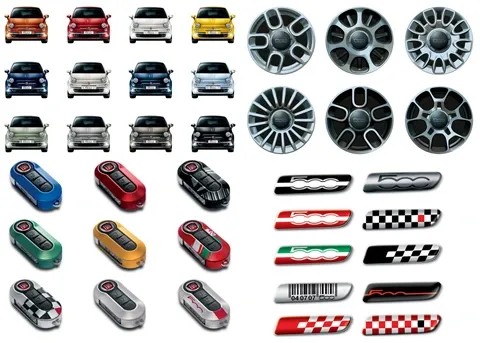
This is just a small part of the available personalization options for the Fiat 500.
History
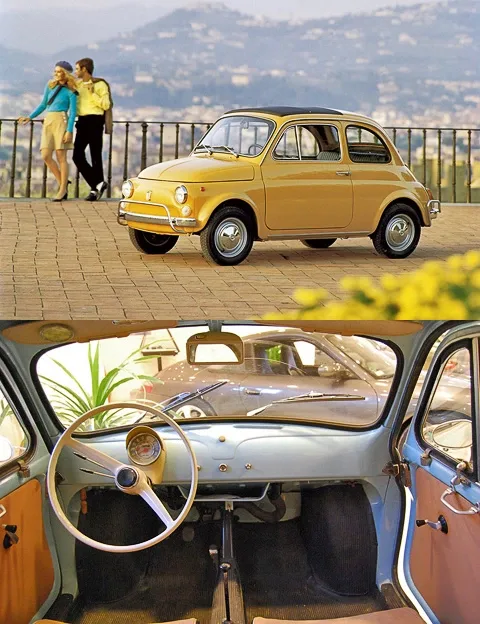
The original Fiat 500, which became the successor to the 500 Topolino and served as the prototype for the "hunchbacked" ZAZ-965, was produced from 1957 to 1975. During this time, almost 3.9 million units were made. The little car was equipped with engines of 0.5 or 0.6 liters, developing from 12 to 27 hp. The car weighed only half a ton and was less than three meters in length. The modern version is half a meter longer and almost twice as heavy.
Behind the scenes
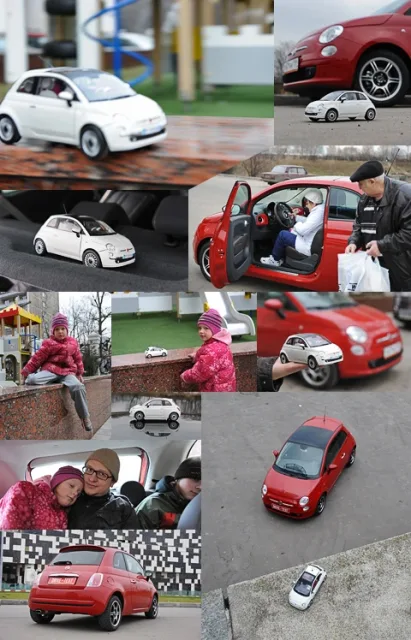
The test of the small Fiat did not go without an incident. During filming in motion, the driver lost control, and the car flew off a cliff. Fortunately, there were no serious damages — only the left mirror and rear suspension suffered. Since no one else was involved in the accident, we decided not to contact the traffic police and insurance, but took the car to the garage service "Uncle Anton's" together with an expert on family cars. There, with the help of superglue, everything was quickly and efficiently repaired, and they even treated us to tea — excellent service, we recommend it to everyone!