
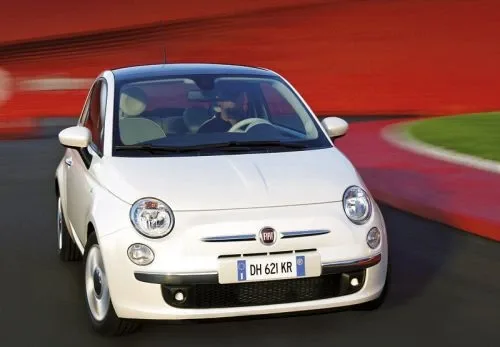
The Italians celebrated the fiftieth anniversary of the Fiat 500 model in grand style, reviving the legend. The new model is technically completely different from its predecessor, but its exterior echoes the style of the veteran. The car will not appear in Russia immediately, but it is worth taking a closer look at it today.
Some things are destined to become legends. They embody the spirit of an era, so they are cherished and nurtured. In the automotive world, there are plenty of such stories. Every manufacturer has its own model associated with many memories and hopes. Take, for example, our "Kopeyka" — what a coveted car it was! Or the Volkswagen Beetle, which stayed on the assembly line for 65 years, sold 21.5 million units, and became one of the best-selling cars in history.
2008 Fiat 500
© Photo: Fiat
The Fiat 500 became the same favorite for millions of lucky owners. It is, of course, younger than its rivals, but it made quite a splash in the automotive world. Everyone drove it — from ordinary citizens to world celebrities. And everyone was satisfied, enjoying rides in their small but so personal little car.
Legends have a habit of returning. Automotive history knows such examples. Take the Volkswagen Beetle: even before the classic model was discontinued in 2003, production of the new generation was launched in parallel. Designers created a look with recognizable features of the ancestor, and engineers filled it with modern systems. But VW New Beetle, alas, did not achieve its former glory...
2008 Fiat 500
© Photo: Fiat
The premiere of the new Fiat 500 was timed to a significant date — the fiftieth anniversary of the model. Thousands of owners of old "Cinquecentos" gathered in the main square of Turin.
The culmination of the celebration was an evening show on the waterfront, attended by both locals and tourists. Amid a mesmerizing water performance and a dazzling fireworks display that turned night into day, the public was presented with him — the new "Cinquecento"!
The fact that Italians treat their legendary car and its heir with such reverence is evidenced not only by the grand show but also by the meticulous approach they took to creating the new model. This is easy to verify by getting to know the car up close.
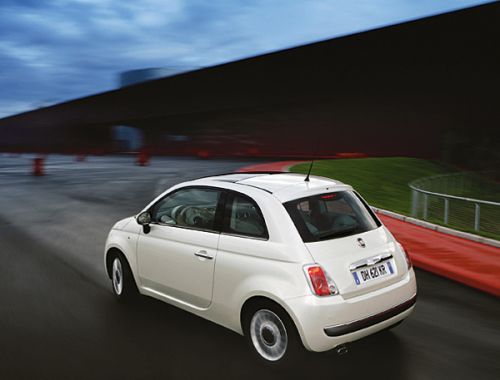
The exterior of the new model is clearly styled after the first Fiat 500. From the front, they can even be confused: the same naive look of round headlights, and instead of the usual radiator grille — a badge with chrome moldings on the sides. From the rear, it is harder to confuse: modern optics, plump wheel arches, and a stylish chrome exhaust tip.
2008 Fiat 500
© Photo: Fiat
However, despite the spirit of the old "Cinquecento," this is a completely new and modern car. It has grown in size to meet safety standards and class requirements.
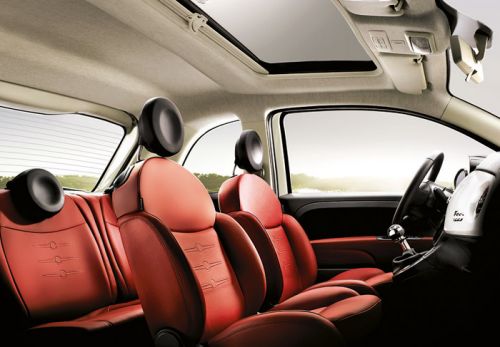
The Fiat 500's interior is spacious and ergonomic. It is comfortable to sit both in the front and in the back, though the rear row is best for two — as hinted by the 50:50 split bench and only two headrests. There is enough room for legs, shoulders, and head.
However, the front seats are not impressive in shape. The rounded cushion with a large bolster under the knees can cause legs to go numb, so you will have to search for a comfortable position by experimenting with adjustments — fortunately, their range is sufficient. But the lateral support is excellent: the body does not sway in corners.
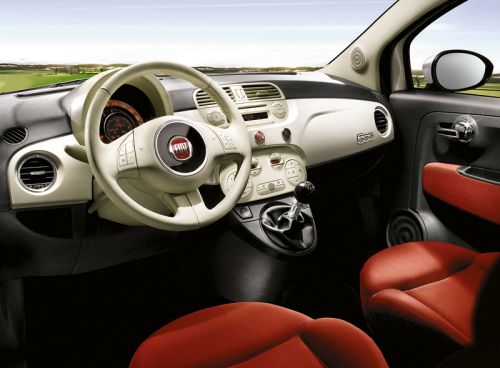
The instrument panel is not ideal in terms of information readability, but it captivates with its originality. It is made in the form of one large dial resembling a Soviet alarm clock. A small speedometer needle runs along the contour, and just below — a tiny tachometer needle. In the center of this speedometer-tachometer is the onboard computer screen. The central tunnel resembles the one in the Fiat Croma or Linea, with convenient and intuitive buttons.
The trim materials will pleasantly surprise even a discerning buyer. A wide lacquered insert on the front panel immediately catches the eye. The fabric and leather of the seats are pleasant to the touch. Moreover, many color combinations are offered — you can literally piece together your own Fiat 500 from the inside. Only the plastic of the door cards disappointed: rough and hard, it is easy to clean, but aesthetically...
The Fiat 500 starts with a regular folding key fob. Its design is as varied as the interior trim: the case can be solid — red, blue, green — or decorated with the Italian or checkered racing flag.
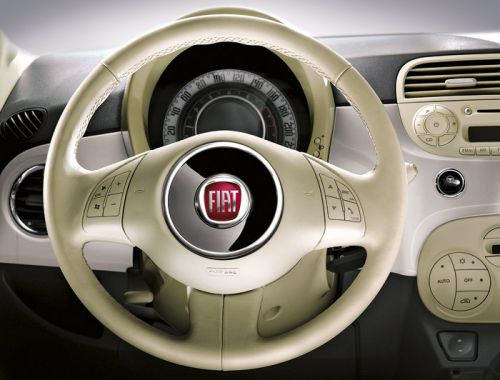
2008 Fiat 500
© Photo: Fiat
Under the hood of the Fiat 500, there can be three engines: two petrol ones with a displacement of 1.2 and 1.4 liters, and one diesel 1.3-liter, which, most likely, will not reach us. Most likely, the first to hit the Russian market will be the 100-horsepower 1.4-liter unit, accelerating the car to 100 km/h in 10.5 seconds. A decent result, considering that the engine meets Euro 5 standards. True, for acceptable dynamics, the engine has to be constantly revved to 4500–5000 rpm, which noticeably affects acoustic comfort — although the sound insulation in the cabin is good in itself, and extraneous sounds from the street do not penetrate here.
The handling of the new model is at an acceptable level. There are, of course, body rolls, but the short wheelbase and the refined suspension from the Fiat Panda allow for quick and precise tracking and control of the car's behavior.
The new Fiat 500 is imbued with the spirit of that era, yet remains a completely modern car. Given its unique style, it can confidently be placed alongside the Mini Cooper. True, the "Cinquecento" has one undeniable advantage — affordability. In Europe, prices start from €10,000, and in Russia, a range of $15,000 to $20,000 is planned depending on the trim level.
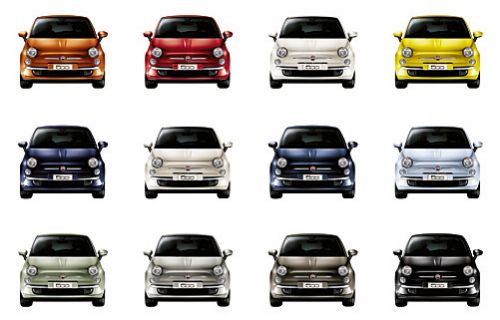
2008 Fiat 500
© Photo: Fiat
To each their own
The Fiat 500 offers an incredible number of exterior options. Its arsenal includes a wide palette of colors from strict black to pleasant pearlescent shades. You can match the interior trim to the body color. And the list of additional services even includes applying various stripe patterns to the body.
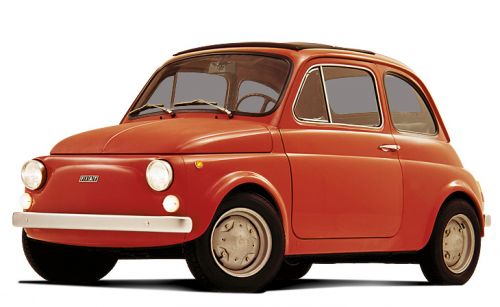
Fiat 500
© Photo: Fiat
CINQUECENTO
"Cinquecento, cinquecento, cinquecento..." — was heard everywhere. The mysterious word, pleasant to the ear, simply means 500 in Italian. This name became attached to the car worldwide along with the numbers. The "Cinquecento" became one of the most popular cars. It had a difficult post-war period, and its mission was to make the car accessible to everyone. And it succeeded! The Fiat 500 quickly began to push mopeds off the roads, which were then the main means of transportation. Engineers developed a simple, lightweight, and practical design. Its compactness allowed parking literally in any free spot. The Fiat 500 gave millions of owners a sense of freedom — freedom of movement. Let us hope that the newcomer will become a worthy successor to the lineage.
Driving
The refined suspension from the Fiat Panda provided the Fiat 500 with decent handling. However, even the most powerful 1.4 engine struggles with Euro 5 standards.
Interior
Inside is as stylish as outside. The large dial combining the speedometer and tachometer attracts attention.
Comfort
The Fiat 500 is a full-fledged four-seater car.
Safety
Even in the base trim — two front airbags and ABS+EBD system.
Price
Not determined.
| Dimensions, mm | 3546x1627x1488 |
| Engine | petrol, 1368 cm3, 100 hp/6000 rpm |
| Transmission | manual, 6-speed |
| 0-100 km/h, s | 10.5 |
| Top speed, km/h | 182 |
| Competitors | Nissan Micra, Mini Cooper |
Strengths and weaknesses
+ Striking exterior, solid and tidy interior, well-thought-out placement of controls.
- Engines that have been significantly "choked" by Euro 5 emission standards.
How we see it
In Europe, sales of the new Fiat 500 are scheduled to start in August of this year, but it is already clear that it has every chance to repeat the success of its predecessor. The first batch of 500 units was sold out in literally two hours. What happens next — time will tell, but it is worth taking a closer look at this car today.
The test drive itself left a mixed feeling. On the one hand, the car is pleasing to the eye and gives a lot of positive emotions behind the wheel. On the other hand, the 1.4-liter engine producing 100 horsepower feels somewhat subdued due to strict emission requirements. This is especially noticeable when accelerating from a standstill: the car reaches 100 km/h in 10.5 seconds, and for such a compact hatchback, you want more agility. However, the six-speed manual allows you to get the most out of the engine, and the top speed of 182 km/h is more than sufficient for the city.
The interior exudes an atmosphere of comfort and quality. The trim materials are pleasant to the touch, and the assembly is flawless. Ergonomics are well thought out: all buttons and levers are at hand, nothing needs to be searched for blindly. This is exactly the case when a small car feels meticulously designed.
Speaking of competitors — the Nissan Micra and Mini Cooper — the Fiat 500 stands out with its character and style. It doesn't try to be universal but simply does what an image city car should do: delight the owner and attract glances. Yes, the dynamics could be livelier, but for most usage scenarios, these 100 horsepower are enough.
In conclusion: the Fiat 500 is a car of mood, and it will clearly become a hit if the demand for the first batches reflects the real interest of the public.
© 5 Koleso