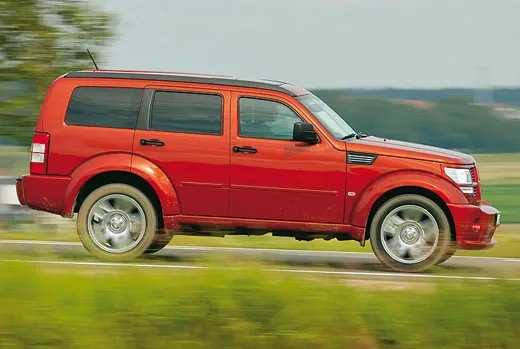
Having hit my crown against the door opening, which is no bigger than a birdhouse hole, I somehow managed to get into the cabin. The seat most resembles a referee's chair from beach volleyball – it is so high that a short driver's legs almost dangle in the air. Then I pulled out onto the highway and floored the accelerator.
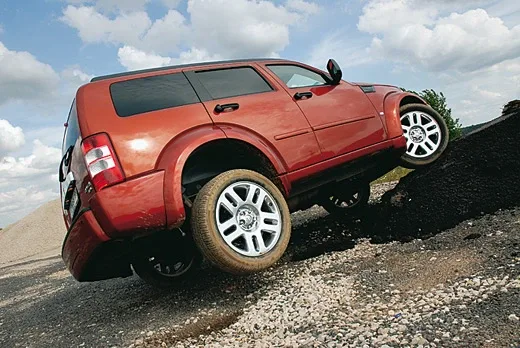
Even such a car can perform feats. But it was not created for this. And it's not even about the suspension: it's just that there is no low-range gear here
A flurry of emotions washed over me from head to toe. And not just me! Already at a hundred kilometers per hour, the photographer jumped out of the car. He left the cabin on the move: a fan of the German school could not withstand the rampant American engineering thought. After 120 km/h, when the Dodge began to sway across the lane with a swing of one and a half meters, I followed the photojournalist out. Then the Nitro continued on its way alone.
It was comfortable. There was no one nearby who would whine about directional stability, which is essentially absent here. There were no indignant cries about rocking like on a ship, or body rolls like a bus. The picture was not spoiled by sharp remarks about the pedal assembly, where there is as much free space as in a child's bucket, or about the buttons on the panel, half of which cannot be reached even with an outstretched arm.
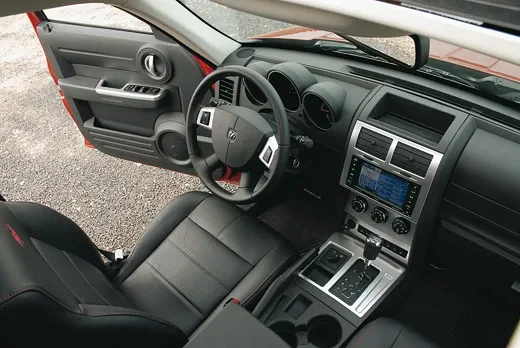
The interior looks nicer than in the less powerful version (3.7 L). Mainly thanks to the beautiful and incredibly plush leather seats
Still, it's a pity that I got to drive the Dodge Nitro from a Volvo XC90. But Igor Gubar got out of his Hyundai Tucson, took a ride in the red "Phantom" and said: "Not bad!" For such a car, the point of reference is very important.
THE FATE OF THE TERMINATOR
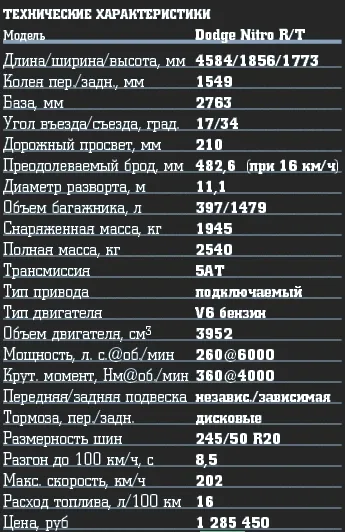
The four-liter Nitro bears the R/T index. This version, among other things, boasts a leather interior and 20-inch alloy wheels. Plus some changes in the plastic body kit. But the main thing, of course, is the engine. How does it differ from the less powerful 3.7-liter unit, with which the Nitro is $6,000–11,000 cheaper depending on the trim? The cylinder bank angle is 60 degrees versus 90. Four valves per cylinder versus two. Power of 260 hp at 6000 rpm versus 205 hp at 5200 rpm, and torque of 360 Nm versus 314. There is another important detail: the 3.7-liter engine was paired with a four-speed automatic, while the new 4-liter one is already with a five-speed. True, this is not a completely fresh development, but a refined version of the 3.5-liter unit used by Chrysler.
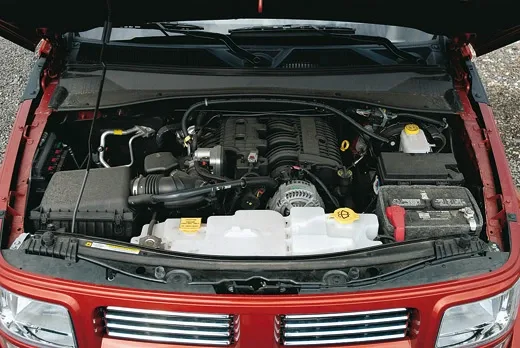
This V-shaped engine is a dying branch of engine building
But the Dodge Nitro R/T is the first car in my practice that has no red zone in the tachometer. How much can you squeeze out of it? Several times I approached the 170 km/h mark, and at this speed the Nitro suddenly dropped the revs and switched to a gentle mode. They installed limiters... What kind of "Phantom" is this that trembles over its iron? Or does it really care about my safety? Touching.
And is it worth buying a Dodge Nitro R/T for 1,300,000 rubles instead of the base version? The difference in power is obvious. As you already understood, with such a chassis it rather hinders, but that doesn't matter. Such cars are chosen with the heart. And if you are crazy enough to buy a Nitro, then go all the way. As the poet said, "if you love, love; if you shoot, shoot."