
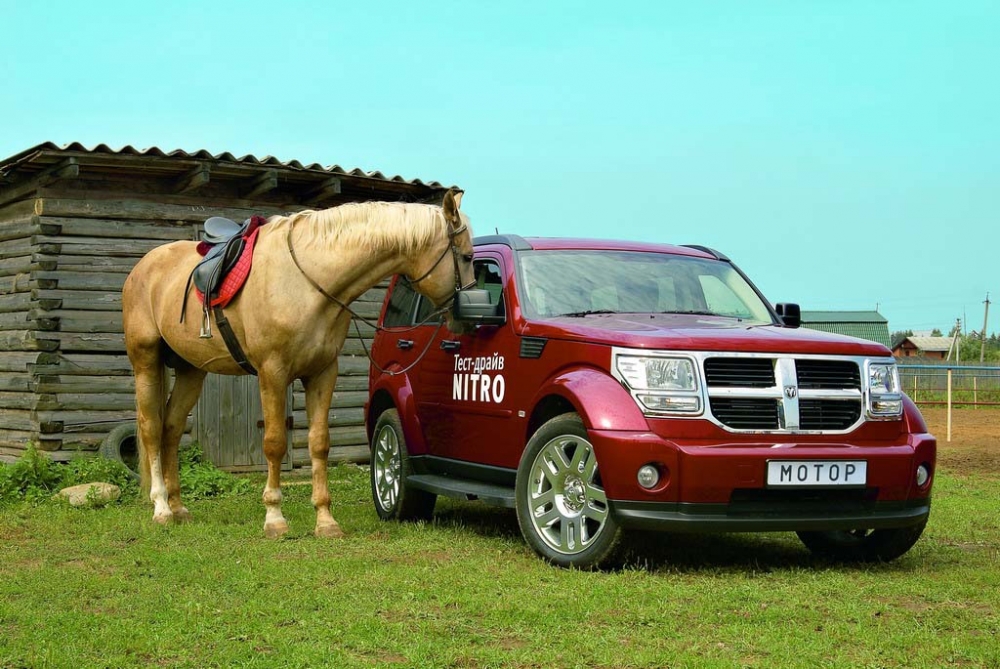
 Going to meet the test car, I recalled a news agency report: “Dodge Nitro explodes the mid-size SUV market.” And I began to mentally list those already playing on this field. The list was impressive. There was the German Volkswagen Touareg, the Japanese Nissan Pathfinder, the fellow Jeep Cherokee, and the Korean SsangYong Rexton with Kia Sorento. Yes, it won't be easy to break through. And even more so to “explode.” Going to meet the test car, I recalled a news agency report: “Dodge Nitro explodes the mid-size SUV market.” And I began to mentally list those already playing on this field. The list was impressive. There was the German Volkswagen Touareg, the Japanese Nissan Pathfinder, the fellow Jeep Cherokee, and the Korean SsangYong Rexton with Kia Sorento. Yes, it won't be easy to break through. And even more so to “explode.” |
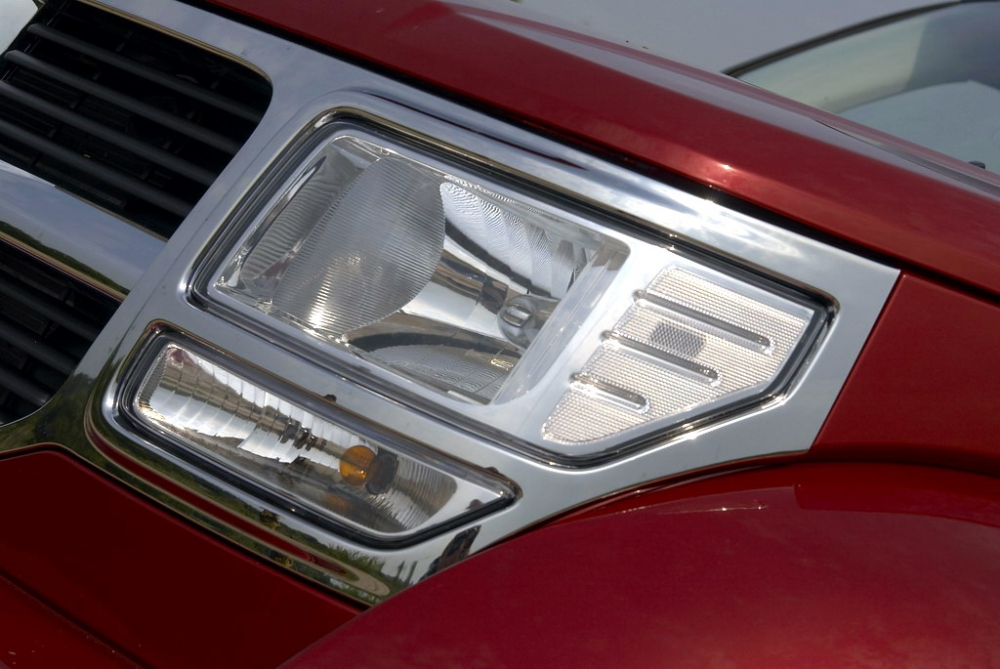
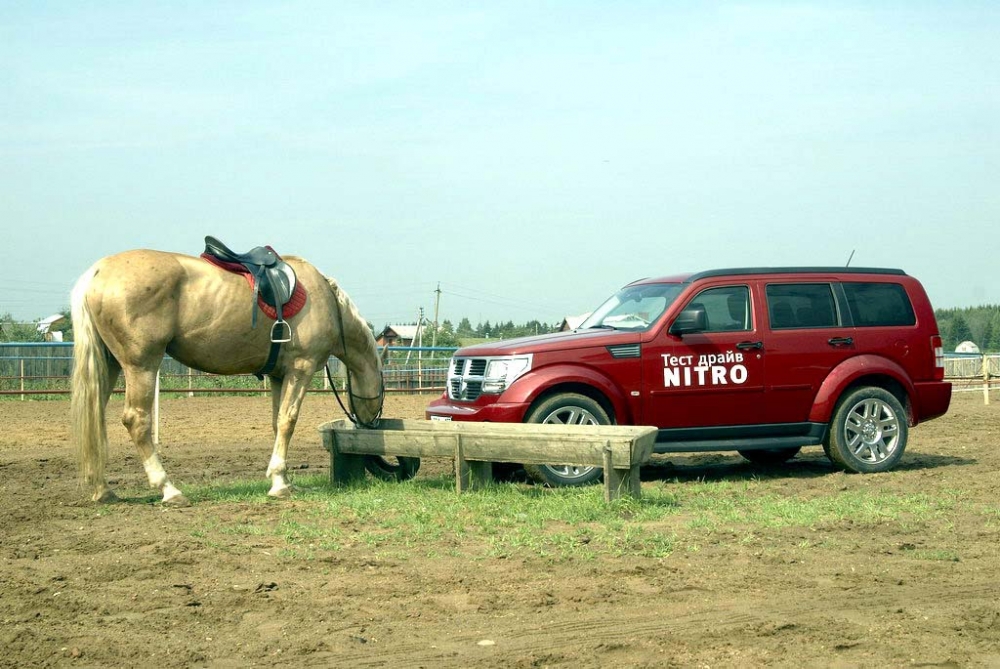 But Nitro shows with its entire appearance that it is not afraid of difficulties. The “chopped” style, already refined on the younger Dodge Caliber, is here complemented and developed. The front end alone is something! A huge radiator grille shield, divided by a branded cross with an emblem, an imposing angular bumper with fog lights, two-tier headlights, wheel arches inflated to the point of grotesque… The slogan popular on construction sites comes to mind: “Don't stand under the load!” But Nitro shows with its entire appearance that it is not afraid of difficulties. The “chopped” style, already refined on the younger Dodge Caliber, is here complemented and developed. The front end alone is something! A huge radiator grille shield, divided by a branded cross with an emblem, an imposing angular bumper with fog lights, two-tier headlights, wheel arches inflated to the point of grotesque… The slogan popular on construction sites comes to mind: “Don't stand under the load!” |
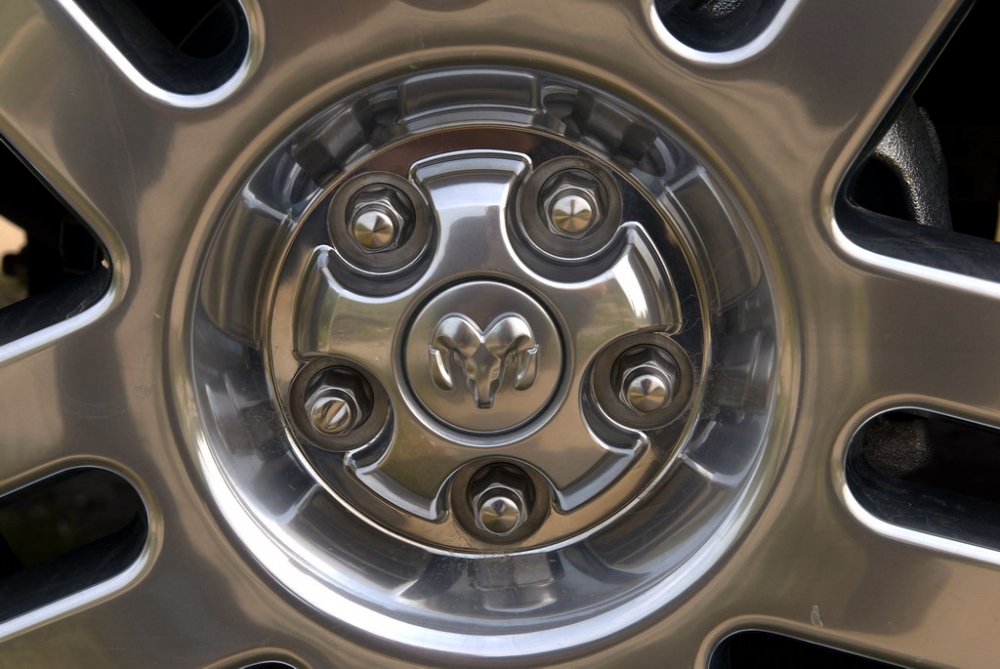
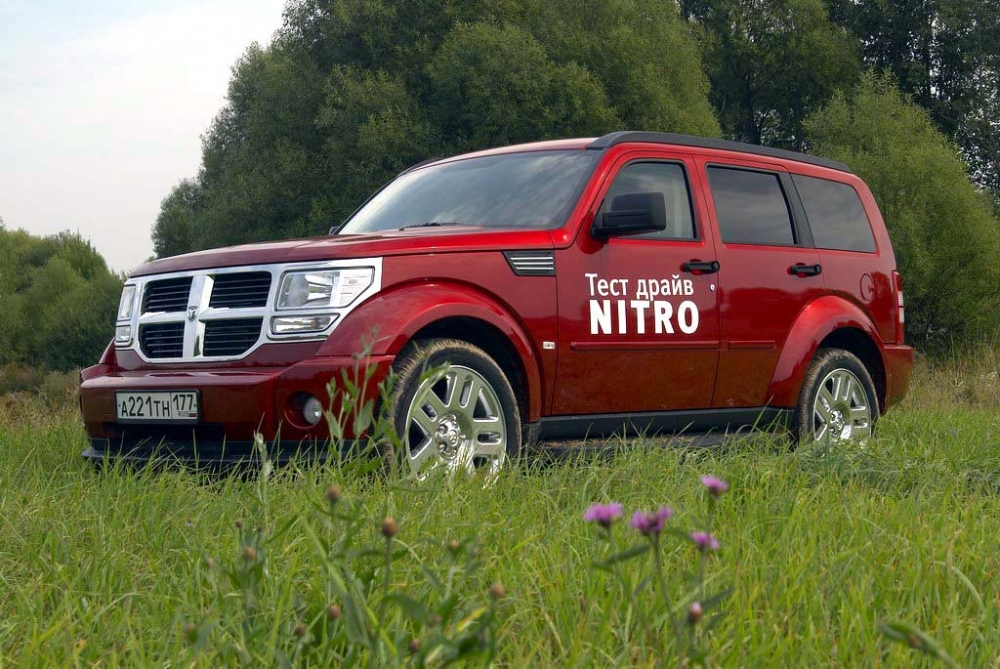 The sides of the body are calmer. But they are also quite expressive thanks to the same large arch extensions, an interesting play of planes, “pinched” glazing, as well as a fake trim on the front fenders stolen from Range Rover, posing either as an air intake or a ventilation grille. And far from the last role is played by the optional 20-inch wheels. At the rear, the Nitro designers clearly rested. Only the bumper tries to resist the sheer tailgate and quite ordinary lights – as serious as the front one, but simpler in shape. All this “cubism” gives the Dodge solidity, makes it visually larger. Credit must be given to the designers – despite all its pomposity, the exterior is not devoid of harmony. A special aesthetic – rough, assertive. American. The sides of the body are calmer. But they are also quite expressive thanks to the same large arch extensions, an interesting play of planes, “pinched” glazing, as well as a fake trim on the front fenders stolen from Range Rover, posing either as an air intake or a ventilation grille. And far from the last role is played by the optional 20-inch wheels. At the rear, the Nitro designers clearly rested. Only the bumper tries to resist the sheer tailgate and quite ordinary lights – as serious as the front one, but simpler in shape. All this “cubism” gives the Dodge solidity, makes it visually larger. Credit must be given to the designers – despite all its pomposity, the exterior is not devoid of harmony. A special aesthetic – rough, assertive. American. |
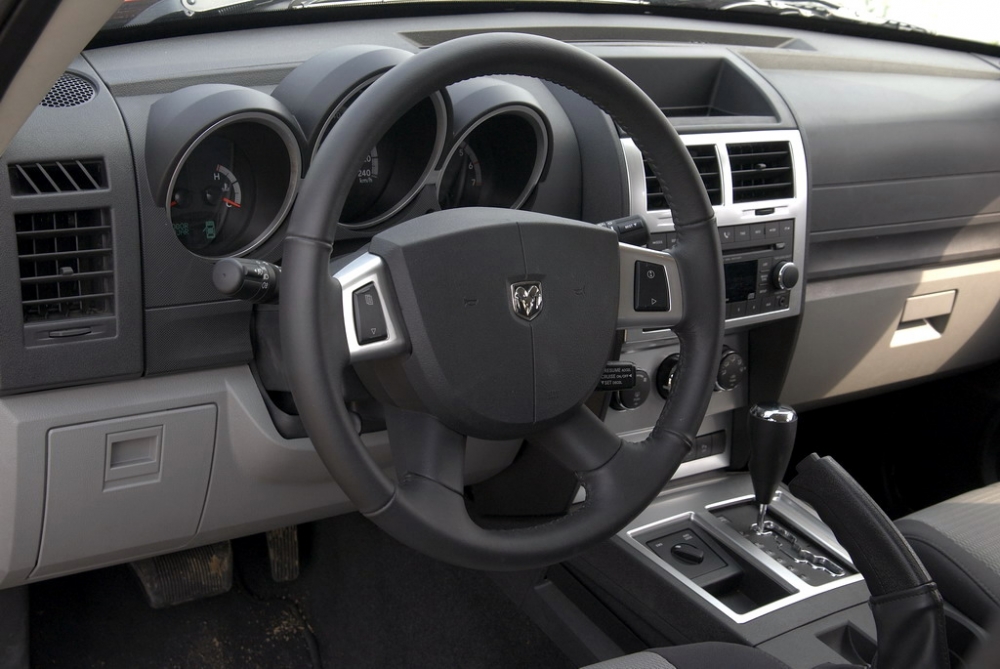 Dodge decided not to learn from its own mistakes, so the interior was done in the same vein as for the Caliber. Outside it's crowded, inside it's empty. Despite the large external dimensions, the cabin is by no means spacious. No, there is certainly enough room for all five occupants, but they could have carved out more. The style matches the exterior. The trim is far from refined – materials are inexpensive, assembly is not without flaws. The transmission mode selector, the little wheels that turn the air vent nozzles – a greeting from the 80s. Ugly. It's unrealistic to wash the plastic on the doors from dirt with cold water, I tried it myself. And while driving, the plastic noticeably creaks. Dodge decided not to learn from its own mistakes, so the interior was done in the same vein as for the Caliber. Outside it's crowded, inside it's empty. Despite the large external dimensions, the cabin is by no means spacious. No, there is certainly enough room for all five occupants, but they could have carved out more. The style matches the exterior. The trim is far from refined – materials are inexpensive, assembly is not without flaws. The transmission mode selector, the little wheels that turn the air vent nozzles – a greeting from the 80s. Ugly. It's unrealistic to wash the plastic on the doors from dirt with cold water, I tried it myself. And while driving, the plastic noticeably creaks. |
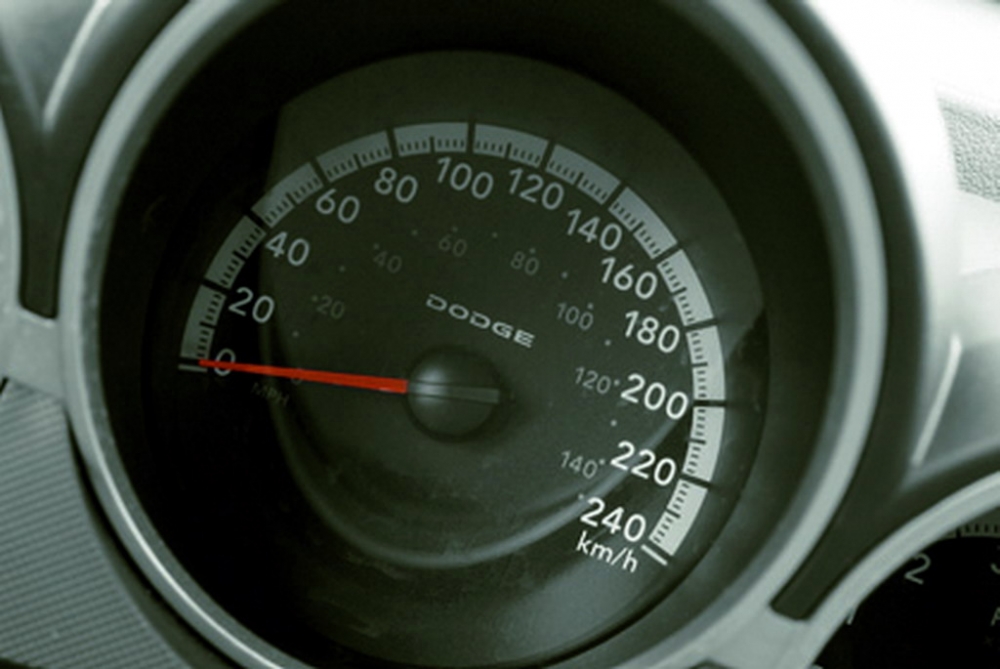 I really liked the three “wells” of the instrument panel and the solid automatic gear lever. The rotating climate control knobs are well executed. The effort on them is correct, but there is no Auto mode. Moreover, the climate system is unable to cope with the size of the cabin. The test took place in 30-degree heat, and the air conditioner worked almost constantly at full blast, but the rear passengers still had a hard time – there are no air ducts. But sitting was comfortable – there is more space in the back than in the front. It's not that the first row is cramped, but you constantly feel some constraint. And why can't Americans ever learn to properly shape interior space? I really liked the three “wells” of the instrument panel and the solid automatic gear lever. The rotating climate control knobs are well executed. The effort on them is correct, but there is no Auto mode. Moreover, the climate system is unable to cope with the size of the cabin. The test took place in 30-degree heat, and the air conditioner worked almost constantly at full blast, but the rear passengers still had a hard time – there are no air ducts. But sitting was comfortable – there is more space in the back than in the front. It's not that the first row is cramped, but you constantly feel some constraint. And why can't Americans ever learn to properly shape interior space? |
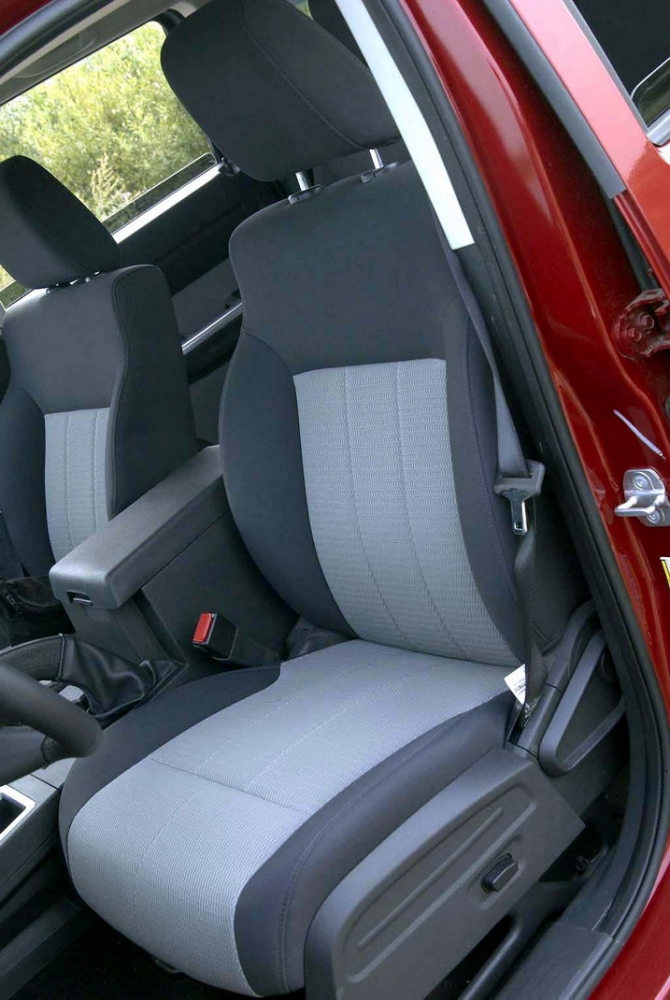
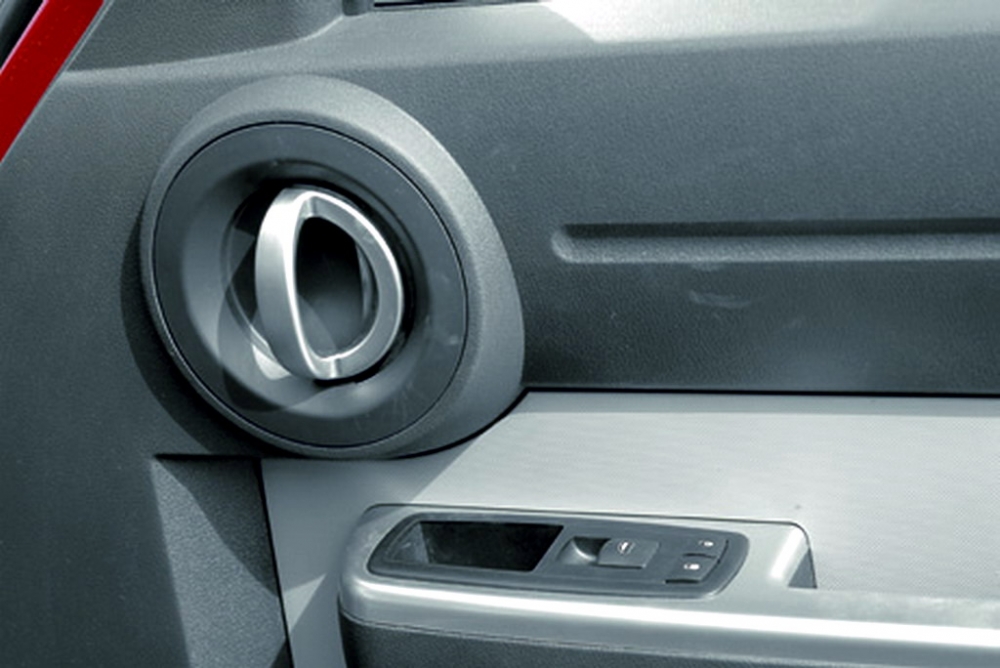 Nevertheless, from an ergonomic standpoint, everything is in order. Of course, I would like to sit a little lower, and pull the “helm” a bit more towards myself. But lower is impossible, because it's an SUV, and with a very high beltline. And the steering wheel is not adjustable for reach. But these are trifles. I easily found the optimal position – I didn't change it once during the test. Moreover, the seats upholstered in YES Essentials fabric turned out to be comfortable and hold you well. Although they are traditionally soft. But on a long journey, you don't get tired at all. Nevertheless, from an ergonomic standpoint, everything is in order. Of course, I would like to sit a little lower, and pull the “helm” a bit more towards myself. But lower is impossible, because it's an SUV, and with a very high beltline. And the steering wheel is not adjustable for reach. But these are trifles. I easily found the optimal position – I didn't change it once during the test. Moreover, the seats upholstered in YES Essentials fabric turned out to be comfortable and hold you well. Although they are traditionally soft. But on a long journey, you don't get tired at all. |
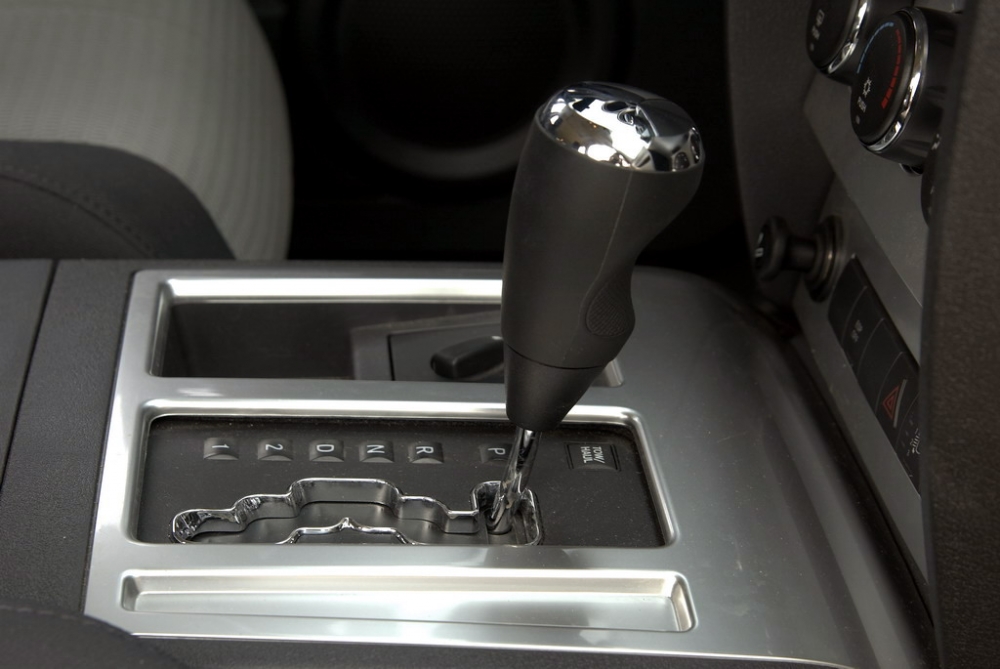 You get tired of something else. First of all, of the ancient four-speed automatic. The gears are long (especially third and fourth), so you can't expect dynamic acceleration. Moreover, the engine power is clearly insufficient for a two-ton car – only 205 hp. If you floor the gas from a standstill, you will, of course, get acceleration. And even quite vigorous. But the “official” 10.3 seconds to 100 km/h seems doubtful. At the same time, acceleration is accompanied by unpleasant sounds: the transmission whines and reports shifts with jolts, and the V-shaped “six” roars primitively at high revs. The engine seems to ask: release the pedal, don't rev it! And indeed, there's no point in pushing the tachometer needle above 4500–5000 rpm – more noise than progress. You get tired of something else. First of all, of the ancient four-speed automatic. The gears are long (especially third and fourth), so you can't expect dynamic acceleration. Moreover, the engine power is clearly insufficient for a two-ton car – only 205 hp. If you floor the gas from a standstill, you will, of course, get acceleration. And even quite vigorous. But the “official” 10.3 seconds to 100 km/h seems doubtful. At the same time, acceleration is accompanied by unpleasant sounds: the transmission whines and reports shifts with jolts, and the V-shaped “six” roars primitively at high revs. The engine seems to ask: release the pedal, don't rev it! And indeed, there's no point in pushing the tachometer needle above 4500–5000 rpm – more noise than progress. |
 Moreover, in a mode with intense acceleration, fuel consumption can exceed 30 l/100 km. Even with measured driving, I couldn't get below 16–17 l. It must be said that it is precisely this kind of movement that the Nitro driver is inclined towards. The automatic transmission's behavior during “kick-down” leaves much to be desired; shifts are performed with a second's delay. Overtaking on the highway will not be effortless. Sometimes the automatic even drops down a couple of gears, but having entered a zone of revs already too high for the engine, it hurries to shift up. Such concepts as “holding a gear” or “engine braking” are, unfortunately, unknown to it. It's a pity I didn't get to try the diesel version. Its power is lower (177 hp), but the torque is higher by 150 Nm (460 Nm), and the gearbox has five gears. Moreover, in a mode with intense acceleration, fuel consumption can exceed 30 l/100 km. Even with measured driving, I couldn't get below 16–17 l. It must be said that it is precisely this kind of movement that the Nitro driver is inclined towards. The automatic transmission's behavior during “kick-down” leaves much to be desired; shifts are performed with a second's delay. Overtaking on the highway will not be effortless. Sometimes the automatic even drops down a couple of gears, but having entered a zone of revs already too high for the engine, it hurries to shift up. Such concepts as “holding a gear” or “engine braking” are, unfortunately, unknown to it. It's a pity I didn't get to try the diesel version. Its power is lower (177 hp), but the torque is higher by 150 Nm (460 Nm), and the gearbox has five gears. |
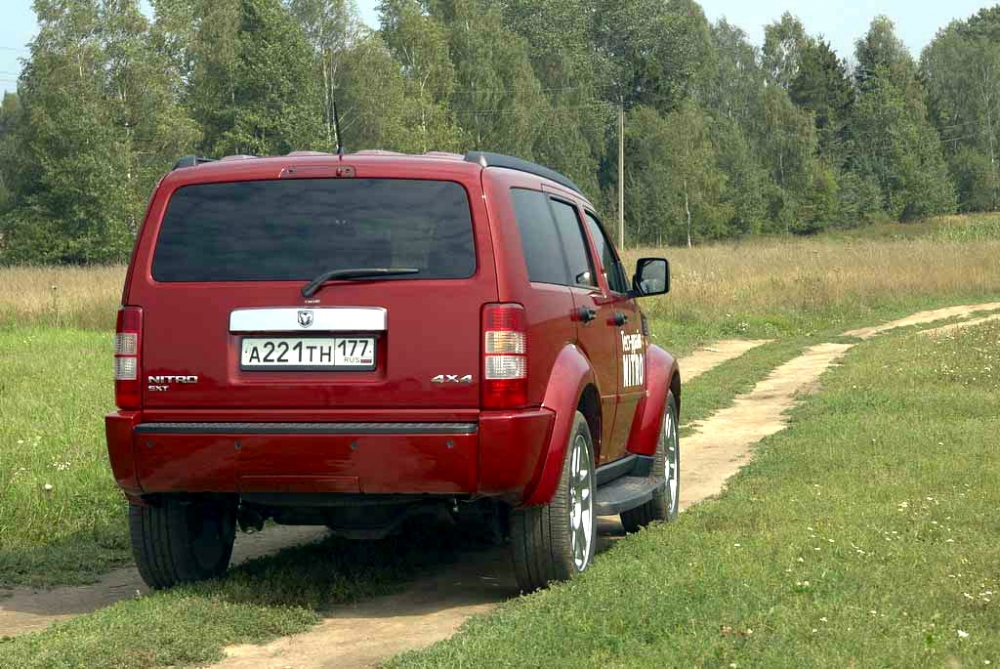 At high speeds, the Dodge behaves as befits a heavy SUV with a rear axle: it floats on course, bucks on bumps, and noticeably rocks on gentle waves. At the same time, its steering and brakes are far from outstanding. At least you sit high, so you can see further and start braking earlier. If you prefer a maneuver to hard braking, then don't expect joy here either – the suspension will not be ready for it. The rolls are large, the response to steering input has a noticeable delay. And this is despite the fact that I drove on 20-inch wheels. I wonder how the car will behave on 16- or 17-inch wheels? The suspension behaves strangely. Sometimes it rocks on an almost level road like a yacht, sometimes on bumps it hits the body with unsprung masses. Neither comfort nor drive. But if you grit your teeth and grip the “wheel” tighter, you can quite quickly fly over potholes. The suspension can't be broken through; it's long-travel and energy-intensive. But how often is that needed in everyday life? In general, on asphalt, the Nitro gives little pleasure. Except maybe on straightaways, and even then after 140–150 km/h it's already hard to relax. At high speeds, the Dodge behaves as befits a heavy SUV with a rear axle: it floats on course, bucks on bumps, and noticeably rocks on gentle waves. At the same time, its steering and brakes are far from outstanding. At least you sit high, so you can see further and start braking earlier. If you prefer a maneuver to hard braking, then don't expect joy here either – the suspension will not be ready for it. The rolls are large, the response to steering input has a noticeable delay. And this is despite the fact that I drove on 20-inch wheels. I wonder how the car will behave on 16- or 17-inch wheels? The suspension behaves strangely. Sometimes it rocks on an almost level road like a yacht, sometimes on bumps it hits the body with unsprung masses. Neither comfort nor drive. But if you grit your teeth and grip the “wheel” tighter, you can quite quickly fly over potholes. The suspension can't be broken through; it's long-travel and energy-intensive. But how often is that needed in everyday life? In general, on asphalt, the Nitro gives little pleasure. Except maybe on straightaways, and even then after 140–150 km/h it's already hard to relax. |
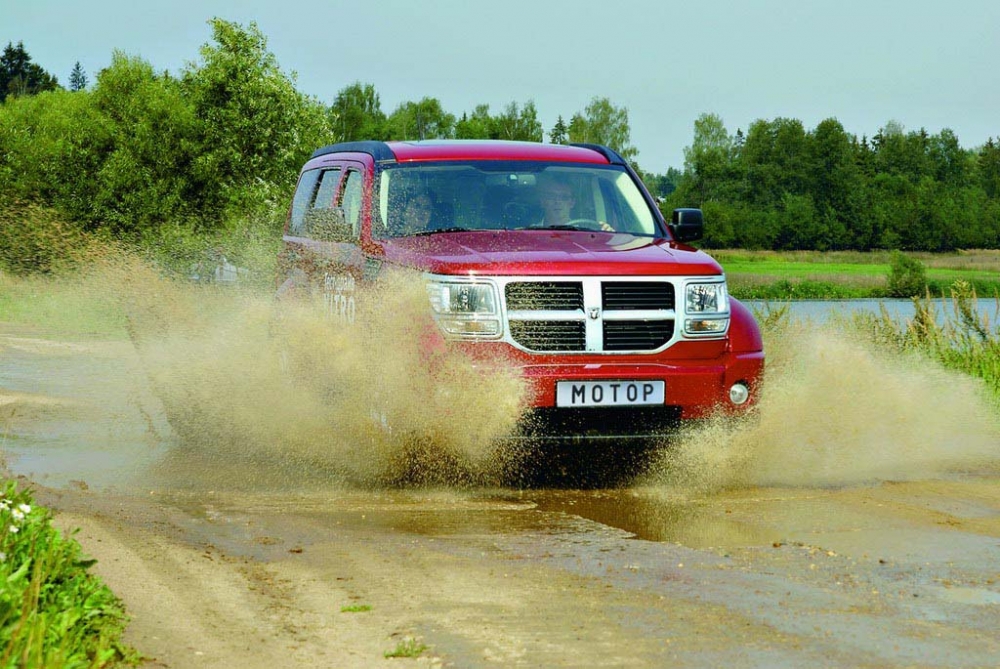
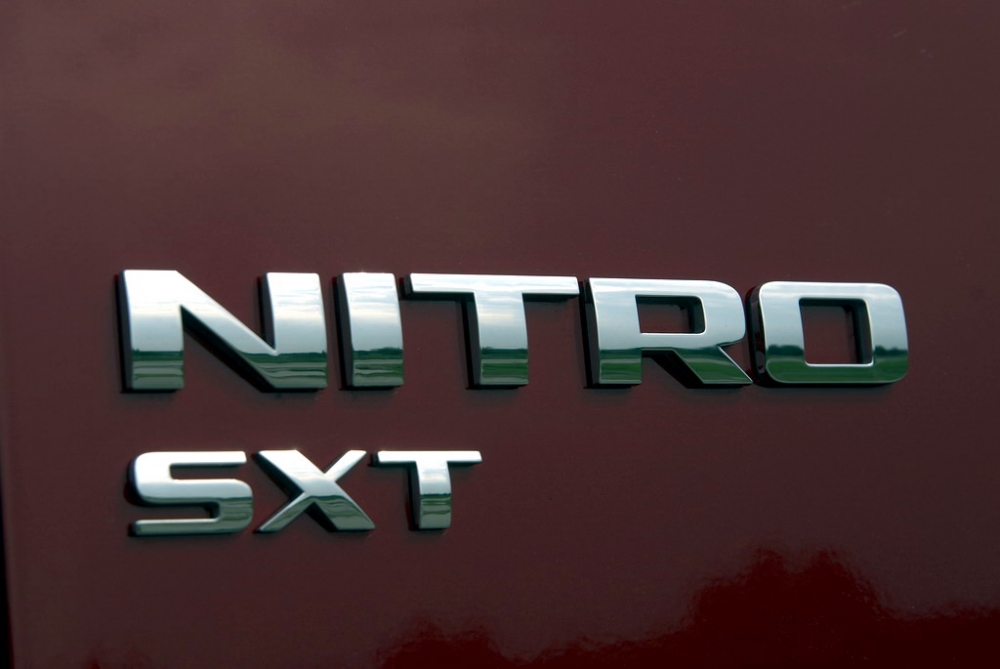 Not checking a car with a 4 x 4 badge off-road would be a mistake. But mindful of the fact that all the all-wheel drive here is the electronic engagement of the front axle (50/50), I didn't go looking for trouble. There is no center differential, let alone lockers or a low range in the transmission. The Dodge Nitro is capable of only light exercises that an ordinary crossover like the X-Trail can handle. More serious off-roading is not for the Nitro. And the ESP system, which partially performs the functions of all-wheel drive, won't help here. It works with noticeable delays, and getting stuck is as easy as pie. Even the ground clearance of more than 20 cm won't help. In light of all that has been said, the conclusion suggests itself: the “explosion” is cancelled. Europe is unlikely to be delighted with such a car. The Dodge doesn't shine in either power or handling, and it will probably be passed over in favor of the Touareg, even though it's more expensive. In Russia, however, the situation is a bit different. Here, many are ready to give a lot for “beautiful eyes” and external pathos. Not checking a car with a 4 x 4 badge off-road would be a mistake. But mindful of the fact that all the all-wheel drive here is the electronic engagement of the front axle (50/50), I didn't go looking for trouble. There is no center differential, let alone lockers or a low range in the transmission. The Dodge Nitro is capable of only light exercises that an ordinary crossover like the X-Trail can handle. More serious off-roading is not for the Nitro. And the ESP system, which partially performs the functions of all-wheel drive, won't help here. It works with noticeable delays, and getting stuck is as easy as pie. Even the ground clearance of more than 20 cm won't help. In light of all that has been said, the conclusion suggests itself: the “explosion” is cancelled. Europe is unlikely to be delighted with such a car. The Dodge doesn't shine in either power or handling, and it will probably be passed over in favor of the Touareg, even though it's more expensive. In Russia, however, the situation is a bit different. Here, many are ready to give a lot for “beautiful eyes” and external pathos.PRICES AND TRIM LEVELS Russian dealers sell the Dodge Nitro with two engines – a 3.7-liter gasoline (205 hp, 314 Nm) and a 2.8-liter CRD turbodiesel (177 hp, 460 Nm) developed by VM-Motori. The car with the gasoline engine can be bought in SE trim or the more loaded SXT. The diesel is only combined with SXT. The base SE version has 16-inch wheels, audio prep, power mirrors, air conditioning, puddle lamps, side moldings, arch extensions, fabric interior, roof rails, security alarm, split-folding rear seat (35/65), and central locking. In the SXT trim, all moldings, trims, and wheel arches are painted in body color, the interior is trimmed with special YES Essentials fabric, and the mirrors are heated. Plus, there's a “music” system with a 6-disc changer, 17-inch wheels, floor mats, tire pressure monitoring, cruise control, a leather multifunction steering wheel, rear parking sensors, and power driver's seat. The price for the base 3.7 SE version is ?31,500. The diesel SXT costs ?36,200. And the most expensive 3.7 SXT is ?36,400. |
 |
 |
 |
False alarm
For the Dodge company, the Nitro model is the 'first pancake' in the class of mid-size SUVs. Did the Americans manage to bake it correctly, without a lump in the end?
Test drive photos
Comments
No comments yet. Say the first word.