
He doesn't need aristocratic manners and polish. He doesn't try to seem like a lady-killer or a tough guy. But he's honest as a ruble and one of the guys, and that's worth a lot.
The name "Logan" should be pronounced in French — with the stress on the last syllable. It grates on the ear, as if it's about a computer "login," although at Renault they swore it's the name of some woman. But let's not dwell on the name; that's not the point. The main thing is that Logan, a "car for 5000 euros," is already selling well in Romania, and with the arrival of summer, it will appear on the Russian market.
What kind of car is this that Renault is going to use to tempt the less wealthy residents of Eastern Europe, Russia, the Middle East, Africa, and South America? These regions are home to a large part of the world's population, and the roads there are still mostly plied by modified models from thirty years ago.
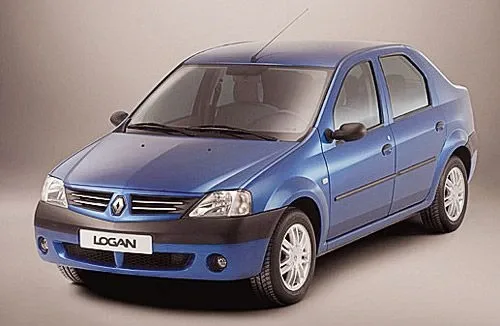
The Logan's appearance is — nothing. At all. My wife has a memory for faces like a camera. I showed her a magazine article about the Logan, and the next day I asked how the car looks — she couldn't even remember! A ghost car that doesn't catch the eye, which means a random passerby won't feel the urge to throw a stone at the window out of envy or anger. That's a huge plus! Perhaps the Logan can be left anywhere without fear for its safety. Although, most likely, such peace of mind is temporary: when in a couple of years "Logans" multiply to hundreds of thousands on Russian roads, they'll start being stolen with the same zeal as old Volkswagens or Zhigulis — for parts.
For an inexpensive car, as for a real man, appearance isn't the main thing. What matters is the substance, and here Logan lays all competitors — I emphasize, all — on both shoulder blades. It's as long as the Renault Megane Sedan, as tall as the Peugeot 307, and as wide as the VW Bora. It's a full-fledged golf class at the price of a set of flashy wheels for a Hummer H2. Even more than golf class: three adults can comfortably sit in the back seat of the Logan, and no one will feel left out.
The Logan's trunk is simply a cave. Half a thousand liters, like the Mercedes-Benz S-Class. True, the rear seat back doesn't fold down, so skis or boards (not snowboards, but actual boards) won't fit inside. But who's stopping you from putting an additional roof rack on top?
The high roof and the slightly higher driver's seat create the feeling of sitting in a minivan. The seats themselves, by the way, are quite comfortable. People above average height won't find it hard to get behind the wheel: there's plenty of space in all directions and seat adjustments. And even when the driver's seat is pushed all the way back, the rear passenger doesn't feel their legs are squeezed.
Yes, the interior is trimmed with cheap plastic. Yes, the ergonomics of the center console are far from ideal. Yes, in the simplest versions, there's an ugly hole where the passenger airbag should be. That's all true. But before nitpicking, remember how much this car costs, or even better, sit in the cabin of any new domestic car. You'll immediately understand that the Logan, though cheap, is still a foreign car, which our auto industry is still far from reaching. I don't know where I got this, but after interacting with this car, I got the feeling that in the first year, the panels won't start squeaking and rattling, the heater motor (which is powerful but quiet) won't howl wildly, and coolant won't pour onto the passenger's feet.
Under the hood are proven eight-valve Renault engines, simple and reliable as a Kalashnikov. With proper care, which boils down to good oil, quality consumables, and their timely replacement, such units typically run for three hundred thousand kilometers or more without a hint of "surgical intervention." And if the engine suddenly gets capricious, it can be fixed not only at an authorized service center but also in any garage that has ever dealt with foreign cars.
After driving the Logan with the 1.4 engine (75 hp) and its 90-horsepower sibling, which, thanks to an increased piston stroke, grew to 1.6 liters, we didn't notice any fundamental superiority of the more powerful engine. Of course, the 1.6 has better low-end torque, accelerates more briskly, and has a higher top speed, but the difference between "better" and "faster" isn't so great that a person counting every penny would overpay a decent amount for an extra 15 "horses" and 16 Nm. Especially since the gearbox is the same for both engines, and it allows good use of torque on both the 1.4 and 1.6.
It's recommended to fill the 50-liter tank with 95-octane gasoline, although electronic injection and a low compression ratio allow it to digest fuel with a lower octane number. Moreover, its appetite is excellent: in the city, the Logan with the 1.4 engine consumes just over nine liters, and the 1.6 version — all ten. What did you expect? The engines weren't developed yesterday, even though they were adapted to strict Euro-4 standards. But on the highway, thanks to the decent aerodynamics of the body, the appetite drops almost by half!
On the road, the Logan behaves quite decently: it confidently enters corners, doesn't annoy with excessive body roll, and bounces off bumps like a ball on its energy-intensive suspension. On broken asphalt, we never found any bottoming out, which means our roads won't wear out such a suspension anytime soon. By the way, up front, there are almost the same MacPherson struts as on the Clio, and in the rear, the same semi-independent suspension as on the Renault Modus and Nissan Micra.
If Moscow assembly doesn't let us down, and the price in dollars doesn't exceed the announced $8,999 for the bare base version with the 1.4 engine (where the only options are power steering and possibly a driver's airbag) and $12,099 for a well-equipped Logan 1.6 with ABS, air conditioning, radio, power package, two airbags, and alloy wheels, then the car can count on nationwide love and recognition. Except, perhaps, in the Far East: there, it's not so easy to tear people away from the "right" steering wheel. However, even the western part of our vast homeland will be enough for Renault to keep the Avtoframos plant loaded with orders for years to come.
Romanian Blood
In 1968, in the Romanian city of Pitesti, the Dacia automobile plant was built, which began assembling licensed Renault 12s, and from 1977, exporting them. We don't know about other countries, but in the homeland of Count Dracula, the car sold well. Years passed, and Dacia kept producing the Renault 12. When the model's design became outdated, the company tried to modernize it, but did so to the extent of its modest capabilities, which clearly weren't enough. By the 90s, there were fewer and fewer people wanting to buy a "clone" of the elderly Renault, despite a wide range of body styles: sedan, hatchback, station wagon, and even a pickup. So in 1996, Dacia decided to launch a new model — the Nova. This front-wheel-drive car with a Renault engine was small and plain-looking, but it had a practical 5-door body and was inexpensive, so it was in demand among locals. In 1998, Dacia was bought by Renault. The French modernized the plant and in 2003 launched the Dacia Solenza — an updated version of the Nova. And in 2004, Renault unveiled the Logan, which looked painfully similar to the Solenza.
Technical Specifications of Renault Logan 1.4 (1.6)
Body — sedan
Number of seats — 5
Curb weight, kg — 975 (980)
Gross weight, kg — 1535 (1540)
Dimensions, mm:
— length — 4250
— width — 1735
— height — 1520
Wheelbase, mm — 2630
Trunk volume, l — 510
Maximum speed, km/h — 162 (175)
Acceleration time to 100 km/h, s — 13.0 (11.5)
Fuel consumption, l/100 km:
— city cycle — 9.2 (10.0)
— highway — 5.5 (5.8)
— combined — 6.8 (7.3)
Fuel tank volume, l — 50
Engine:
— type — gasoline, 4-cylinder, with distributed injection
— displacement, cm3 — 1390 (1598)
— power, hp at rpm — 75 (90)/5500
— torque, Nm at rpm — 112 (128)/3000
Transmission — manual, 5-speed
Tire size — 165/80R14 (185/65R15)
Suspension:
— front — independent
— rear — semi-independent
Brakes:
— front — disc
— rear — drum
Steering — power-assisted
Price, $ — 8999–12099