
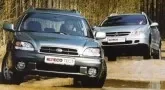
At first glance, comparing an all-wheel-drive station wagon with a single-axle drive one seems absurd. But sometimes it is useful to go beyond the usual ideas. And although the Subaru Legacy Outback and Citroen C5 Break are cars with completely different characters, their practical essence is largely similar: both are spacious and comfortable station wagons. Only instead of permanent all-wheel drive, like the Japanese car, the French one offers adjustable ground clearance.
The thought of such a comparison did not arise by chance. Several years ago, while testing the Citroen Xantia, we drove off the highway onto a snowy field out of curiosity. The ease with which the car on its proprietary hydropneumatic suspension overcame snowdrifts was remembered for a long time. Why not repeat this experiment on the new generation of the model?
Next to the tightly built Subaru, the C5 Break looks more relaxed and imposing. There is a certain attractiveness in its appearance, and the silhouette created by the designers seems to have come from the underwater world, unlike the down-to-earth Outback. On the road, this feeling intensifies: the Citroen glides softly and smoothly, while the Subaru handles bumps noticeably stiffer.
But the stiffness of the Subaru does not turn into jitteriness. Its suspension is elastic just enough to confidently handle serious potholes and restrain body rolls in corners, without turning the ride into a test. However, the Citroen's suspension electronics also handle rolls very decently.
But in handling, the advantage is unconditionally with the Subaru. And this is not surprising: it has more informative and sharper steering, and permanent all-wheel drive. Under normal conditions, torque is distributed between the axles in a 40:60 ratio, and when traction deteriorates, the electromechanical clutch transfers torque to the wheels with better road contact.
Thanks to such a transmission, the Subaru's 2.5-liter boxer engine is revealed as efficiently as possible. The one-and-a-half-ton station wagon accelerates with enviable briskness. Against this background, the Citroen looks more modest, although the two-liter engine fully matches the character of the car: in acceleration to a hundred, the Frenchman loses to the Japanese by only one and a half seconds. But the C5 is noticeably more economical.

Both cars are equipped with four-speed automatic transmissions. Their responsiveness can be judged by the acceleration seconds given above, but they cannot boast of smooth operation. The Subaru, when driving calmly, reacts to each shift with a slight but noticeable jolt. If you drive at a more dynamic pace, the transmission works noticeably smoother. The Power sport mode, which allows revving the engine about 1000 rpm longer, adds almost nothing to the agile car.
The C5's gearbox lives its own life — it shifts according to some unknown laws. Perhaps the adaptation to different driving styles built into it is to blame, but it shouldn't take an hour and a half to adapt! Another minus: the Citroen's automatic transmission noticeably slows down the coasting when the gas pedal is released, unless the selector is moved to neutral. But the Frenchman has a manual shift mode.
The brakes of both cars do not cause complaints — both in terms of efficiency, pedal informativeness, and the correctness of ABS operation.
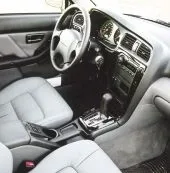
Visibility is better in the Subaru: the Citroen's mirrors are too small, and the interior mirror is too small. But the French car's cabin is more spacious, including in the rear row. The C5's trunk is also more capacious, and in addition, it has a button to adjust the loading height.
The interior of the Outback looks more noble and is finished better, but in terms of equipment level, the Citroen is ahead. The C5 has dual-zone climate control, six airbags (the Subaru has four), a standard stereo with a CD changer and an additional remote control on the steering column, as well as a cooled glove box. The Subaru responds with two electric sunroofs in the roof and cruise control.
The ergonomics of the driver's seats are approximately equal — each car has its pros and cons. The C5 has a larger range of seat adjustments, but the backrest tilt handle is located inconveniently: to reach it, you have to twist your wrist. In the Subaru, the heated front seat buttons constantly get under your elbow, so you have to turn off the heating from time to time so as not to get roasted.
The Citroen's instrument panel is overloaded — your eyes run wild. But the Subaru's neat black scales are much easier to read. However, with the onset of darkness, the picture changes: the C5's instruments glow brightly and clearly, while the Outback's backlight is dim, pale green.
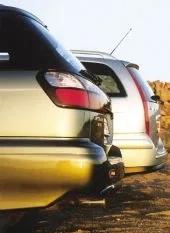
On gravel, the all-wheel-drive Subaru is beyond competition. And even light off-road, not to mention dirt roads, it overcomes without difficulty — a ground clearance of 190 millimeters is enough for confident movement over broken sections. The Citroen, if it loses, is only slightly, and in some places even wins: the hydropneumatics, at the touch of a button, raises the body up to 250 millimeters. True, the advantage is not as great as it seems, because the C5 has a longer wheelbase. In addition, with the body raised to the maximum, the suspension, having selected all its travel, becomes absolutely stiff.
On loose or viscous surfaces, the Citroen can no longer compete with the tenacious Subaru, although it continues to hold on where an ordinary passenger car would have long ago sat on its belly.
It seems that the C5 Break is indeed capable of those feats that summer residents and tourists expect from it. At the same time, it is more comfortable and cheaper. The Subaru Legacy Outback is meaner, nobler, and more expensive. But by and large, both cars represent two sides of the same talent: to give more than others usually can.
Technical specifications
Subaru Legacy Outback 2.5 AT // Citroen C5 Break 2.0 AT
- Body — 5-door station wagon
- Number of seats, persons — 5
- Curb weight, kg — 1505 // 1380
- Gross weight, kg — 2015 // 1975
- Dimensions (length/width/height), mm — 4720/1745/1580 // 4756/1770/1516
- Wheelbase, mm — 2650 // 2750
- Ground clearance, mm — 190 // 250 (off-road)
- Maximum speed, km/h — 197 // 194
- Trunk volume, l — 528/1646 // 563/1658
- Acceleration time to 100 km/h, s — 10.3 // 11.2
- Control fuel consumption, l/100 km:
— urban cycle — 13.3 // 12.7
— suburban — 7.9 // 6.4 - Fuel tank volume, l — 64 // 66
- Engine:
— type — petrol, 4-cylinder, 16-valve, boxer // inline
— displacement, cm³ — 2457 // 1997
— power, hp at rpm — 156/5600 // 136/6000
— torque, N·m at rpm — 223/3600 // 190/4100 - Transmission — 4-speed, automatic, permanent all-wheel drive // with manual mode, front-wheel drive
- Tire size — 215/60R16 // 195/65R15
- Wheel suspension:
— front — McPherson type // hydropneumatic
— rear — spring, multi-link // hydropneumatic - Brakes:
— front — disc, ventilated
— rear — disc - Steering — rack and pinion, with power steering
- Price, $ — 36150 // 28900