
Citroen C5. Speaking Two Languages
A journalist who has been doing test drives for years, switching from an Audi R8 to a Daewoo Matiz or from a VW Phaeton to a Chevrolet Lanos within a week, is hard to surprise or put in a situation where it's impossible to objectively determine which class a car belongs to.
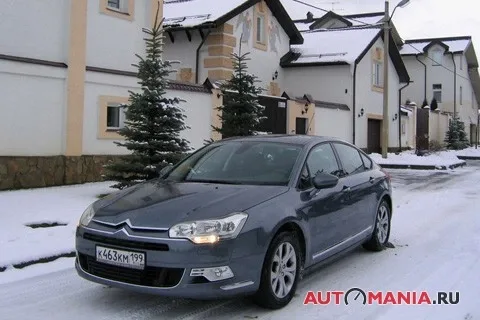
But still, such cases happen, and extremely contradictory cars are encountered. One of them I recently got to drive — it was a Citroen C5. For the first few days, I thought I was dealing with an almost ideal D-class car, but by the end of the test, I became more and more disappointed. Although I did get plenty of positive emotions.
The Best French Taxi
The representative office of the company "Peugeot Citroen Rus" offered us to test the "best taxi in France" — a diesel C5 2.0 HDI with 138 hp. However, the title of "best taxi" was not a surprise for us. Tell me, what other car could French passengers choose? Mercedes or Audi? As true patriots, they would only call their "compatriot" the best taxi, which in France has no competitors in the taxi role at all. No one can compete either in the convenience of sitting three in the back seats (thanks to the completely flat floor in front of the second row), or in the level of passive safety (the car has 7 airbags), or in comfort (hydropneumatic suspension), or in fuel efficiency. If, of course, the average French taxi has the same options that were in our test car. The price of 947,500 rubles (taking into account the current discount of 50 thousand rubles) included payment for parking sensors, adaptive headlights, heated front seats, climate control, cruise control, light and rain sensors, as well as the "metallic" color, which increased the base cost of 897 thousand rubles to the above-mentioned figure.
The Optimal Option
The C5 has six engine options. Three petrol — 1.8 liters, 2.0 liters, 3.0 liters, plus three diesel, including a V6 2.7 HDI with 208 hp. The most expensive option in the base configuration currently costs 1 million 380 thousand rubles, and the cheapest 127-horsepower "five" costs 639 thousand, but it has not Hydramatic III+ suspension, but a regular spring one. Perhaps this is a very good option, but unfortunately, there is no such car in the press fleet, and we won't be able to drive it. But there is a middle ground in the engine lineup — a 2-liter 138-horsepower turbodiesel. Given its efficiency, it is likely that with it the "five" could become the most optimal purchase option for many.
We were only able to examine the car from the outside the next day after receiving it. The daylight hours are very short now, and the lighting in the city leaves much to be desired. But I had to take a closer look at the interior right away. I noticed that some elements have undoubtedly migrated here from the more budget-friendly C4. This affected the scales of the radio and onboard computer, as well as the buttons for controlling the audio system and climate control, buttons with very small labels. But the "finish flag" we wrote about in the Citroen C4 test was not found here. Yes, and the quality of the dashboard trim and the entire interior as a whole is at a very high level.
Triangles Instead of Arrows
Well, let's go! Very comfortable, complete silence in the cabin also because the car hasn't been fitted with studded tires yet. To the left and right of the speedometer are digital slider scales with indicators for coolant and oil temperature. And along the diameter of the "sliders" are fuel level sensors and a tachometer. In the center, naturally, is the speedometer. In the central part of the speedometer there is a small window — the onboard computer display, which shows information. If you don't need any additional information at the moment, turn the wheel on the steering wheel and the display will show you the speed in numbers, duplicating the speedometer's work. Neither on the tachometer, nor on the speedometer, nor on the fuel gauge will you see the usual arrows. They have been replaced by small red triangles that move along the semicircular scales of these instruments from bottom to top clockwise. Very original, unusual at first, but you can't say it's inconvenient, especially since the speed indicator is also duplicated with numbers.
The turbodiesel is economical and pleases with fuel consumption figures of 8.2 — 8.4 l/100 km obtained during the test, and it's also torquey. After 50 km of travel, the fuel level indicator practically didn't move, frozen at one mark. The 6-speed adaptive automatic is like a waiter in a good restaurant — attentive, unobtrusive, able to adapt to your driving style. The gas pedal is soft, but press harder — you feel the acceleration with your whole body. Gear changes are typically German — precise and straightforward. But if in some moments the Citroen C5 is a pure German, it presents surprises more like a Frenchman.
Shower — Waterfall
The first surprise appeared almost simultaneously with the second. It started drizzling outside, and the road was also sprayed with some chemical that turns the liquid on the asphalt into something dirty and sticky. This mess from the road surface naturally began to move onto the windshield — the first drops of dirt appeared. I press the steering column switch and... practically go blind for 1-2 seconds. Blind, of course, not literally, but figuratively. The windshield becomes completely opaque due to a powerful stream of tiny water droplets gushing from two nozzles simultaneously. After a couple of seconds, the volley onto the glass repeats with slightly less intensity — it's the rebound from the headlight washer. I try to press the switch, want to make it quieter — it doesn't help, I get the same powerful volley from the water cannon.
Unlike most cars, the spray level in the Citroen C5 is not adjustable; press gently or with all your might — you get a standard portion of water. This is doubly inconvenient. Not only is it truly dangerous to use the washer while driving (so now we have to wash the glass only at traffic lights?) — you lose control of the road situation for a couple of seconds, and the water will run out very quickly with such generous consumption. The washer reservoir holds only 3.7 liters of fluid, it doesn't last long, and you have to constantly top it up. It's warm now, you can pour water, but when it freezes — you'll go broke on antifreeze!
Surprise number two "delighted" right after the rain stopped. The rain, of course, ended, but the dirt on the road remained, and its small drops still flew from under the wheels onto the windshield, and the wipers, following the rain sensor's instructions, carefully smeared it across the glass. The driver is not a decree for the wipers; he cannot turn them off. And for the rain sensor, as it turned out, rain is any speck of dust that gets on the glass and so on. You can tolerate all this for a day or two, but by the fifth day, this crazy company — "wipers-sensor" — began to seriously annoy. Everyone drives normally, and only your wipers start swinging in front of your nose without any desire on your part or any need for it. The "Citroen" folks clearly didn't finish this option, and if it remains in this form, I don't advise taking it.
This is how, because of little things, thoughts about driving an almost ideal vehicle with miracle pneumatics, known since the days of the Fantômas Citroen DS9, dissipate.
Like Cheese in Butter
First, I'll quote the manual: "The Hydractive III+ suspension automatically adapts to the condition of the road surface or driving style. It can switch from soft to firm mode and adjust the ground clearance depending on load and driving style. You can change the suspension mode manually while driving or while parked. At speeds above 110 km/h, the car's clearance decreases, and after 90 km/h it returns to the normal position. At low speeds and when driving on bad roads, the clearance increases to the maximum. When adjusting manually, High Position is used at speeds no more than 10 km/h or for convenience when changing a wheel. Mid Position — no more than 40 km/h and use on bad roads or when parking." Normal — that's "normal" even in Africa. "Low Position — no more than 10 km/h and use for convenience when unloading, loading, and disembarking passengers."
After reading all this, I involuntarily remembered the previous fish-shaped Citroen C5, which itself took care of getting in and out, lowering the car to the minimum clearance when the ignition was turned off. The current one has forgotten how to do this. It also can't rise to the 230 mm that is unattainable even for crossovers. The new Citroen C5 has a maximum of 170 mm.
Well, what are the sensations while driving? I sharply press the gas pedal, the car, raising its nose and lowering its rear, solidly picks up speed — you feel like the captain of a small vessel. You press the brake before a traffic light — the picture is the opposite. When entering a turn — a soft rocking, as if you're in a hammock or on a water mattress. But driving in a straight line at speed is incredibly comfortable. The Sport mode doesn't change much, except that body rolls in turns are less, and acceleration is a bit faster. After several nose dives, it even seemed to me that something was wrong with the pneumatics. Maybe it broke? It turned out, no. That's exactly how it should work.
The top-spec C5 V6 3.0 has four individual sensors on each wheel. The diesel version has softer suspension spheres and only 2 wheel travel sensors — one in the middle of each anti-roll bar. So the diesel C5 doesn't like any sharp movements or lane changes. Only gentle driving. Well, as befits a Parisian taxi. It's a lazy car — it likes smooth pedaling and steering. The C5 absolutely can't stand bad roads and speed bumps. The suspension gets badly knocked and something starts thumping unpleasantly underneath. So there's another fly in the ointment for this glamorous Frenchman, which is contraindicated for people prone to motion sickness. Apparently, for this very reason, the base version of this very beautiful car is offered with a conventional coil spring suspension.
A Gallant Frenchman for Enthusiasts
Actually, you don't even want to compare the Citroen C5 with any competitors. If the Germans are perceived as the benchmark in technical solutions, build quality, materials, and ergonomics, then the Japanese are valued for reliability. But the C5 is a car for enthusiasts; it's nice to have one as a second or third car in the family.
We haven't said anything about the design. It's controversial. From some angles, the car looks too plain and mundane, for example, from the rear. Here, apparently, the ideas of the German design school have manifested. From the front, it's a gallant Frenchman, but when viewed from the side, you notice something Japanese. All together, it seems to catch the eye, but then again, it doesn't. But what will definitely leave no one indifferent is the concave rear window. In short, in terms of design, it's not the C6 at all, which we still have to drive.
Dmitry Shavyrin
We thank the representative office of Peugeot Citroen Rus for providing the car for the test.
Technical Specifications
| Dimensions (mm) | 4779 x 1860 x 1451 |
| Wheelbase (mm) | 2815 |
| Curb weight (kg) | 1658 |
| Gross weight (kg) | 2190 |
| Trunk width (mm) | 1115 |
| Trunk height (mm) | 566 |
| Tires | 225/55 R17 |
| Ground clearance (mm) | max. 170 |
| Engine displacement (cm3) | 1997 |
| Max. power (hp) | 138 |
| Max. torque (Nm/rpm) | 320/2000 |
| Max. speed (km/h) | 201 |
| Acceleration time 0-100 km/h (s) | 11.8 |
| Fuel consumption (avg. l/100 km) | 5.5, 0-9.9 |
| Turning circle diameter (m) | 11.4 |
| Fuel tank capacity (l) | 71 |
| Fuel | A-95 |
| Price (base) (RUB) | 897,000 |
| Price of tested car (RUB) | 947,500 |
Source – AUTOMANIA.RU